After earning a bachelor’s degree in civil engineering in 1959, Jerry Bayless began teaching in the department as he worked on his master’s degree. Bayless explains how he gained that teaching appointment.
Audio transcript
Somewhere along the line when I was a junior, I guess, here, there was a deal at that time where you got your BS degree and if you wanted to stay and go to graduate school, you could teach either full time or part time. And it seemed like the faculty all got along well and I thought, gee that would be great to do that. So, I decided that’s what I would do. So I went in pretty early in my senior year, talked to Skip Carlton, told him what I wanted to do. He said yeah. He knew me then, I hated class. He said yeah, I said I think I kinda like to have you stay, but I don’t know whether I’m going to have any money or not. He hadn’t told me what I got yet. So I went ahead and did some interviewing and went back two or three times and he said I just can’t tell you; I can offer you half time. Well, I was broke. I needed to work full time. If I couldn’t stay here, I was going to take a job somewhere. So I interviewed, I don’t know, three or four places and finally late in the year, I accepted a job with the highway department, in their bridge office in Jeff City. And then, just before commencement, we didn’t take final . . . seniors didn’t take final exams in those days, so I went home, my classes were over with. Went up to Jeff City, I had already gone up to Jeff City and reported to the department, and stuff like that. And he had Kent Roberts call me. And he said, “Skip wants to talk to you. Can you come in to talk to him?” I said well, yeah. So I came back and talked to him. And he said “I got some money, the dean told me I can hire you full time and I would like to do that. Are you still interested?” And I said, “Well Skip, I am, but I can’t do it.” He says “Why not?” And I said “I accepted a job and you told us that if you accept a job, that’s it, you got to take it, no matter what comes along later.” And he says “Who’s it with?” And I told him and he said “Let me see what I can do.” Well I don’t know what he told them, but he was pretty good at BS-ing people. So they contacted me and said that I could work there in the bridge office in the summer and I could come back if I wanted to. And asked me if I wanted to. So he fixed it up, and I don’t know what he told them, but he made up something, I’m sure. But he knew those people pretty well.
So you worked with the highway department in the summer to start TM here in the fall of ‘59?
Yep.
And you began taking graduate courses too?
Yep.
And how long did it take you to finish?
It took three years to get a master’s degree. Three years and a summer. It caused me to . . . the deal was after three . . . I started as an instructor, but my official employment date was Sept. 1, 1959, and the deal was you got your master’s degree you got promoted to assistant professor and those three years counted toward tenure . . . toward retirement, because it was full time. And then Skip kept telling me . . . I don’t know why he took a liking toward me . . . but anyway he kept telling me, get your thesis done so I can get you promoted as assistant professor, I want to keep you. And Paul Munger was a year ahead of me and he got his thesis done after, I been here two years and I got promoted and we had a professor come here and he left in the middle of my third year and I ended up teaching four hours, four courses and two of them I hadn’t taught before.
Wow.
And that is why I didn’t get my thesis done. Well in those days the Board of Curators met on campus in April. And you knew when they were going to meet and you knew your appointment paper would be in the mailbox that next Monday. Well, Skip hadn’t told me anything . . . you know, he was telling me all along get your thesis done and . . . well I picked up my paper, there was a raise, instructor, no assistant professor. So off I went to see Skip, I was pretty upset. He said, “Well, you didn’t get your thesis done.” I said “Yeah, I know. Whose fault was that?”
(Chuckle)
But he said well, you’re pretty young to be sworn away here, so I said . . . so I said well okay. So I did get my thesis done and maybe . . . that load I had that semester, I just didn’t get it done. But he did pay me over the summer to teach a class so that I could stay and get my thesis done. Well, I thought everything was fine. The next year, that Monday morning, I went in and picked up my paper. There it was, a nice raise, Instructor of Civil Engineering. And I was right there in his office and I went in and said “I’m out of here.” I threw it down on his desk and started out. I’m a leaving. He said “Wait a minute!” He says “What’s going on here?” (Chuckle) I said “Well, look at that.” He looked at it, and I could tell he was really confused. And he said, “Well, there’s been a mistake made. The dean said he’d approve your assistant professorship.” So he says, “Sit down there.” So he called the dean’s office and they had made a mistake.
So that had been the spring of ’63?
’63, yeah.
]]>John F. “Jack” Carney, who served as chancellor at S&T between 2005 and 2011, explains his reasons for pursuing a name change for the campus and how he went about it.
Audio transcript
I really thought that the University of Missouri-Rolla was a disservice to the institution. It’s a tricky situation when you’re chancellor of the university, but you’re also part of the system. So you have to promote your own university, but you also have to be reasonable, play nice with the other three campuses in the system. And that’s a tough thing to do sometimes. One of the stories I kept hearing as I met some of the older graduates of the institution, some going back prior to 1963, I think it was, when the name was changed from Missouri School of Mines and Metallurgy. Rightly or wrongly, there was a strong sense of it, that Rolla was getting, historically getting the short end of the stick, with respect primarily Columbia. I don’t know whether that was true or not, but I wanted to make darn sure that we got our fair share because I thought we had such a superb institution and you should reward institutions that are doing what they’re meant to do. So, in the northeast, for example, the mistaken impression on the part of some was that “What are you, a branch campus of Columbia? What, do you go to Rolla for two years and then switch to the main university?” And it really just annoyed me. It must be totally annoying to someone like you who’s spent basically your whole career there. So I wanted a name that told the world, not just the country, what we were; primarily a technological research university where, what’s the number, 75% of the undergraduates are majoring in engineering or science. Not that we don’t have superb history and English, but we are not a comprehensive university with a law school and a medical school and all the rest of them. And we should take advantage of that uniqueness. So, with the support of the Board of Trustees, and I must say Gary Forsee, who you know later became the president of the whole system, that was a wonderful event from Rolla’s point of view. I knew that if we were going to pull this off, it had to be done quickly. If we debated it for the concept and the name for a couple of years, forget about it, it wouldn’t happen. The whole thing was accomplished in about six months. And I divided the effort into two parts. First I tried to get support from the various groups. What are the groups? The students, the faculty, the staff, the community, the graduates, the businesses that hired our graduates, that a name change that would properly reflect the character of the institution was something we should do. But I did not start composing the name. I thought that would be a bridge too far to fight both battles at once. And then after more or less winning that first battle, then we zeroed in on, okay we all, we agreed, the majorities agree, we should change the name, what should the name be? And I was surprised that the consensus zeroed in rather quickly on the name that we chose. But it was tough. I think the only group that I basically got to a 50-50 proposition were the undergraduates. As you know, most of the undergraduates came from Missouri and rightly considered themselves the center of the university. And when I would say, “You know, we’re not well known in other parts of the country.” They would say “What are you, crazy? What do you mean, everybody knows Rolla is the place to go, blah, blah, blah.” So I had a tough sell with the undergraduates. I remember having a couple of open meetings with them, they were very interesting. But with the other groups, I would get, you know, over 60% at least agreeing we should do it. And then, of course, we had to get the Board of Curators to bless it all, AND I was hoping that the other chancellors from the other three campuses, would not throw a monkey wrench into the deal. And I have to give great credit to the other three campuses, especially Brady Deaton for not doing that. And I think that the curators may have had cold feet right toward the end, and it was great to have some strong individuals like Gary Forsee and other members of my board to say the right things at the right time, and we unanimously did it. And it was, I think it was quite an event. And I was very proud of it. I think it took a year, or two, or three to really win over the vast majority of folks with an interest in the university. But, if you look at things now, look at the enrollment, look at where the students are coming from, I think it was a wonderful change to be made. And, of course, we are still part of the system, but now we have a name that says something, and I’m really proud of that.
]]>Mun Choi, who has served as president of the University of Missouri System since 2017, shares his impressions of S&T during his first year in office.
Audio transcript
After joining the UM System and learning more about S&T, I’m even more impressed. It’s a university that cares deeply about students’ success. The metrics on employer satisfaction with the students who are hired, or the graduates that are hired, stands at 100%. Which is, is truly amazing. But it goes to show that the programs that have been developed, and the level of nurturing of students, the opportunities to . . . for students to participate in experiential learning, and the mentorship by the faculty have really come through in the success of the students. It’s a university that has created a number of outstanding leaders. This was a university in which a student who was trained here eventually went on to discover the neutrino and receive a Nobel Prize. And we have people like Gary Forsee, Tom Voss, Bob Brinkmann, Joel Ruff, Kathy Walker, just outstanding leaders who are making contributions. So my impression is very, very high. Higher than what I had before joining the system.
]]>Harvest Collier, a professor of chemistry, served several years in the early 21st century as vice provost for undergraduate studies. He discusses his efforts in that role to make the campus more focused upon student success.
Audio transcript
The most significant experience was to be able to report to the campus that we had an 88% first-year retention ever, for the first time ever. And even more so, you had a high minority student retention, first year retention, it was in the low 90s, 91, 92%. So to have reached that goal, you know, I was expecting, I was expecting I’d be fully supported and everybody would join in and buy in, and “whatever you want to do Collier, you bring it on!”
(Chuckle)
LARRY: . . . just do it. And chancellor made a comment, “Well AA or that’s, that’s pretty good, why don’t you make it 90?”
Yeah, I remember Jack Carney saying that. Yeah. (Chuckle)
But I, I think just for us to demonstrate that we could improve strategically to have a predictable, sound improvement is just pretentious, because it was based on the kinds of things that needed to be done. And as those changes were occurring, the impact in terms of the bottom line and it was real nice. Maybe the more quantitative thing, there was good improvement in the focus on student academic success. The faculty paying attention too, besides that. If I don’t provide a syllabus to students to have expectations of what my course required, it’s still going to be throw them out there and I’ll throw the stuff at you and if you get it fine, and if you don’t, see you next semester. And so, I think that’s, that’s something that’s
and even just improving the learning
not just that academic grades and that’s the same thing. Improving the learning environment from the students. And particularly the student learning outcome. And that fact that accreditation requirements have changed and requiring that we be accountable for student learning outcomes. Although that was a struggle of a process, it still led to bringing awareness to the campus that being accountable for student learning outcomes is really important, so just for us to move down that path I think is really good.
LARRY: And a big salute from the Higher Learning Commission when they came and saw that 2009 document.
Yeah, absolutely. I still remember, after they left, jumping up and clicking my heels.
LARRY: Yeah.
(Chuckle and inaudible)
That was outstanding. And actually being able to set strategic goals for undergraduate student graduation criteria. To do it realistically and to see us moving at least in that direction . . . and improvement in graduation rate, I think it’s important. You know one of the, one of the most significant testimonies that I recall ever receiving was from parents that were alumni that brought their students to S&T to attend to complete their degrees. And so during those days when they’d come to registration and I get the opportunity to stand there in front of them and tell them about what the institution is doing to help students be even more successful and to hear the numerous comments from most parents saying “Man I wish I had that when I was a student.” That to me is a very significant testimony to how the institution has changed and the fact that I was confident in talking about those changes and how they were impacting the students, that was pretty good.
]]>Mohammad “Mo” Dehghani, who has been chancellor at S&T since 2019, discusses what he believes lies in store for the campus.
Audio transcript
In my assessment, the campus of S&T has the engine, the reputation, the history behind it to expand itself, both here on site as well as reaching out. You know, the campus has to take itself to the world. In the era of distance learning and online education and all that. We can provide the level of education, the rigor of curricula that S&T has offered for decades, a century and a half, essentially, we ought to be able to provide that education to a bigger cross section of Missouri citizens and beyond. So our longterm rise in goal is for the campus to be a campus of 12,000 students. I envision it to be 8,000 undergraduate and 4,000 graduate students. We need to expand and enhance our research so we will get to the R1 category of universities. This is the Carnegie R1 category. Which essentially means we need to double plus our research activities. That will come through the expansion of the campus as well as the enhancement of research that goes on here. Faculty of the future will be much more research focused. This campus has always had a wonderful reputation of doing world-class research here. Particularly in the area of materials and manufacturing and infrastructure and design of systems. But we can . . . the faculty of the future will do much more of that. So our mission of educating the Missouri young men and women will remain the prime challenge for us to continue providing that caliber of education. But at the same time we have to enhance our research as well as our ranking. Ranking is a reality of life; students look at it, parents look at it, and we need to get ourselves to the point where we are recognized as a research-intensive university, as well as a full . . . the reputation that we have been providing education, classroom education, online education, distance learning and all of that. So, I think the campus of the future will have a massive presence in cyber physical space. Cyber informatics will have to expand. The campus itself will have to expand. I believe this is one of the crown jewels of American engineering and science education. How do we expand? As I said, we have the reputation. This past year’s class of freshmen’s average high school GPA was 3.95. Okay. So we do have excellent students, we have excellent faculty, we have excellent staff, and we need to enhance our infrastructure so that we will have excellent infrastructure and services, and those are the four main ingredients for an excellent university. So I am highly, highly optimistic about the future of S&T. In the next 150 years, we’ll see S&T continue its growth in reputation, in size, in quality, and if we are successful, in our research initiatives, in our philanthropic initiatives, in our capital campaigns that we have ongoing, I think this will be a campus where the Missouri kids will be proud to consider themselves having been educated at Missouri S&T.
]]>After earning a bachelor’s degree in physics in 1967, Ron Epps began a long and illustrious career at NASA. He explains the circumstances that led to NASA’s job offer.
Audio transcript
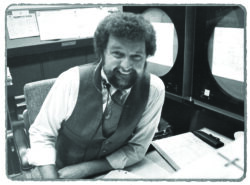
But I always kind of thought well, you know, I learned a little bit from my interview trips. I never did want to work for the United States Steel in Gary, Indiana. I knew I did not want to work for IBM in Poughkeepsie, New York, because they all talked too fast, I couldn’t understand anything. And California was a long ways off and it got cold in Minnesota. And the more I thought about it, I’d been reading a little bit, but it was kind of out of the blue. In fact, the recruiter’s name was Jerry Horsington and he had come to campus and I signed up for an interview and, this is the honest God’s truth, I forgot about it.
Oh goodness.
Yeah, and so I went running over . . . I don’t know where the recruiting hall is today, but it was more downtown then. Anyway, so I went in there it was about 5:00 and he was gathering up his things and I said “Sir I really would like to talk to you about a spot at NASA.” And I said, “First of all I apologize. I missed the interview.” And I didn’t know if he was going to say well, I’ve got to go. But anyway, he looked at me and he says, now this is another true story, he looked at me and said “Is there a beer joint around here?” I said “Yes, right next door is Blue Jays Tavern.” And that building of the Blue Jays is still there, it’s right next door to where the recruitment building was. We went next door. Beer was a quarter and I interviewed in Blue Jays Tavern. That’s a true fact.
How did it go?
It went well and I got a letter . . . in fact, I got a telegram. Well I got, I got . . . NASA’s the only place I did not visit. I did not go on a live trip to see where it’s at or anything.
Okay.
About that time, I had gotten married in April and my wife and I drew a line across the country and said let’s live south where it’s warm, because Missouri gets cold.
Right.
So we agreed with let’s go south, so that eliminated a bunch of job offers. Then I got a call from the NASA folks and they wanted me to come work on land landing of spacecraft. And it sounded pretty good and the offer was the lowest that I got by about $100 a month. Typical, but I got to reading more about benefits and long term, if you stayed with them, and whatever, whatever and . . . anyway so I got to talking to them and here come a telegram. The 1310 Bridge saying . . . I still got it . . . you got what it takes to help land a man on the moon, we would like you to come work for us. So that’s the way that all come down. So . . .
So where were you located?
In Houston, Texas.
Okay.
]]>Martin C. Jischke, who served as chancellor at UMR between 1986 and 1991, describes the importance of African-American alumni as well as the role of Lawrence and Katherine George in the recruitment and retention of African-American students.
Audio transcript
So, when I came it was obvious we weren’t doing very well in terms of enrollment of minority students or faculty. And I met with them and they told me the story and had . . . their great credit, they were willing to give it another go. And they became the basis for sort of building a deeper commitment to a growing enrollment dealing with issues of climate and so on. And they became donors . . . . And these really admirable men . . . and in a funny way, I mean it’s an interesting life lesson, that the environment they had at Rolla was really tough, it was challenging and . . . God Bless Lawrence and God Bless Catherine, provided a kind of home away from home in that tough environment and that love from the Georges, built in these guys, I think both real strength and tenacity and persistence, and also, oddly, an affection for the place. It would be easy to rationalize that once they got their degrees, it was goodbye forever. But that isn’t what happened. I mean, they really were committed to continuing to help and make a difference, and they did, they did. It partly signaled to the whole campus that the leadership of the campus was serious about these kinds of issues.
]]>Janet Kavandi, who earned a master’s degree in chemistry in 1982, discusses the importance of professors’ interest in student success at UMR.
Audio transcript
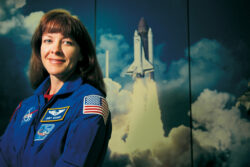
I started in the spring of ’81. It was not the size at that time. But a very nice, small . . . it was just a small campus because Missouri Southern was small. And I liked the personal interaction that the students could have with faculty. And I found the same thing here. And Dr. James Stoffer became my advisor and he, of course, is a very wonderful man and is very interested in the success of his students and so, it was very easy to converse with him, which was the same kind of experience I had in my previous undergrad education. So I really liked that aspect of this school. I think that’s why I like the smaller university. Both of my children actually are back at smaller universities as well, because they like the same connection. If you have the ability to face-to-face ask your professor a question, whether it be about homework that you don’t understand or your future career or your research topic; being able to do that in person rather than possibly through an RA or a TA really adds a lot. Because some of the universities, larger universities, while they are very prestigious, and you know the University of Washington was one of the very large ones, it’s . . . you just . . . I think, have an advantage with that personal connection. And there is a bond there, I think, that grows between the professor and the student. Especially if the professors really have a true deep commitment to ensuring that their students do well. Then you can maintain that lifelong relationship.
]]>Engineering management Chair Suzanna Long, who holds four degrees from the university, recalls her arrival to campus in 1982.
Audio transcript
When I first came to the Rolla campus in 1982, I will confess, I grew up in a tiny little town, De Soto, Missouri, about 90 miles away from here. And Rolla seemed huge to me. It was probably two to three times larger than the small town where I grew up. And so I was so impressed with all the restaurants, all the stores, but the thing that really made a difference from my life was that it seemed like a magic land of scholars. Those who were doing truly interesting work. And for me, this was exactly what I had been searching for. Because my family was really short of money, then I qualified for work study. And I had what I referred to as a defining moment of my academic career, because I had a chance to meet Dr. Barbara Hale in the department of physics. I was a physics student and she wanted to hire physics undergraduates so that she could mentor them and help them see the beauty of research. And she gave me a chance. And I must honestly say that it was amazing working with her. Getting to see a keen mind, such as she had, really opened my eyes to the possibility of good research of the things that can be done if you’re willing to work hard and to stay focused. One of the things I have always been incredibly proud of is that we started with her as a mentor and as a supervisor. And now, however many years later, we’ve ended as dear friends.
]]>Paula Lutz, who earned a bachelor’s degree in chemistry with a life science preference from UMR in 1976, and then served as a faculty member, associate dean of arts and sciences, department chair, and dean of arts and sciences, discusses adjusting to a campus which had few female faculty members.
Audio transcript
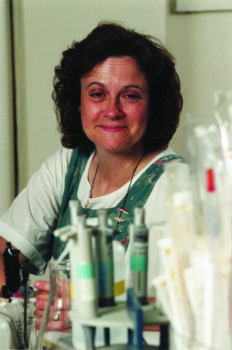
Everyone, and I think part of it was because I was a known quantity. I mean the chemists, most of the older chemists knew me from my time there and treated me well. Of course, Stig (Friberg), Nord (Gale) and Jim (Hufham) and that bunch, they treated me very well and not like . . . I guess it might have been if you come home and they kind of treat you like the kid sister or something. They treated me like a, you know, a full-fledged faculty member and bragged that they got their top choice and so they really made me feel welcome. The weird thing I do remember, Larry, in my first year, or two, or three . . . of course, we had quite a few women in biology by this time, and word spread, you know, that there were women in departments. There were starting to be a handful of women in engineering. And I would get a young woman on my doorstep that I didn’t know. And she would say, “My roommate had you for general biology and I have a question that I need to ask basically another woman.” And I’d say “Okay.” She said “What do I wear for my interview? You know, nobody is giving me any advice.” I mean these would be women with engineering experience. They were being told things that they weren’t sure were correct about how ultra conservative to be in their dress and, you know, things like that and I tried to be . . . you know, I say “well, you probably need to pay attention to what they tell you, but you probably can get away with a dress and a jacket. You don’t need to buy a suit”, right. I mean these were the kinds of things that I think women worry about and there really weren’t any women role models in the whole building. So that was, that was kind of an interesting thing. Well actually through Kappa Delta, there were a couple of other women on campus in engineering who had been Kappa Delta’s other places, and I got acquainted with them. And there were women in arts and sciences, just not so much on the science side. But I’d say women in the humanities and social sciences and the arts and sciences were very, were very welcoming to me. Liz Cummins, you know, great, just a great person. Catherine Riordon. I remember Catherine in psychology. She was very warm and welcoming. Sara Preston, actually in physical education. We crossed paths in a number of ways – children the same age, and I remember being on several committees with her. So, yeah, they were, they were very warm and welcoming, but we were a pretty select small group.
]]>