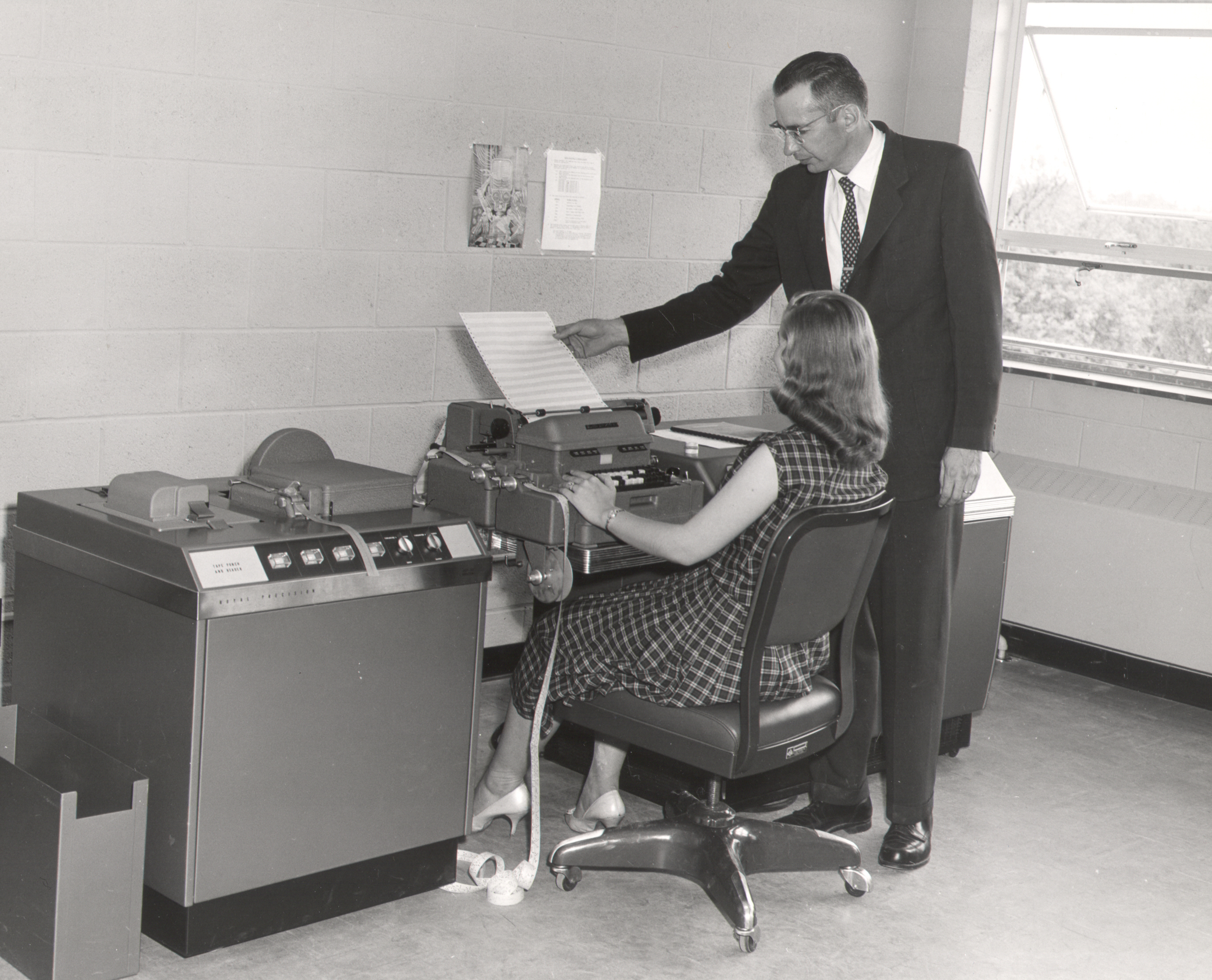
Professor Ralph Lee standing with the first Missouri S&T computer, an LPG-30 or Librascope Precision General computer.
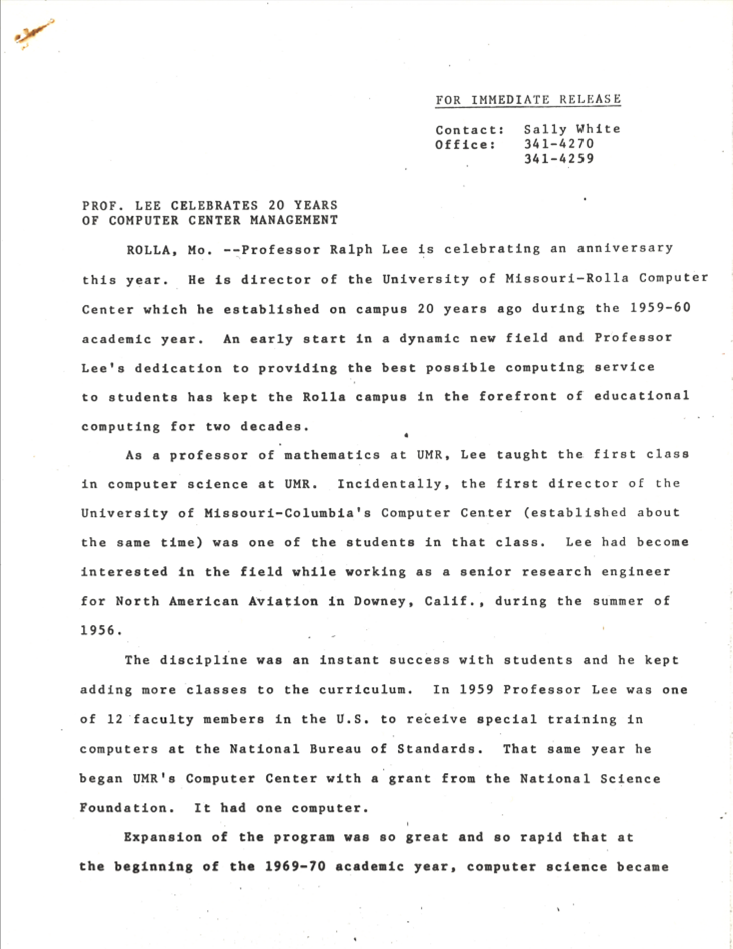
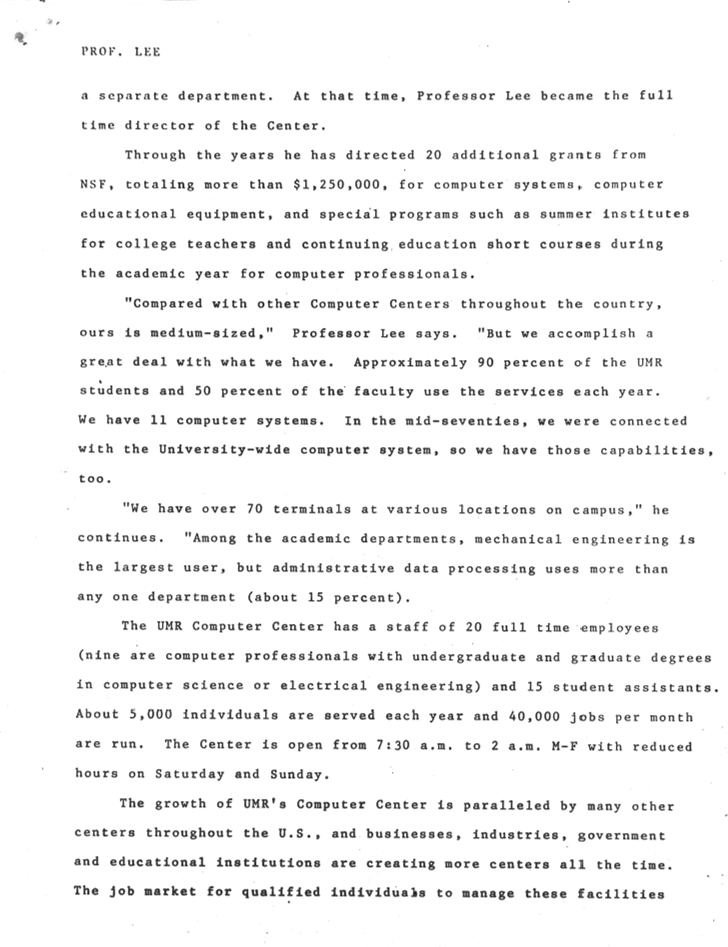
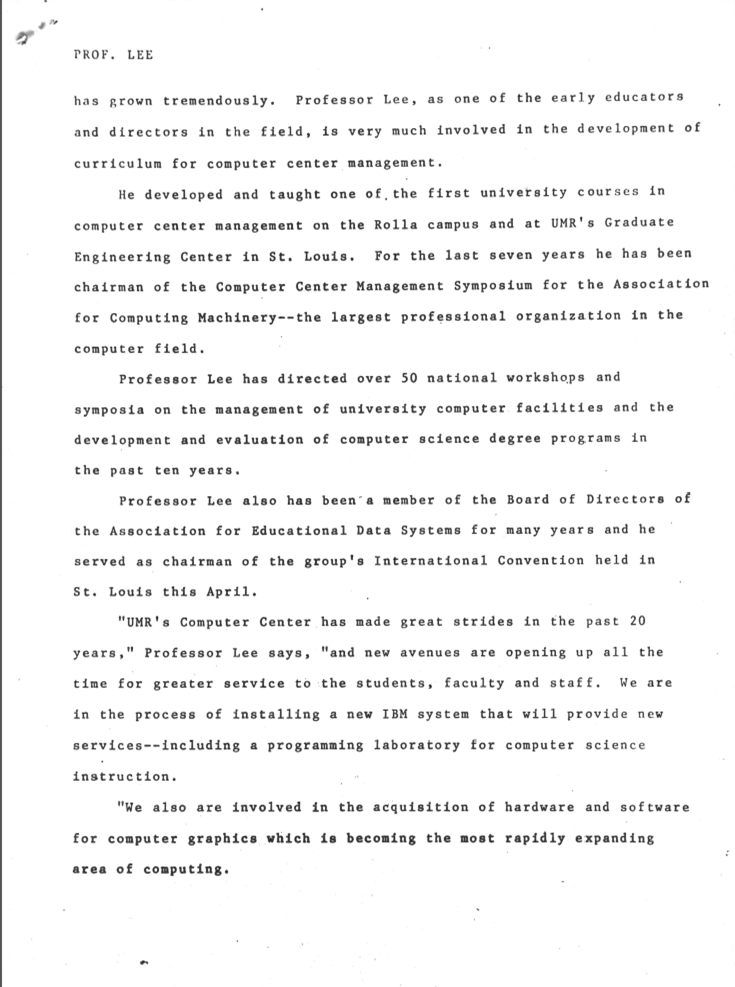
Professor of Mathematics, Dr. Ralph Lee, taught the first Missouri S&T (then MSM) computer class in 1957. He established the campus computer center in the 1959-60 academic year. A press release, likely from 1979, celebrates Dr. Lee’s 20th anniversary as director of the computer center. Here are some highlights from that press release.
About Dr. Lee
- Lee became interested in computers while working as a senior research engineer for North American Aviation in Downey, CA during the summer of 1956.
- One of Dr. Lee’s students in the 1957 computer class in Rolla became the first director of the Mizzou computing center in Columbia.
- In 1959, Professor Lee was one of 12 faculty members in the United States to receive special training in computers at the National Bureau of Standards.
- By the time of the press release, Dr. Lee had been the chairman of the Computer Center Management Symposium for the Association of Computing Machinery for seven years. In the ten years prior, he had also conducted over 50 national workshops and symposia on the management of university computer facilities, and the development and evaluation of computer science degree programs.
About the campus Computing Center
- The computing center was established in 1959 with a grant from the National Science Foundation with one computer. The press release doesn’t mention what computer, but other sources indicate the first computer was an LGP-30, a Librascope General Precision computer.
- At the time of the press release:
- The campus had 11 computers and 70 terminals, as well as access to computers at the other University of Missouri campuses.
- Approximately 90% of the students and 50% of the faculty used the services. Mechanical Engineering was the largest academic user, but administrative data processing accounted for more usage (about 15%) than any one department.
- The computer center had 20 full time employees and 15 student assistants. The center ran about 40,000 jobs per month.
You can read the complete press release below.
]]>
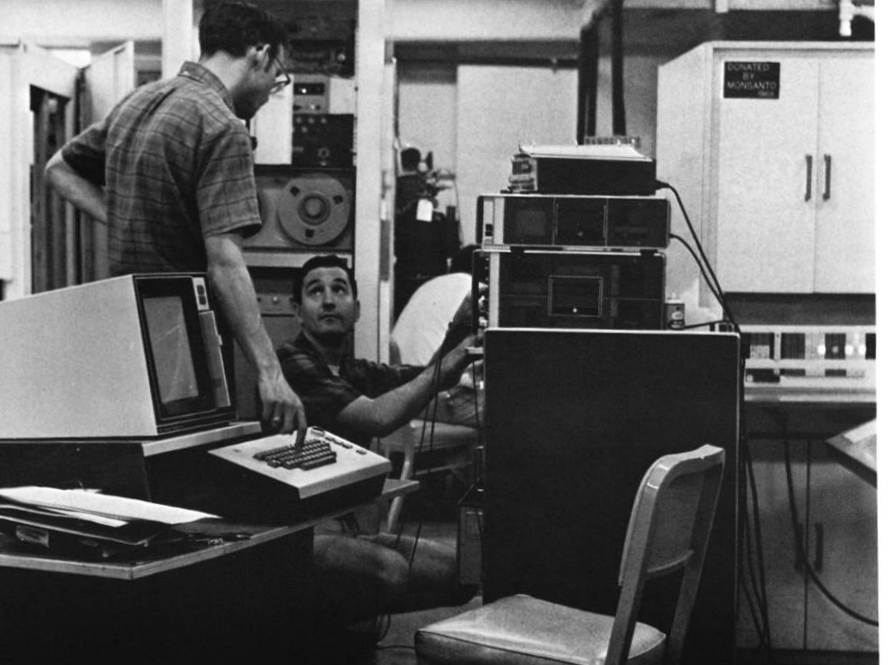
1971 Rollamo Photo 1: Who is this and are they in the computer center? What equipment is being used. Notice a sign on the cabinets in the upper right says “Donated by Monsanto.” What was donated by Monsanto?

1971 Rollamo Photo 2: Who is teaching this programming (FORTRAN) class?
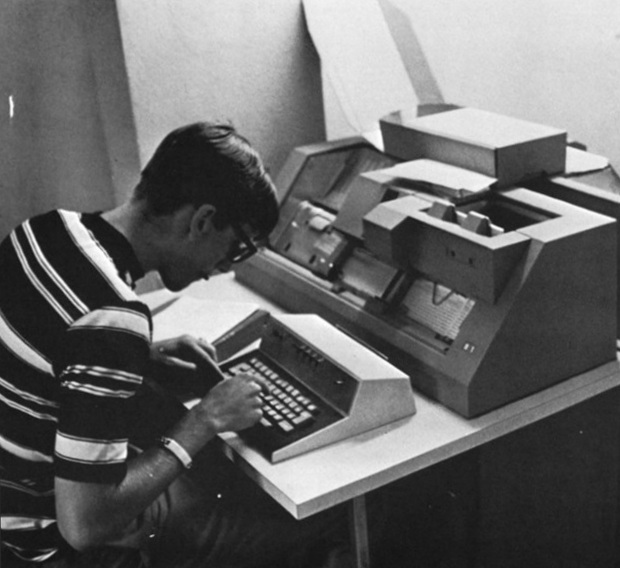
1971 Rollamo Photo 3: Another day, another keypunch — but who is using it?
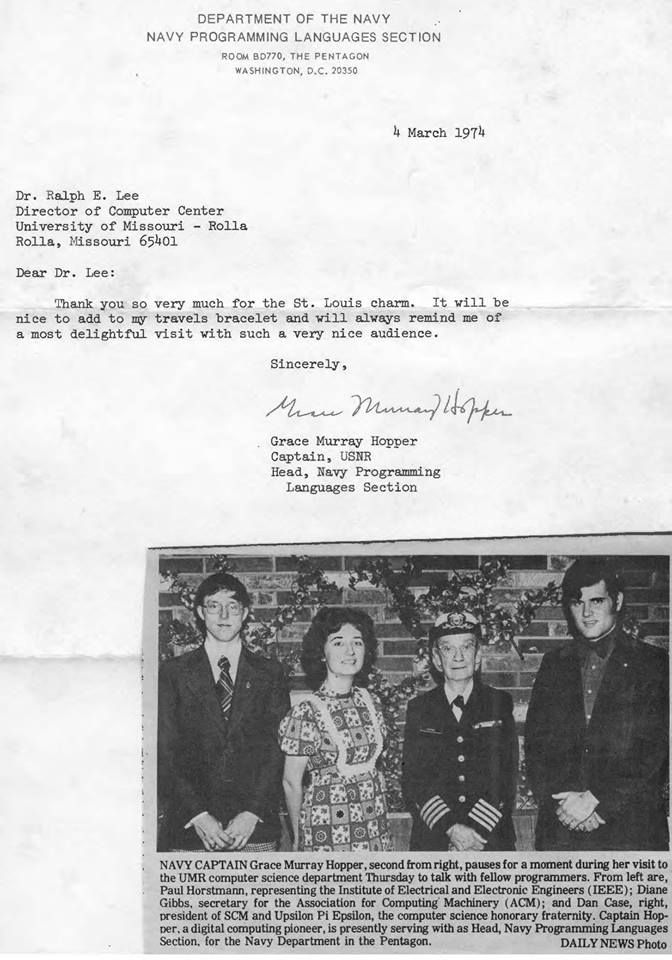
Grace Hopper Visits University of Missouri-Rolla in 1974.
Alumni Memories from Bob Gaebler
Editor’s Note: Grace Hopper (December 9, 1906 – January 1, 1992) was an American computer scientist and United States Navy rear admiral. She was one of the first programmers of the Harvard Mark I computer in 1944, and she invented the first compiler for a computer programming language. Hopper helped promote the idea of machine-independent programming languages which led to the development of COBOL. She is also credited with popularizing the term “debugging” for fixing computer glitches (in one instance, removing a moth from a computer). Grace Hopper visited Rolla in 1974 and Alumus, Bob Gaebler, shares his memory of that event.
I attended Grace Hopper’s lecture in the evening. It was not only very charming, but it was informative and inspiring to the point that I still apply some of the insights and lessons she transmitted in that talk.
As for the charming part, she presented her now famous object lesson in which she learned what a nanosecond was – holding up a piece of wire about a foot long, and relating how, early in her career, an engineer explained to her that light travels that distance in the space of a nanosecond, cutting a piece of wire to length so that she could better visualize it. She then related how, when that engineer later mentioned a microsecond, she asked for help in visualizing THAT small time interval. The engineer cut for her a visual aid for that unit of time as well – at this point Grace held up a huge coil of wire about 100 yards long, to universal laughter from the audience. At the end of her evening talk, she passed out free samples of a nanosecond, to any who were interested, as souvenirs of her visit.
Bob Gaebler
B.S. Computer Science, 1977
Marion, IA
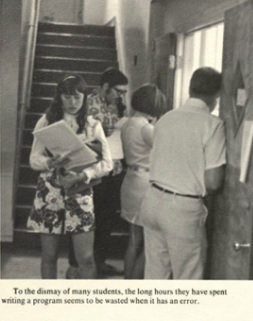
1970 Rollamo Photo 1: Students waiting for printouts of their programs
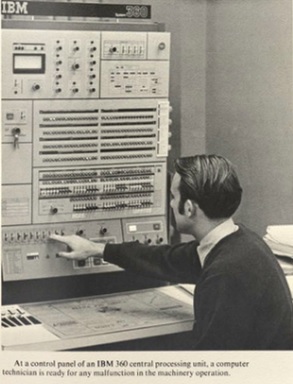
1970 Rollamo Photo 2: Computer Technician at an IBM 360

Brochure Photo of the HP 2647A Intelligent Graphics Terminal
Alumni Memories from Pam (Thebeau) Leitterman
The top of the line end-user product for the 264X series was the 2647A Intelligent Graphics Terminal. It made its debut in May 1978 and listed for $8300. It came with a BASIC interpreter, a Multiplot program for creating line, bar, and pie charts, and an HP Slide program for making text-based overhead transparencies using an HP plotter. Incredibly slick technology for its day, but for those of us now accustomed to projecting powerpoint slides from a laptop, it’s hard to imagine the number of hours and manual attention it used to take to create a 30-page slide deck when you had to align each single transparency on a plotter, start the 4- or 8-pen plotting action, remove the plotted transparency, and then wait for it to fully dry before inserting it into a 3-hole sleeve. I’m sure I plotted hundreds of slides in my early years at HP.
Here’s a diagram of the input screen for HP Slide followed by a sample of the plotted output from that screen. Notice on the input screen, there was a column labeled “Pen#.” This was the function that allowed text to be in different colors. Though you could arrange the plotter pens in any order, it was typical to put the black pen in the #1 spot, the red in the #2 spot, the blue in the #3 spot, and the green in the #4 spot. In the example shown below, only pen #1 is used.
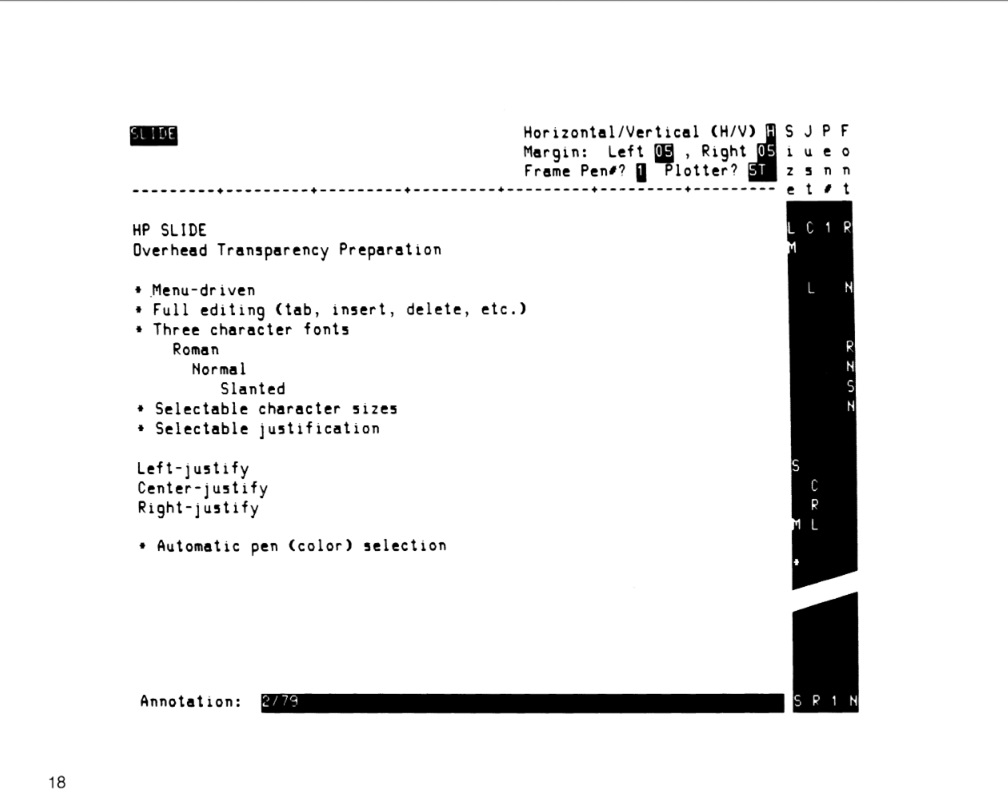
HP Slide – Sample Input
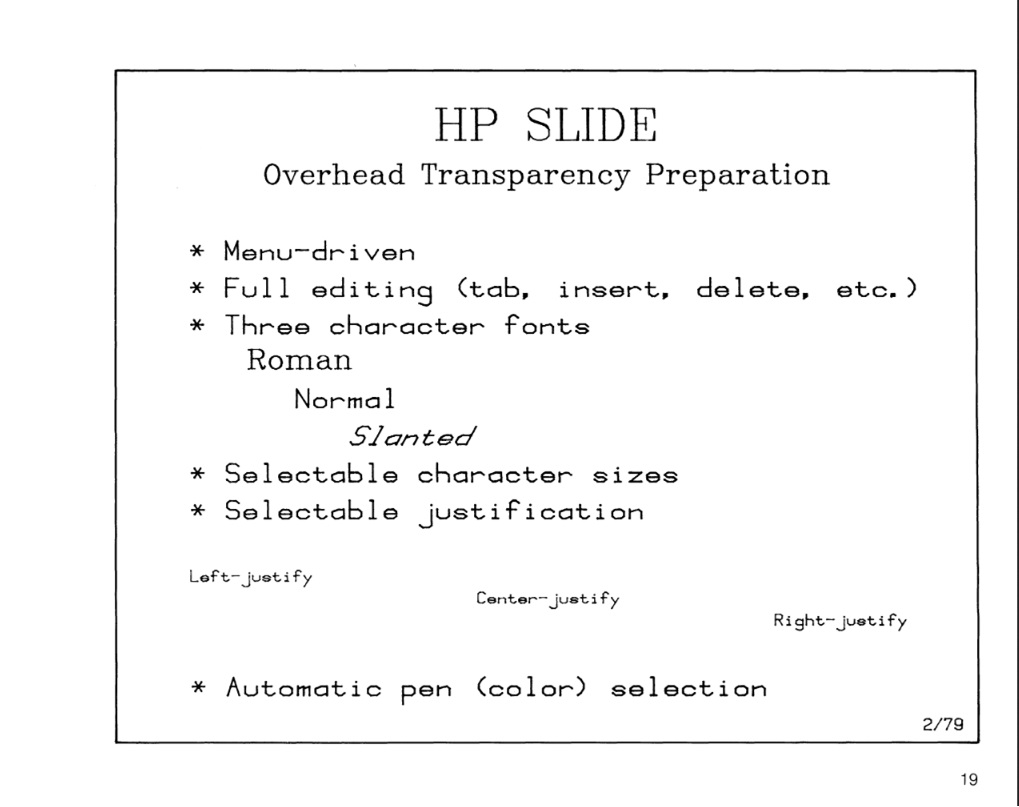
HP Slide – Sample Output
More information about the HP2647A Intelligent Graphics Terminal can be found at bitsavers.org, a website with links to over 32,000 documents for over 500 companies / organizations. Specific HP2647A documents include:
Related Post: Data Terminals — Predecessors to Personal Computers, Part 1 of 2: HP 2640/44/45
Pam Leitterman
BS Applied Mathematics, 1975
Co-chair CS Golden Jubilee Steering Committee
President, Academy of Computer Science
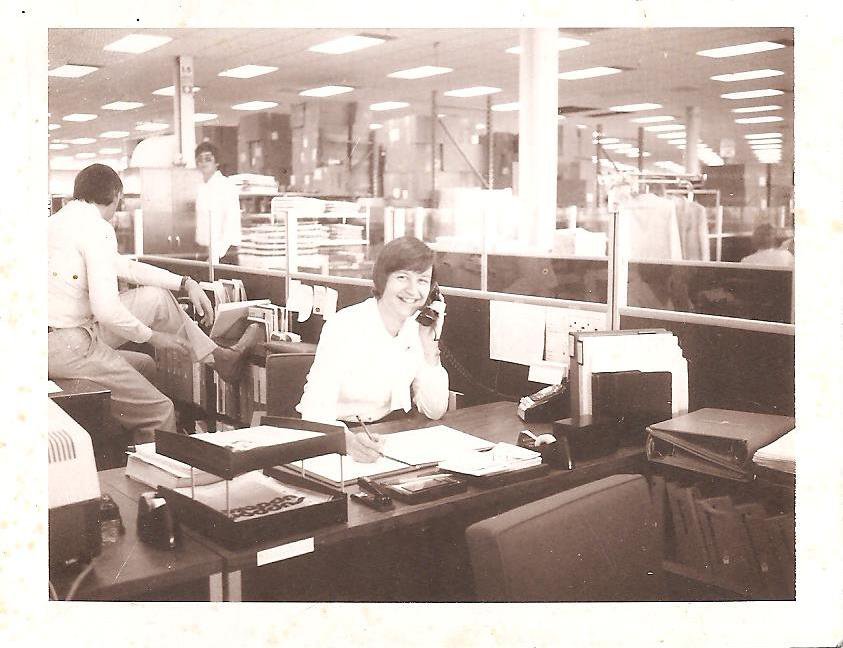
Pam Leitterman at her desk in HP’s Data Terminals Division, Bldg 43U, in 1979. The new Apple campus is being constructed on the former HP site on Homestead Road in Cupertino, CA where Bldg 43 and other HP buildings were located.
Alumni Memories from Pam (Thebeau) Leitterman
In July 1979, I embarked on an almost 28-year career with Hewlett-Packard. In my first job, I was a technical marketing engineer for HP’s Data Terminals Division (DTD). One of my primary responsibilities was to train HP Systems Engineers (SEs) on DTD products. HP was booming then and hiring systems engineers at an incredible rate. For several years we conducted new hire SE training on our products almost every other week, 20+ SEs at a time.
I supported and delivered training on the 264X terminals. They all featured an 8080 (8-bit) microprocessor and a 15-slot backplane that allowed them to be configured and sold as a series of products with varying degrees of capability. For training purposes, the modularity enabled us to swap out PC boards and key caps to provide hands-on experience with the full product line over a period of several days. Initially, we weren’t aware we might be causing problems for the products due to electrostatic discharge (ESD) that could occur from swapping boards in and out with our bare hands. Later, we learned to wear protective gloves and store our training circuit boards in anti-ESD packaging.
HP’s data terminals were primarily used as consoles and data entry devices for computers. However, the terminals also had enough display memory and intelligence that they could be used as standalone word processing devices. In DTD, we often used them this way to create memos and short documents that we printed to an attached daisy wheel printer, saving our data on the mini cartridge tape drives that were available on most of the product line. Each data cartridge could store a whopping 110,000 bytes of information!
The 2640A, the first of the 264X terminals from HP was introduced in 1974. It displayed 25 lines of text (80 columns) on its five by ten inch rectangular screen. It initially sold for $3500 but a discounted price of $2640 each was offered for quantities of six.
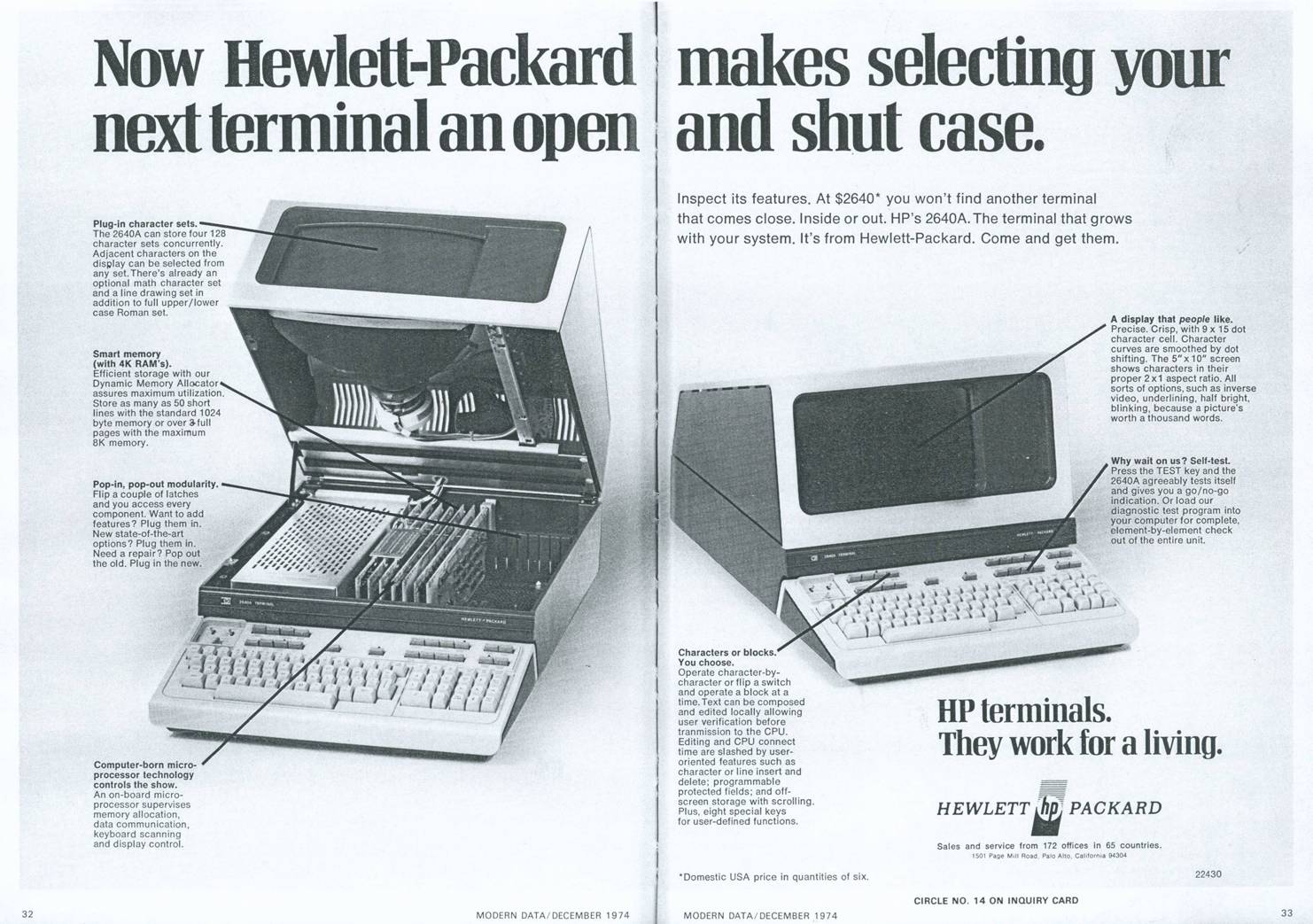
Ad for HP 2640A terminal, Dec 1974. Click picture for full size view.
The 2644A was introduced in 1975 for $5000 and included two mini cartridge tape drives. The 2644A was replaced by the 2645A ($3,500 without tape drives, $5,100 with two tape drives) in 1976. The 2645A was the most common of the 264X terminals.
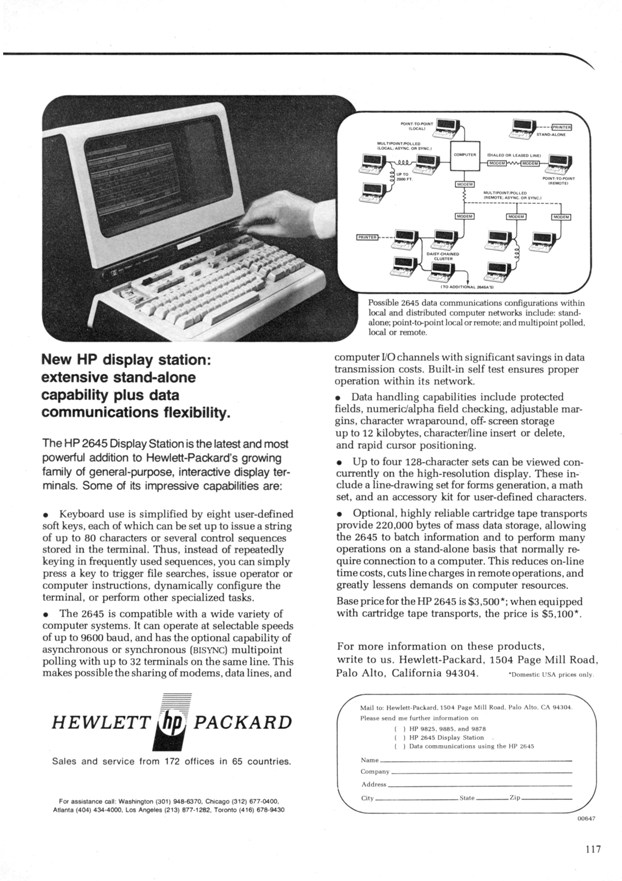
Ad for HP 2645 terminal, 1976. Click photo for full page view.
Thanks to hpmuseum.net (a private museum based in Australia and not affiliated with the Hewlett-Packard Company) for refreshing my memory on facts and features of the 264X terminal line, and for the old ads which are posted on their web site.
Related Post: Data Terminals — Predecessors of Personal Computers, Part 2 of 2: HP 2647A
Pam Leitterman
BS Applied Mathematics, 1975
Co-chair CS Golden Jubilee Steering Committee
President, Academy of Computer Science