Here is what Angie experienced:
=================================================================
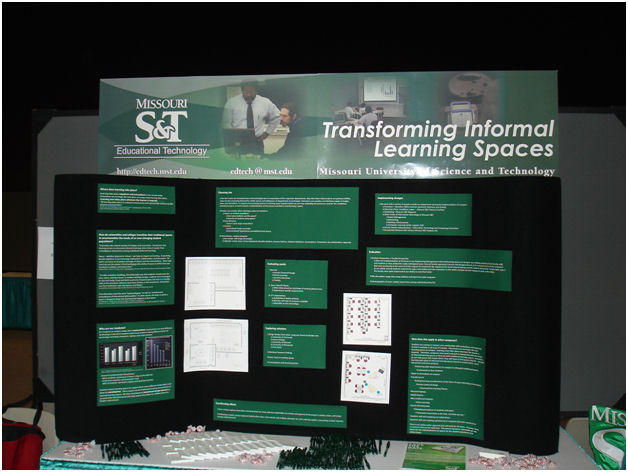
I had the privilege of being accepted to present a poster
session at Educause 2008 in Orlando with Lauren Oswald. I have presented at
multiple conferences all over the United States but wasn’t prepared for what
Educause was truly like. To give you a little idea of what the conference was
like, there were over 8000 attendees from around the world. The theme this year
was “Interactions, Ideas and Inspiration.” It was incredibly exciting to share
with individuals what we are working on here on campus and know that we have
many interested in coming to visit with us to see what we have been doing. It
was a great conference to connect with other professionals involved in higher
education. It was a great opportunity for me to explore the issues surrounding
pedagogy that got me into education originally. So often, I focus on the
technology but truly enjoyed this opportunity to explore how we use technology
in the classroom and how it can truly impact the education process. The
integration of technology into any classroom should not be about having a shiny
new toy. It truly should be about providing new tools that enhance the learning
process. It is incredibly important that the addition of technology to a course
should be carefully planned out and designed.
The poster session was scheduled for late Thursday
afternoon, so I was expecting a lot of people to not be interested in coming.
Boy was I ever wrong. There was an incredible amount of people who descended on
the presentations. For the entire hour and fifteen minutes, we didn’t quit
talking and sharing how we have been transforming informal learning spaces on
campus. I had the opportunity to connect with many universities around our state
as well as around the world. Informal learning spaces have become an important
topic in higher education.
Where does learning take place?
This
was a question that began the process of examining the learning spaces on
campus. Learning takes place anywhere
and everywhere in our society today. Classrooms are no longer the only place on
campus that learning takes place.
Learning now takes place wherever the learner is inspired. “All learning
takes place in a physical environment with quantifiable and perceptible
physical characteristics.” – Graetz, Ken “The Psychology of Learning Environments”,
Learning Spaces, Educause 2006, http://www.educause.edu/LearningSpaces/10569
How do universities and colleges
transition their traditional spaces to accommodate the needs of an
ever-changing student population?
If
learning takes place anywhere, how do we as universities plan spaces or
vignettes that support a process that is ever changing? “Learning is the
central activity of colleges and universities. Sometimes that learning occurs
in classrooms (formal learning); other times it results from serendipitous
interactions among individuals (informal learning). Space – whether physical or
virtual – can have an impact on learning. It can bring people together; it can
encourage exploration, collaboration, and discussion. Or, space can carry an
unspoken message of silence and disconnectedness. More and more we see the
power of built pedagogy (the ability
of space to define how one teaches) in colleges and universities” – Oblinger,
Diana, “Space as a Change Agent”, Learning Spaces, Educause 2006, http://www.educause.edu/LearningSpaces/10569
Our goal was to define a process that could be repeatable on
our campus and others. We have begun the process to standardize how we design
these spaces. It is the design process that can be repeated. You can’t have cookie-cutter rooms where all
informal spaces are the same. They must truly be tailored for the students and
the discipline that will utilize that space the most. We are continuing to
develop this process and will be excited to share it in the January issue of
Educause Quarterly.
* What is it?
* Who’s doing it?
* How does it work?
* Why is it significant?
* What are the downsides?
* Where is it going?
* What are the implications for teaching and learning?
The answers to these questions varies depending on the technology.
Here is the answer to the last question excerpted from their brief on Wikipedia (June 2007):
What are the implications for teaching and learning?
Wikipedia blurs the line between consumption and creation of knowledge, giving motivated students the opportunity not only to use but also to generate knowledge and see themselves as members of a community of learners. Wikipedia offers students an opportunity to hone their research skills—by evaluating its content against other information sources—and to engage in a global community of collaborative content development. Students can
see how knowledge is created, participate in that process, and understand when their comprehension of a topic is sufficient to make a valuable contribution. Some learning theorists contend that content creation and analysis is a necessary component of learning. Wikipedia can encourage students to analyze what they read, ask questions, and engage in reflective, creative learning.
Wikipedia is a highly controversial topic, especially in the academic world, since it is very difficult for people to evaluate the veracity of the information. I’ve heard that in many instances Wikipedia actually rivals Encyclopedia Britannica. However, on particularly controversial topics–especially those that involve politics, pop culture, or current events–Wikipedia can be worse than useless.
In my own experience, I often use Wikipedia as a starting point when I go looking for information. It can be a very useful aggregate of related information that can then lead me down many different paths until I find information that I can feel confident is fairly accurate and reliable.
In any case, if you are interested in learning more about the Educause Learning Initiative’s "7 Things You Should Know About…" series, then visit their web page for the latest information. The EdTech home page also has links to selected briefs from their series.