Learn more about AAC&U’s Project Kaleidoscope and the 2017 Active Learning Day
How can you participate in active learning?
- Spend at least 10 minutes implementing a culturally responsive STEM teaching strategy that promotes active learning in your classroom (Culturally Responsive Teaching is a pedagogy that recognizes the importance of including students’ cultural references in all aspects of learning);
- Identify innovative ways to deepen and extend your departmental/institutional commitment to inclusive STEM higher education reform throughout the week, academic year, and beyond;
- Tell a friend! Reach out to at least one colleague (in either a STEM or non-STEM discipline), and engage in dialogue around what they can do to implement similar strategies in their classroom;
- Tweet or post on social media about your participation using #ActiveLearningDay2017; and
- Share with others what you did on Active Learning Day by creating and uploading a two-minute video! Upload the video to YouTube and send us the link at pkal@aacu.org. We will showcase your effort on STEM Central.
Interested in participating and/or need help with making a video? Contact EdTech@mst.edu to schedule a videographer to stop by your classroom while you engage your students in an active learning exercise!
]]>
On our campus, plagiarism is defined by the UM Collected Rules and Regulations (200.010 – http://www.umsystem.edu/ums/rules/collected_rules/programs/ch200/200.010_standard_of_conduct) as “The term plagiarism includes, but is not limited to: (i) use by paraphrase or direct quotation of the published or unpublished work of another person without fully and properly crediting the author with footnotes, citations or bibliographical reference; (ii) unacknowledged use of materials prepared by another person or agency engaged in the selling of term papers or other academic materials; or (iii) unacknowledged use of original work/material that has been produced through collaboration with others without release in writing from collaborators.”
Missouri S&T is very strict with our students, and the university has set up sanctions for these actions depending on their severity. But what about when plagiarism happens in “real life?” Are there consequences? In short, yes—and they’re often far more serious and long-lasting than a simple failing grade. In “real life”, plagiarism can result in a loss of trust and professional status, which can have a very real impact on one’s livelihood. Even in cases of unintentional plagiarism the process to correct a non-citation can be long and painful. I recently talked with an instructor on our campus who had just gone through an experience where her work had been co-opted by another author.
Dr. Kate Sheppard is an instructor on our campus for the History and Political Science department. She works hard as an instructor and a researcher. She is always working to know about her area of specialization and interest so that she can continue to publish papers, give talks and write her next book. She was excited when she found what she thought was a new article on Margaret Murray. She was shocked when she realized that there was nothing new in this article but that the author had taken Dr. Sheppard’s own book and other papers and put them in a condensed form in this article. It’s not word- for-word copying but if you look at our definition of plagiarism, isn’t that what this author did?
Technology makes our lives easier every day and it is incredibly easy to find the authors of papers and books today, many of whom are very happy to collaborate with you and help further the academic pursuit of a topic that they may be very passionate about. Instead, Dr. Sheppard spent many hours trying to clear this issue up. All she wanted was credit for her thoughts and ideas. Here is a link to her original blog post about what happened to her. https://doctorkate.wordpress.com/2015/11/02/the-forgotten-citations-and-the-third-wave-feminist-and-scholar-who-really-wrote-them/
Dr. Sheppard was able to work with the publisher to get the issue resolved. The publisher edited the online article to give credit to Dr. Sheppard where it was due. That’s what Dr. Sheppard had asked for along. Here is Dr. Sheppard’s update on this issue. https://doctorkate.wordpress.com/2015/11/04/the-forgotten-citations-a-resolution-from-broadlyvice/
When we are working with students and colleagues we need to let them know that plagiarism—even unintentional plagiarism—is wrong. Unless otherwise stated, thoughts, ideas, conclusions based on research belong to the person who did the work and we should honor that with the correct citations. Give credit where it is due.
Written in collaboration with Raz Kerwin.
]]>
“Metacognitive strategies facilitate learning how to learn. You can incorporate these, as appropriate, into eLearning courses, social learning experiences, pre- and post-training activities and other formal or informal learning experiences.”
Source: theelearningcoach.com
This article provides ten strategies for incorporating metacognitive strategies into teaching and learning.
- Ask Questions
- Foster Self Reflection
- Encourage Self Questioning
- Teach Strategies Directly
- Promote Autonomous Learning
- Provide Access to Mentors
- Solve Problems with a Team
- Think Aloud
- Self-Explanation
- Provide Opportunities for Making Errors
One simple thing you can do is have the students write two or three points that they felt were important during class that day. Once they have had a chance to write, you as the instructor can give your two or three points that you thought were important and model how students can begin to understand what is important in your course.
]]>
Vanderbilt University
Source: cft.vanderbilt.edu
This link has two articles in it. It defines what Metacognition is and gives some practical ways to implement it in learning. How often do you stop during a lecture (or other activity) and give students a chance to process what you have been saying or doing? Sometimes, we get so caught up in fitting everything in an 50 minute slot that we forget processing time. Those are the days that students leave dazed, with notes but maybe not a clear understanding of what the lesson was actually about. Taking time to pause and reflect is one way to help students connect with content and with their own learning strategies.
]]>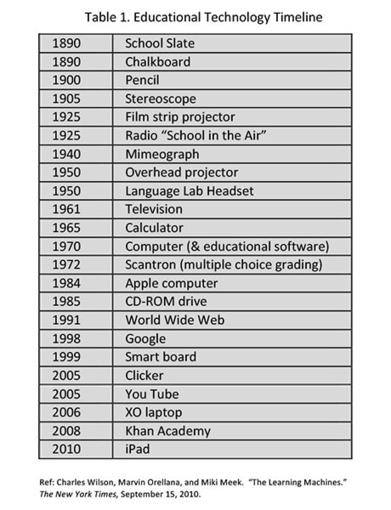
The educational tools that we choose often shape how we educate our students, so let’s choose them wisely with one eye on the future.
Source: www.edutopia.org
This same concept applies to a lot of lab courses. There’s some big machine which drives the lab activity because it’s there, we’ve paid for it, and it’s all we know. Don’t let the tools that we have limit the way we think about teaching.
]]>
Source: www.cmu.edu
What is the most important thing in your course for students to know or do in five years? That’s the question that we use to start the first consultation we have with instructors. It is important to understand what you expect of students. This becomes the foundation that instructors build their course. Once they know what the consider to be the most important part of their course, they can begin to build the learning objectives that will guide students in their learning.
This website has great resources on building good learning objectives that are student centered and help to guide students. This website also shows the importance of alignment. This is where you align your assessments and learning activities with specific learning objectives. This helps to eliminate confusion and keep students on track with what the instructor finds to be the most important parts of the course.
]]>
I had the opportunity to attend a conference in October called Transforming Institutions: 21st Century STEM Education. There were many good ideas that I took away from this conference but the question that I started the conference with is, what is Transforming Institutions, STEM Education really all about. I know what STEM is. It stands for Science, Technology, Engineering and Math. But what does transformation mean? The easy definition that I found was “a thorough or dramatic change in form or appearance”. (Thanks Google!) So the question really is, what needs to change (or be transformed) about the way that we teach STEM disciplines?
That question is a little harder to answer. If we say that we need to transform the way we teach, that first assumes that we admit there is an issue with how we are teaching now. Is that true? The opening keynote gave a couple of statistics that are quite startling. Two-thirds of Americans over the age of 25 don’t have a college degree. Around 50% of students who start college never complete. Is this true?
In the past few years we have seen an increase in the scholarship of teaching that has been focused on actively engaging students in courses and the positive outcomes that come from that. Unfortunately, these activities are a minority on most campuses. The culture of most campuses was fashioned many years ago and success for all students wasn’t part of that culture. What was re-iterated over and over at the conference was that to make true change we must make student success the focus for the campus and make it the mission of everyone.
What does student success mean to you?
]]>
I had the opportunity to attend a conference in October called Transforming Institutions: 21st Century STEM Education. There were many good ideas that I took away from this conference but one that continues to resonate with me is that for many of us in higher education, we influence student success by helping to make faculty successful. When faculty succeed in the teaching and learning mission we can help students succeed as well.
In order to establish this culture of success, we need to first understand who we are as a university. Many of our institutions have a culture that was formed many years ago and hasn’t changed even though our students have changed. We base are strategic plans, activities and events around assumptions. As those who want to change this culture we need to be deliberate and systematic about analytics. Spending time studying our data will help us understand who we are and where we are. We must never stop taking risks as it is through these risks, and sometimes failures, that we can learn the most.
We can make a difference and the way that our universities were in the past doesn’t mean they must be that way in the future. We can be agents for change. We must always strive for success and realize that when we have success in one area we should not consider it final. We should push for a culture that accepts nothing less than continued success.
]]>This event will be focused on syllabi. Bring a copy of your syllabus and join with fellow instructors for a discussion and “how-to” session on writing good learning goals and aligning assignments and assessments with learning goals. Dessert and drinks will be provided, and you are welcome to bring your lunch.
If you would like to attend this event, Please RSVP with Diane Hagni by Monday, October 27th. (hagnid@mst.edu)
]]>