
I had the opportunity to attend a conference in October called Transforming Institutions: 21st Century STEM Education. There were many good ideas that I took away from this conference but the question that I started the conference with is, what is Transforming Institutions, STEM Education really all about. I know what STEM is. It stands for Science, Technology, Engineering and Math. But what does transformation mean? The easy definition that I found was “a thorough or dramatic change in form or appearance”. (Thanks Google!) So the question really is, what needs to change (or be transformed) about the way that we teach STEM disciplines?
That question is a little harder to answer. If we say that we need to transform the way we teach, that first assumes that we admit there is an issue with how we are teaching now. Is that true? The opening keynote gave a couple of statistics that are quite startling. Two-thirds of Americans over the age of 25 don’t have a college degree. Around 50% of students who start college never complete. Is this true?
In the past few years we have seen an increase in the scholarship of teaching that has been focused on actively engaging students in courses and the positive outcomes that come from that. Unfortunately, these activities are a minority on most campuses. The culture of most campuses was fashioned many years ago and success for all students wasn’t part of that culture. What was re-iterated over and over at the conference was that to make true change we must make student success the focus for the campus and make it the mission of everyone.
What does student success mean to you?
]]>
I had the opportunity to attend a conference in October called Transforming Institutions: 21st Century STEM Education. There were many good ideas that I took away from this conference but one that continues to resonate with me is that for many of us in higher education, we influence student success by helping to make faculty successful. When faculty succeed in the teaching and learning mission we can help students succeed as well.
In order to establish this culture of success, we need to first understand who we are as a university. Many of our institutions have a culture that was formed many years ago and hasn’t changed even though our students have changed. We base are strategic plans, activities and events around assumptions. As those who want to change this culture we need to be deliberate and systematic about analytics. Spending time studying our data will help us understand who we are and where we are. We must never stop taking risks as it is through these risks, and sometimes failures, that we can learn the most.
We can make a difference and the way that our universities were in the past doesn’t mean they must be that way in the future. We can be agents for change. We must always strive for success and realize that when we have success in one area we should not consider it final. We should push for a culture that accepts nothing less than continued success.
]]>This event will be focused on syllabi. Bring a copy of your syllabus and join with fellow instructors for a discussion and “how-to” session on writing good learning goals and aligning assignments and assessments with learning goals. Dessert and drinks will be provided, and you are welcome to bring your lunch.
If you would like to attend this event, Please RSVP with Diane Hagni by Monday, October 27th. (hagnid@mst.edu)
]]>The primary users of iThenticate are academic researchers and publishers, including graduate and doctoral students (and their advisors!) who are writing theses or dissertations. These writers will appreciate iThenticate’s easy-to-use interface as well as several features not found in Turnitin. iThenticate allows for much longer documents to be submitted, as well as allowing for document sharing and version comparison. Unlike Turnitin, iThenticate does NOT save a copy of submitted work to a central database. This means your in-progress publication will stay confidential until it is ready for publication.
If you are a scholarly writer interested in using iThenticate, please contact the IT Help Desk to submit an iThenticate access request to the Educational Technology office; The EdTech office will get you set up and also provide a short training session, if desired. Happy writing and publishing!
]]>At a recent eLearning Community of Practice meeting at S&T (October 14, 2013), one professor remarked that students are often so ingrained that they have to get the “right” answer that they forget they are really being trained in how to ask the “right” question which will hopefully lead them to an answer, if not necessarily the correct answer. After all, science is as much about discarding incorrect theories as it is about finding correct theories–at least until science marches on and the current theory on a topic is superseded by new information. The Standard Model of quantum mechanics is a perfect example of this. A lot of “bad” theories had to be discarded as more about atoms was discovered over time, leading to more and more accurate theories about what goes on at the subatomic level. And many of the discoveries in quantum mechanics required radical ways of looking at the world (Einstein’s theories on relativity perhaps being the most famous). But I digress.
Bloom’s Taxonomy (and its variations) is one way of tracking how well students are performing at different cognitive levels. The lower levels (3 or below) typically track only the most basic levels of understanding of materials. Students simply absorb and regurgitate information. They may apply it, but typically in well-defined scenarios with equally well-defined solutions. Another professor who attended the eLearning Community of Practice meeting showed some of his research indicating how his exam questions measure according to Bloom’s Taxonomy. Almost all questions were at level 3 or less.
The higher levels of Bloom’s Taxonomy are the levels that focus more on analysis, evaluation, and creation. These are the types of activities that should be introduced earlier to the undergraduate students so they are better prepared to take on the more “messy” problems found in upper-level undergraduate projects and graduate programs. After all, one of the main activities of a graduate student (Master’s or Doctoral) is to identify a problem that hasn’t been studied before and come up with a thesis or dissertation that studies the problem and presents finding, thus expanding human knowledge and helping the student become an expert in a particular subject matter area (knowledge is becoming more and more specialized these days).
So what can S&T do to help our students become more creative?
NOTE: On a totally unrelated subject, there are a lot of interesting articles at Emory University’s eScience Commons blog. Check it out!
]]>
 The Office of the Provost, along with Educational Technology (EdTech), is issuing a second call for participation in the 2013 eFellows program. This program is an opportunity for instructors to redesign their courses to incorporate more technology, with the overall goal of improving student performance.
This round of proposals will only be for Tier 2 and Tier 3 projects.
Tier 2 – Stepwise Redesign (up to $2,000) is an intermediate step between Tiers 1 and 3. It is smaller in scope than Tier 1, focusing on one or more aspects of a single course, rather than a full course redesign. A Tier 2 project could eventually lead to a course redesign over time.
Tier 3 – Teaching with Technology (up to $1,000) eFellows projects are about the adoption of technology and the teaching strategies to improve teaching and learning.
Interested participants are strongly encouraged to review the video of the 2013 eFellows Program Participation Workshop from the Teaching and Learning Technology Conference 2012. The presentation can be found at the link below, along with the PowerPoint slides:
http://edtech.mst.edu/events/tltconference2012/abstracts-room-124/#p3
EdTech also hosts an eLearning Community of Practice (eCoP) which is a peer learning community that coincides with the eFellows program and is especially helpful for instructors who are interested exploring ideas before attempting a full course redesign. Along with the eFellows, members of the eCoP will be invited to participate in a blended course, CyberEd (inside of Blackboard), that introduces essential concepts and best practices for eLearning. eCoP participants will receive consultation and assistance from EdTech staff on applying these practices to their courses, in small scale, at their option.
If you would like to request an application packet for the 2013 eFellows Program at the Tier 2 or Tier 3 level, please send a brief letter (email) of intent as described in the brochure linked below to Meg Brady (megbrady@mst.edu).
An instructional designer or technologist will be assigned to work with you to complete the application. Alternately, you can schedule an appointment or stop by EdTech U (Thursdays, 11 a.m. to 1 p.m. in IDE 105).
Applications are due no later than Friday, October 26, 2012.
]]>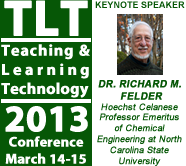
Educational Technology is now accepting presentation proposals for the Sixth Annual Teaching and Learning Technology Conference, scheduled for March 14-15, 2013. Interested presenters can download a copy of the Call for Presentation form at the EdTech web site or click one of the links below:
Call for Presentations: Word Document
The theme for this year’s conference is Assessments – From Syllabus to Final. EdTech is looking for presentations that showcase how assessments have an impact on student learning at all stages of a course. However, EdTech will review ALL submissions regardless of content.
The opening keynote speaker will be Dr. Richard M. Felder, Hoechst Celanese Professor Emeritus of Chemical Engineering at North Carolina State University. Dr. Felder has many research interests, as outlined on his web site.
This year we will be offering several tracks for presenters and participants:
- Teaching with Technology – Enhancing the instructional process by including a technology component
- Blended Learning – Replacing some or all of the face-to-face communication in class with online tools
- Best Practices in Teaching Strategies – Pedagogical theories on effective teaching (with or without technology)
- “Hands-on” Activity – Computer labs are available for hands-on presentations or demonstrations
- K-12 Education – By popular request, we will be offering a few sessions geared towards K-12 instructors. If you would like to present towards this audience, please use the same form available through the links above.
Proposals will be accepted until Wednesday, October 31, 2012. Decisions regarding acceptance will be made by Friday, November 16, 2012.
]]>Summative and formative assessments are both important components to the learning process for both students and instructors. Summative assessments typically take place after the students have “learned” the material to gauge how well they actually learned the content (think standardized test for an example of summative assessment).
Formative assessments, by contrast, take place during the learning process, allowing students to practice the conceptual material while minimizing immediate accountability (formative assessments are often ungraded). Self- and peer-assessments are very effective types of formative assessments in the classroom.
A balanced implementation of summative and formative assessments will yield the greatest benefits for both students and instructors.
For more information about how formative and summative assessments might be useful to you, come to the eLearning Community of Practice on Wednesday, April 18, in Norwood Hall Room 208 from 2 – 3:30 p.m.!
(Snacks will be provided courtesy of EdTech)
]]>Normal
0
false
false
false
EN-US
X-NONE
X-NONE
/* Style Definitions */
table.MsoNormalTable
{mso-style-name:”Table Normal”;
mso-tstyle-rowband-size:0;
mso-tstyle-colband-size:0;
mso-style-noshow:yes;
mso-style-priority:99;
mso-style-parent:””;
mso-padding-alt:0in 5.4pt 0in 5.4pt;
mso-para-margin-top:0in;
mso-para-margin-right:0in;
mso-para-margin-bottom:10.0pt;
mso-para-margin-left:0in;
line-height:115%;
mso-pagination:widow-orphan;
font-size:11.0pt;
font-family:”Calibri”,”sans-serif”;
mso-ascii-font-family:Calibri;
mso-ascii-theme-font:minor-latin;
mso-hansi-font-family:Calibri;
mso-hansi-theme-font:minor-latin;
mso-bidi-font-family:”Times New Roman”;
mso-bidi-theme-font:minor-bidi;}
EdTech is hosting an eFellows Call for Participation
Workshop on Wednesday, March 21 in Engineering
Management 103 at Noon. This is primarily aimed at potential candidates who
were unable to attend the first workshop opportunity at the recent Teaching and
Learning Technology conference. However, it
is open to any instructor who wishes to apply.
If you are interested in redesigning your course to take
advantage of new technologies to improve student outcomes, or simply to reach
more students, then this workshop may be for you.
This workshop will unveil the newly expanded Missouri
S&T Provost’s eFellows Program for 2013. The eFellows Program is designed
to incentivize and support faculty to redesign courses using best practices for
teaching methodologies and technology for blended or online delivery.
Mini-grants are available to support the redesign process as
well as focused support and instructional design expertise from Educational
Technology. Participation in this workshop is required before applying to
the 2013 eFellows Program. Program materials and application packets will be
distributed at the workshop.
What components in a course create a quality online space for your students? Instructional designers will show you some easy ways to implement required and recommended online resources to include in your Blackboard course or website. Whether you are working toward a fully online or blended course or just want to have some web enhanced materials, this is the session for you.
]]>