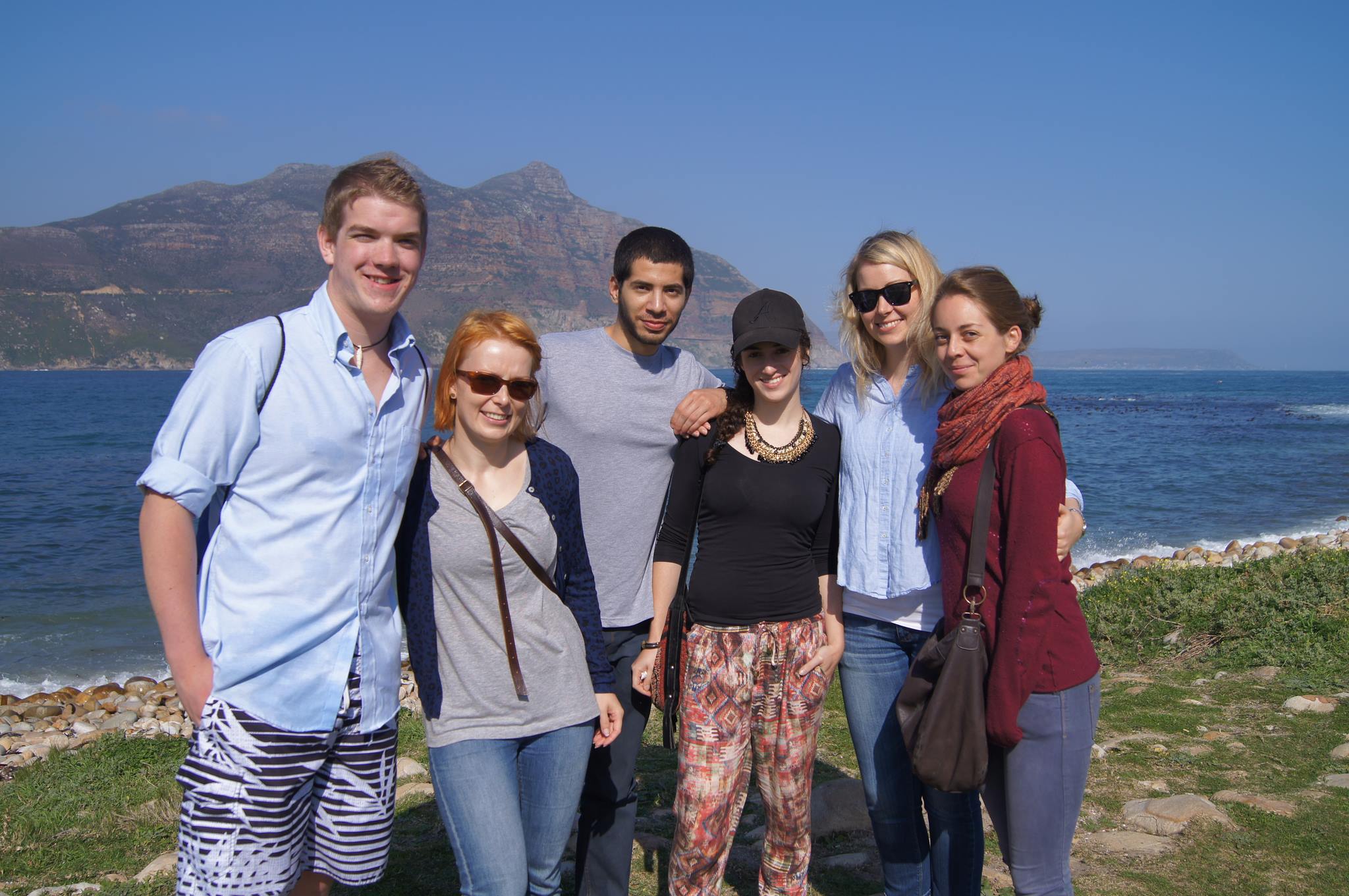
Curry Spray with friends in South Africa
I’m probably not the right person to be describing the wonderful, life-changing experience that studying in a foreign country, in a totally new environment, will be for someone, but I’m here to give it a try. I am a student at Missouri University of Science and Technology and I studied in South Africa during the Fall of 2013. The three keys to having a successful study abroad are patience, professionalism, and preparedness.
After several months of packing and getting ready to travel south, to the tip of Africa, I finally arrived at my residence for the next five months, Kovacs. I had forgotten plug converters, I had no way to charge my phone and get ahold of someone, the campus was isolated from the nearest town, and everyone was gone for the weekend. It was scary. I was not to be deterred though. My second day there I wandered outside of the confines of campus and caught what appeared to be local transport towards a destination that I hoped was Cape Town. After about 30 minutes the minibus came to a stop and all of the passengers got off. I would later realize that we were just switching minibuses, however, I had no idea what was going on and strayed into the nearby surroundings. As I began to walk a voice rang in the back of my head, the voice of Mr. Leonid Jackson, the director of International Affairs at the University of Western Cape, whom I had the pleasure of meeting before I flew over. A few kind words of advice he had told me came to mind, “Don’t get lost in the ghetto.” I was not in the most savory of environments. Needless to say, I left fairly quickly, and made my way back to the safety of University housing, my pride of being independent and able to fend for myself slightly wounded, but mostly feeling pretty good. The next day I was able to get in touch with a friend living in Cape Town and she took me to the mall where I bought converters and started learning how things worked in and around Cape Town.
I learned a little something about patience during my time in South Africa. In the first few weeks of classes there was a group project in my Information Systems class. Our group met weekly, on Tuesdays, in order to discuss our topic and break down the work assignment. People were very often late to these meetings, including the group leader. When we were asked to reflect on our group project at the end of the quarter, my classmate, Abonga, had this to say (copied straight from his reflection report):
“F. The time management approach did not work well because there is a thing that is called African time and that has affected our mentality. When you finally start to slow down you start enjoying so many more things.”
African time is a real thing, but it’s not a bad mentality. In this instance it affected our work timeframes, but it has so many other effects that are quite positive. Americans and Europeans and some cultures in Asia are so strict and work-oriented that we forget to enjoy the little things and we also strain our health. When working in the hot African desert, you have to take your time while doing things or you will succumb to heat exhaustion through overexertion. If you walk too fast in flip-flops or sandals, you will get rocks in them. If you just slow down you can begin to enjoy so many things: the sun shining down on you, the bustling wind at the top of a mountain, or the sound of the ocean at the seaside. Patience helps you through the struggle of the day and it can help you get the most out of everything you do.
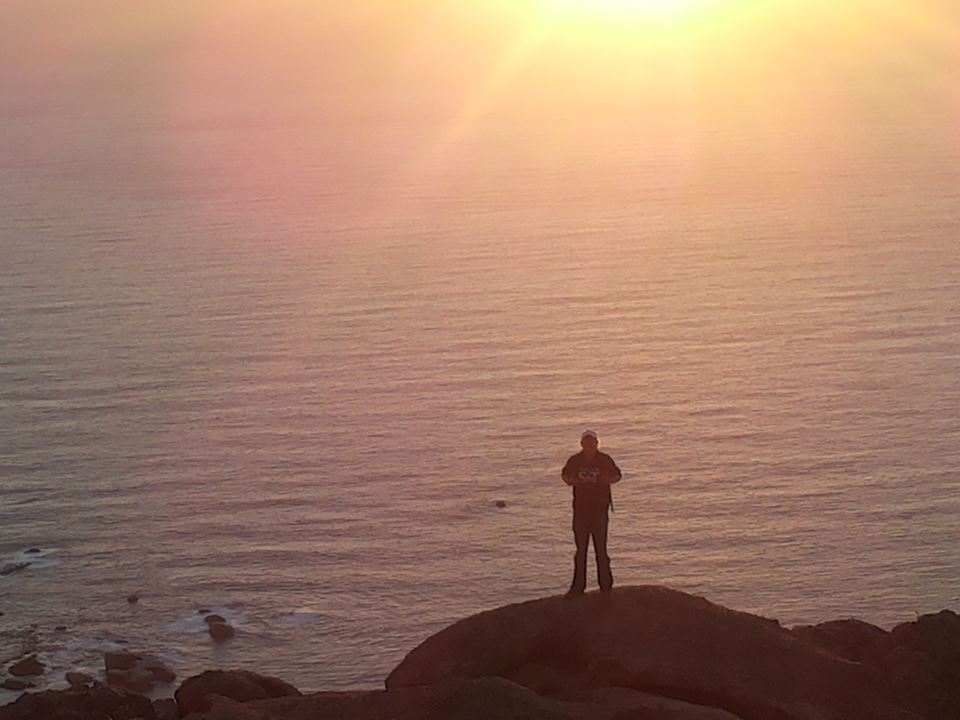
Taking time to enjoy the view
Professionalism is very important when going anywhere new. Always remember, if you travel abroad in the future, you are an ambassador for your country/organization/self. And make sure to respect and take in all of the new cultures you experience. You might find that you like them quite a lot. Most important though, is to have fun and better yourself from the time you have. I have many more stories to tell and if you’re considering studying abroad in South Africa in the future, I hope you will read them. For now, thanks for reading!
Ubuntu,
Curry
]]>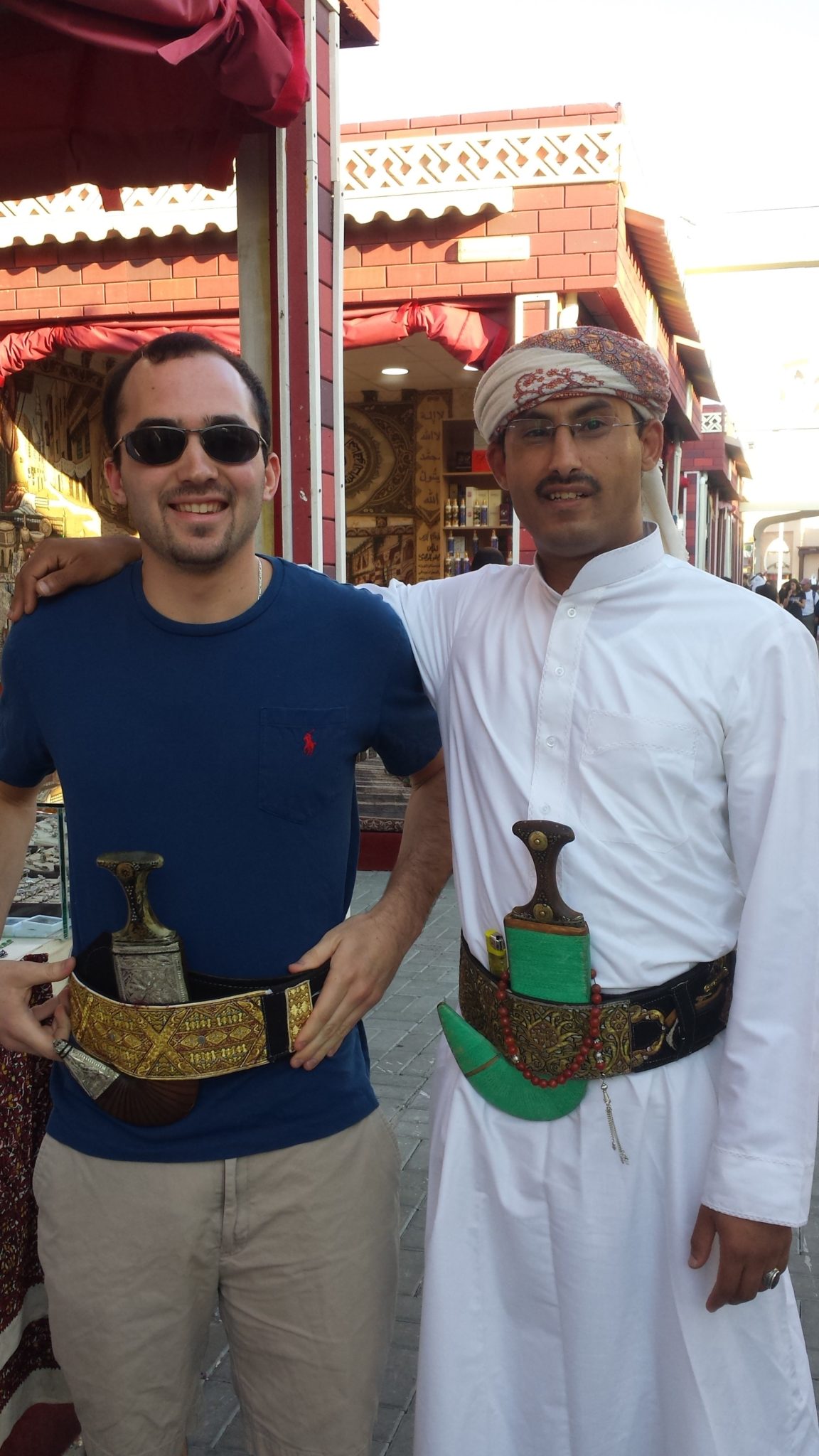
David Zdvorak in Dubai
Here are his reflections on his experience abroad:
My experience at the American University in Dubai is unlike anything I’ve ever had before. I now live in a city that is a polar opposite of Rolla, where the tallest building is the Burj Khlaifa rather than Thomas Jefferson Hall. I live in a region that is often unfamiliar and somewhat feared by Americans, but being here has helped me understand the Middle East much better. The Middle East has a beautiful culture with great history.
That said, Dubai is still a city that is extremely multi-national. There are hardly any other Americans here. The local Emirates are a huge majority, but there are quite large populations of other Arabs, Hindis, Africans, and even British. Seeing the blend of these cultures is absolutely amazing, and I have gained international friends from countries I have never met anyone from in the US. Dubai is a bustling city. There are people interested in business and pleasure. There’s really opportunity to do anything in this city, as it has sprung up from the desert in the last 40 years. It is a very fancy, new, and safe city as well. People are very well taken care of and catered to, both in the city and on campus. And I don’t feel unsafe here in Dubai because it seems like everyone is watched carefully by security guards and cameras, laws are strict, and stakes are high, so the crime is low.
The AUD experience is very pleasant as well. The campus here has a nice feel and contains some beautiful architecture. My walk to class is about one minute, and the weather is always pleasant. It has only rained a handful of times, and during the day it can get hot, but in the evenings it’s quite temperate. The class sizes are very small and eventually the students in the same major really get to know each other and often talk together. That doesn’t mean they won’t include a study abroad student—my class is like a family that has adopted me for a short time. The teachers speak understandable English and are very interested in their subjects and do a good job. The campus student center is fantastic, there’s a mini mart for all basic necessities, the cafeteria is very affordable, and there’s even a hair salon.
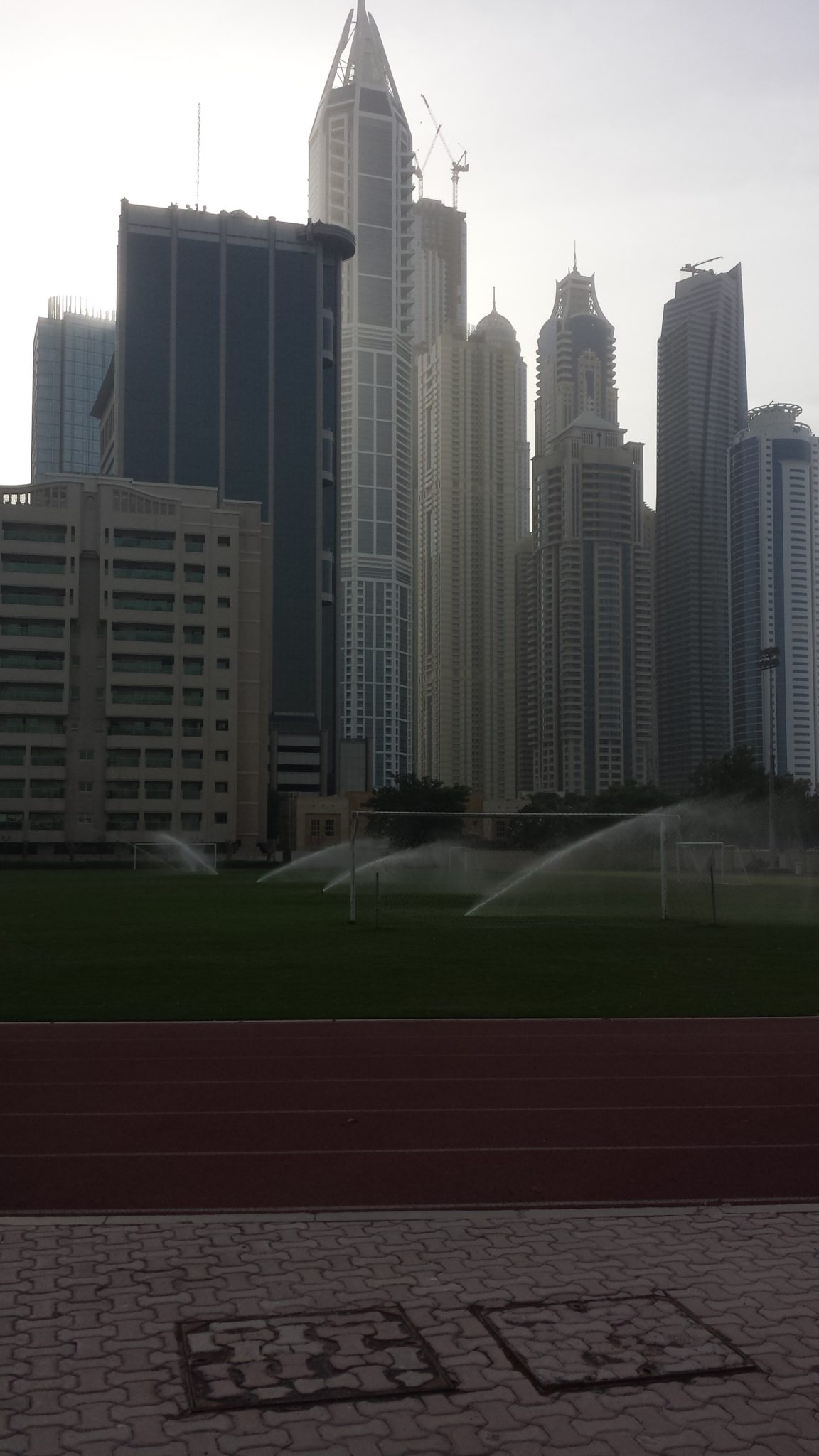
Soccer fields at AUD
There’s a soccer field that has the Dubai Marina in its backdrop, quite possibly the most impressive soccer field backdrop I’ve ever seen. There are a lot of soccer fans and players on campus from a wide range of skill levels who are always willing to accept anyone into their pickup games. The campus location is also great as well. The campus is so close to the base of the Palm Jumeirah, which is probably the coolest coast in the world. Going out on the palm for a drive or a run is a special experience. The campus is also located right next to a Dubai Metro station, which is so convenient. This gives the whole campus easy and cheap access to places like the Dubai Mall, the Mall of the Emirates, the Dubai Marina, the soccer stadium, old markets, and much more. Overall, I’m so glad I came to Dubai and AUD because the experience is entirely different than anything I’ve ever had.

As a recipient of a Clinton Scholarship, Zdvorak had the opportunity to meet the former President
Looking for a semester-long program abroad with classes taught in English?? Consider the Missouri London Program! All classes are taught in English by professors from universities in Missouri.
The Missouri London Program gives you a chance to engage in experiential learning. You get an educational experience above and beyond the physical classroom while living like a Londoner in one of the world’s most exciting cities. Meanwhile, your credits automatically transfer back to Missouri S&T. Some classes being taught in Spring 2014 are Social Media/Web-Based Communication and Sports Literature.
See mlp.mst.edu and programs.capa.org/MLP for details. Email Stephane Menand (stephane.menand@mst.edu) or David Wright (wrightmd@mst.edu) with any questions or for additional information.
Applications and deposits are due October 15, 2013.
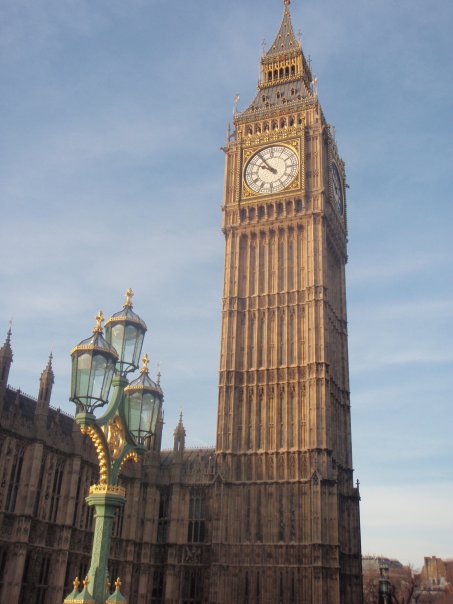
Big Ben
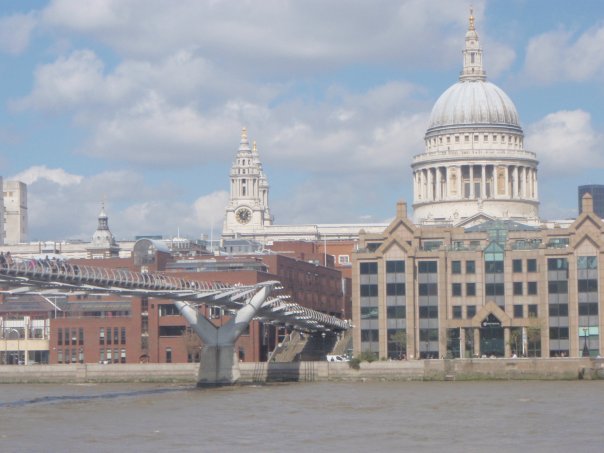
St. Paul’s Cathedral and the Thames

S&T students in Paris
Have you ever thought about studying abroad? Do you have questions you’d like to ask students that have studied abroad? Do you think you can’t fit study abroad in your schedule? Come find out more about the many options for study abroad at this fall’s Study Abroad Fair. Between 11 and 2 on Tuesday, September 3 in the Carver-Turner room of the Havener Center, you can learn more about short-term and semester or year-long opportunities. Visit with students that have studied in Malaysia, South Korea, China, and other countries. Studying abroad may be easier than you thought! Come learn more! Refreshments and live music included.
What: Study Abroad Fair
When: Tuesday, September 3 from 11 am – 2 pm
Where: Carver-Turner Room of the Havener Center.
]]>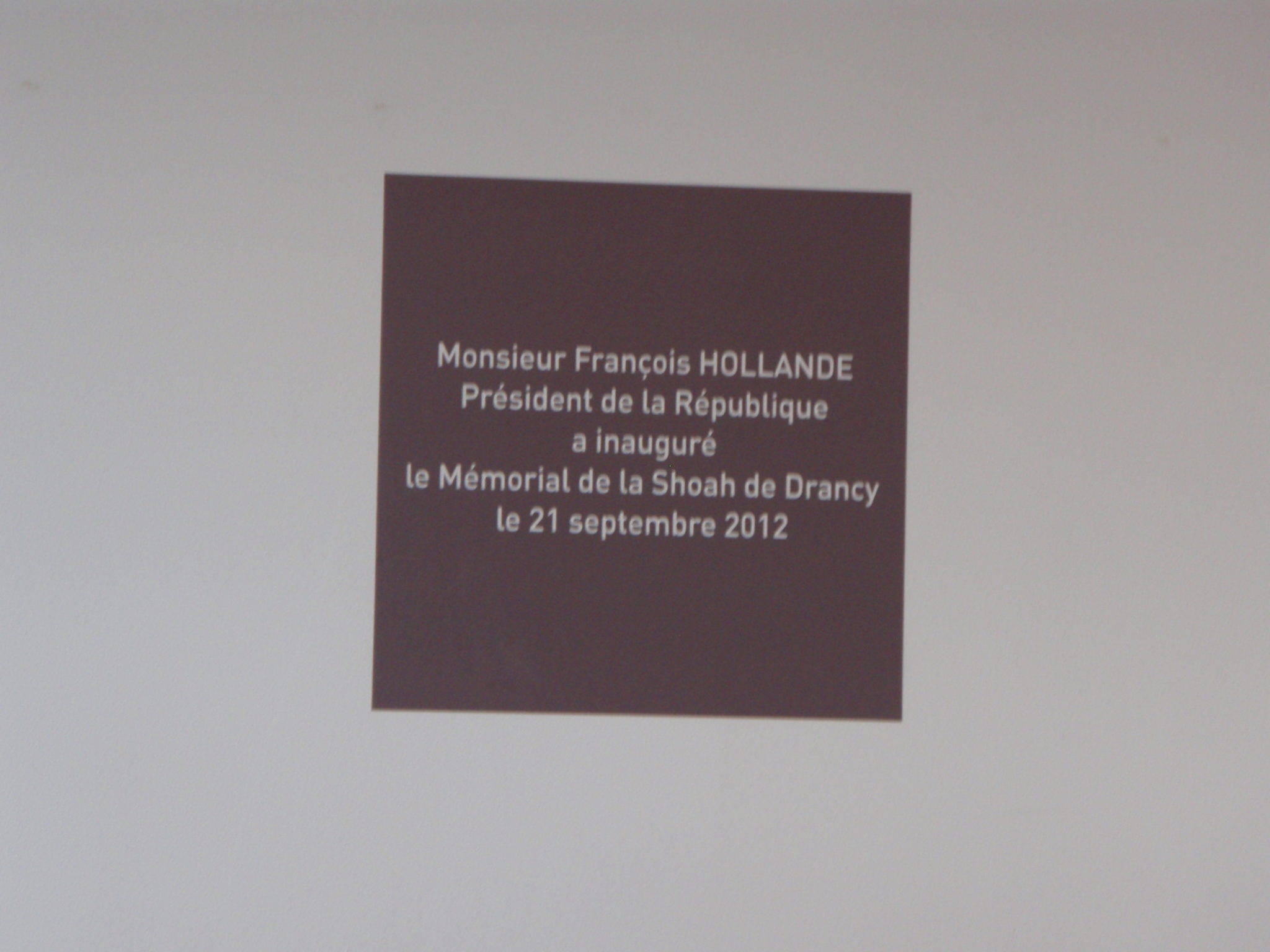
Holocaust Memorial at Drancy – opened September 2012
When designing the study abroad program, we purposefully scheduled four longer days of classwork during the week so that students would have long weekends to explore France and other European countries on their own. The students took advantage of this for the first time over the weekend. Some went to London and some went to Berlin while others visited places outside Paris that were of particular interest to them. I was one of the people that took advantage of the weekend to visit a place I’d never been before. I went to visit a new museum that just opened in September 2012 in the Parisian suburb of Drancy.
Drancy is located north of Paris and tourists travelling from Charles de Gaulle airport into the city center pass it on their journey. It’s often not high on the list of places to visit in France, but for a historian of the Second World War and the Holocaust in France (like myself) it is a must-see.
I began research for dissertation on daily life in France during World War II in 1999. Since then I have made regular (and extended) trips to France to work in the archives and libraries here. I have spent months researching the Holocaust at the United States Holocaust Memorial Museum in Washington, D.C. I have spent countless hours in the Centre de Documentation Juive Contemporaine (Center for Contemporary Jewish Documentation) in Paris. I have participated in international conferences and seminars on war and genocide, and in all of my research I have learned about Drancy. But I have never been there myself.
So what is so important about this suburb for someone who studies the war and the Holocaust in France? Drancy was literally the antechamber to the death camps in Poland. An unfinished housing development in the city, the Cité de la Muette, served as the main transit center for Jews after their arrest and before their deportation to extermination camps. Between March 1942 and the summer of 1944, an estimated 63,000 of the 76,000 Jews deported from France passed through the camp. The buildings that were used to intern these men, women, and children still exist and are now the home of new residents. The buildings and the site have an interesting history that is part of a permanent exhibit explaining the events that transpired there and that serves as a dialogue between the past and the present.

A view of the Cité de la Muette building
In the 1930s, the Cité de la Muette was an architectural novelty. The four-story, U-shaped building was constructed completely on site in order to be more cost effective. But the economic depression of the 1930s meant that the metal-framed building covered by concrete panels was never finished. The Germans requisitioned the apartment block after the Occupation of France in 1940 and it was first used as a detention site for French and English prisoners of war. Starting in August 1941, it became a camp for arrested Jews. When the Nazis’ “Final Solution” began in earnest in 1942, Drancy became the transit camp that would serve as the last step before deportation. The apartments were never finished so internees stayed in open, unfurnished rooms. There was no indoor plumbing and two buildings of latrines were constructed in the building’s courtyard. The entire complex was surrounded by barbed wire and watchtowers.
So on Sunday, I took advantage of the free shuttle service provided by the Mémorial de la Shoah (Holocaust Memorial) in Paris and travelled to Drancy for a guided tour of the site and the new museum. We began our tour outside, looking at the building (that was classified as a historic site in 2001) and the earlier memorials on the site. In the area in front of the Cité de la Muette there is a sculpture as well as a railcar like the ones used to deport Jews to the death camps.
As our guide explained, both of these memorials demonstrate the links between history and memory. The inscription on the sculpture mentions the 100,000 Jews deported from France. The sculpture was created and dedicated before the historical research was conducted that now places the number of deported Jews at approximately 76,000. The design is also symbolic in many ways (see this link for more info on the symbolism.) The columns on the side mirror the iconic image we have of the entry to Auschwitz, which is reinforced by the train tracks behind the sculpture. The placement of the railcar in front of the camp buildings also reflects our common perceptions of the Holocaust. In this case, however, it gives a false sense of reality since there was no railway in front of the camp. Inmates chosen for deportation were bussed from Drancy to nearby train stations.
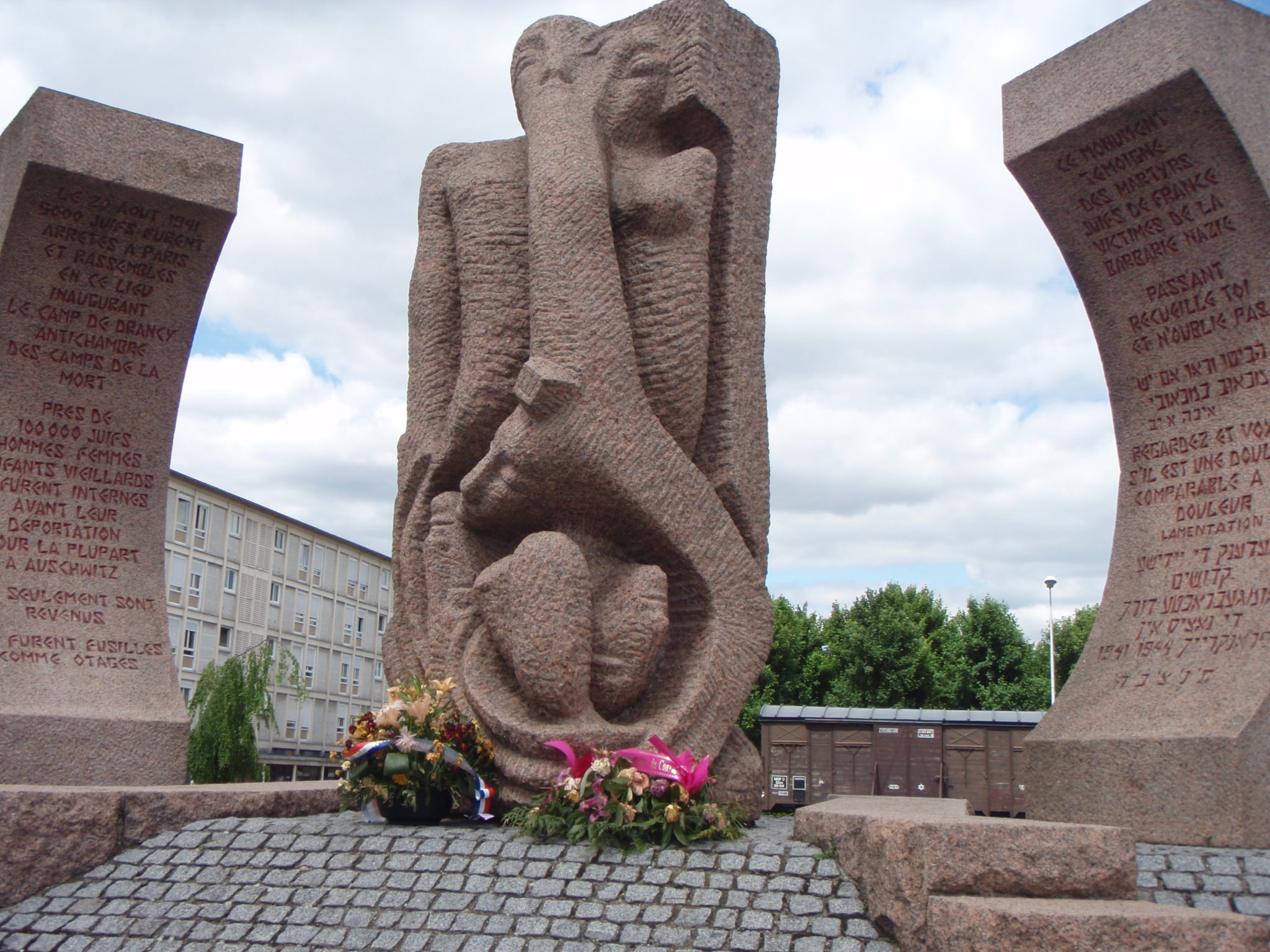
Sculpture with building and railcar in the background
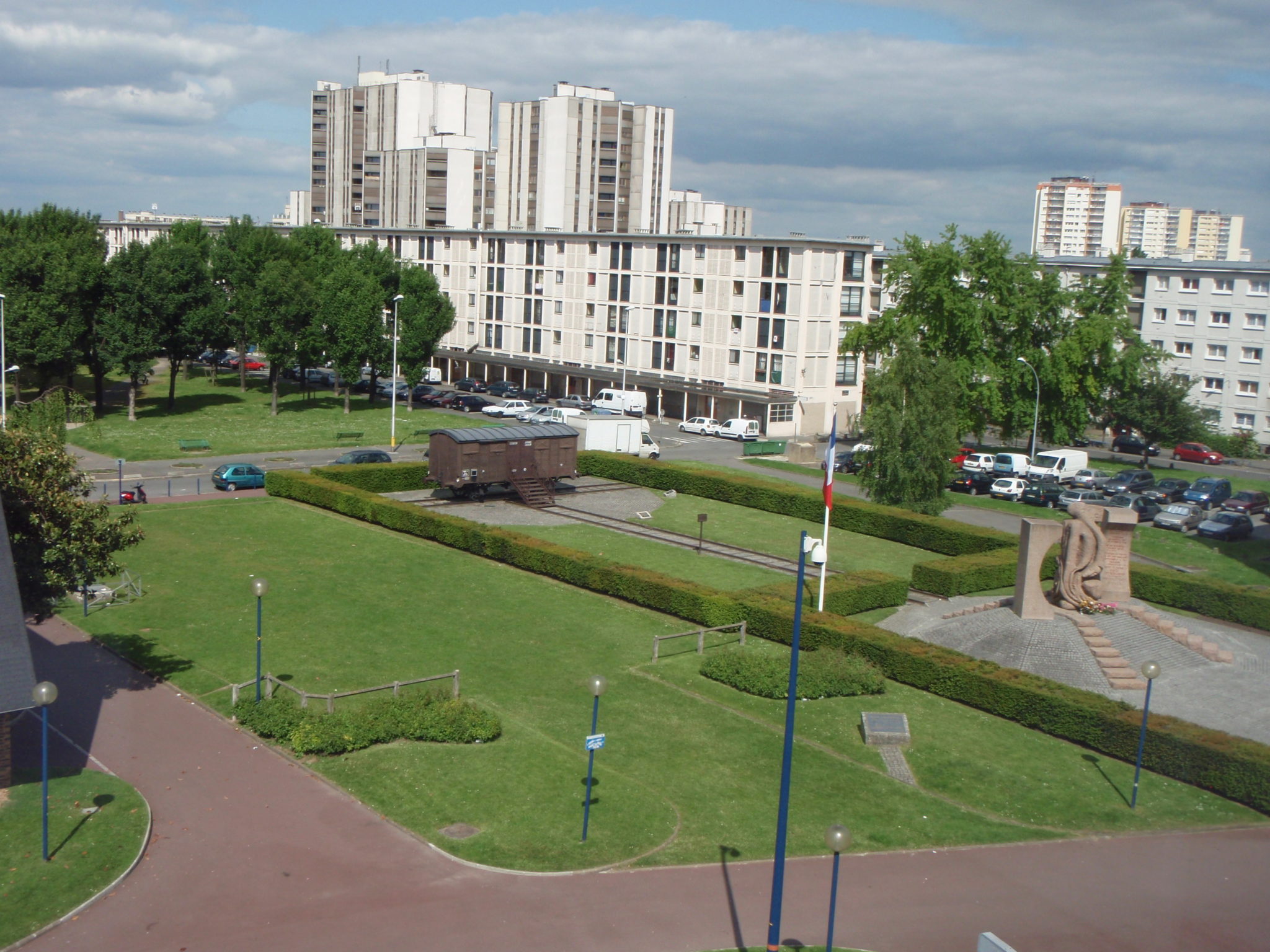
View from the museum windows
We continued our tour inside the museum, which was built across the street from the Cité de la Muette and overlooks the site. On the ground floor, visitors see photographs, names, and date of deportation of some of the Jews that passed through the camp. The museum currently has 12,000 pictures of victims that were interned at Drancy. The fourth floor is the home of the permanent exhibit. The room itself is almost the exact opposite of the Mémorial de la Shoah in Paris, which is in the basement and is a dark, somber space. At Drancy, the exhibit and displays are all in white in a room with floor to ceiling windows on two sides. Videos explain the history while interactive displays allow you to learn more about individual experiences.
One of the videos talks about the three camps in Paris that were annexes to Drancy. Jews that were considered “non-deportable” because their spouse was “Aryan” or because of their previous military service were transferred to camps within Paris where their job was to sort and package the domestic items looted from Jewish apartments. (For more information on this topic see this book.) I was reminded that one of these camps was in a furniture store called Lévitan located in the 10th arrondissement of Paris. The building with its memorial plaque is less than a block away from the hotel where we are staying.
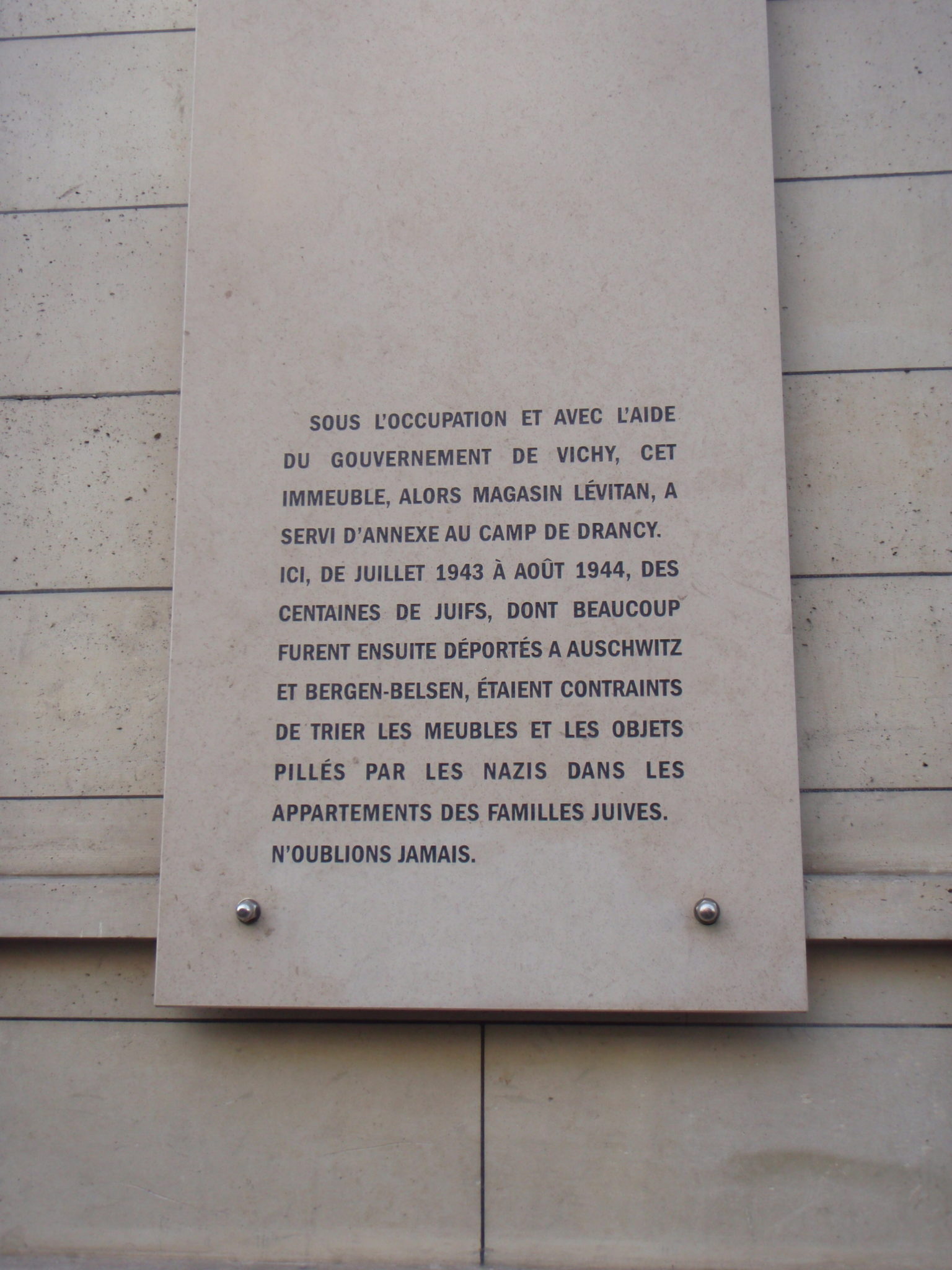
Plaque explaining Lévitan’s role during WWII
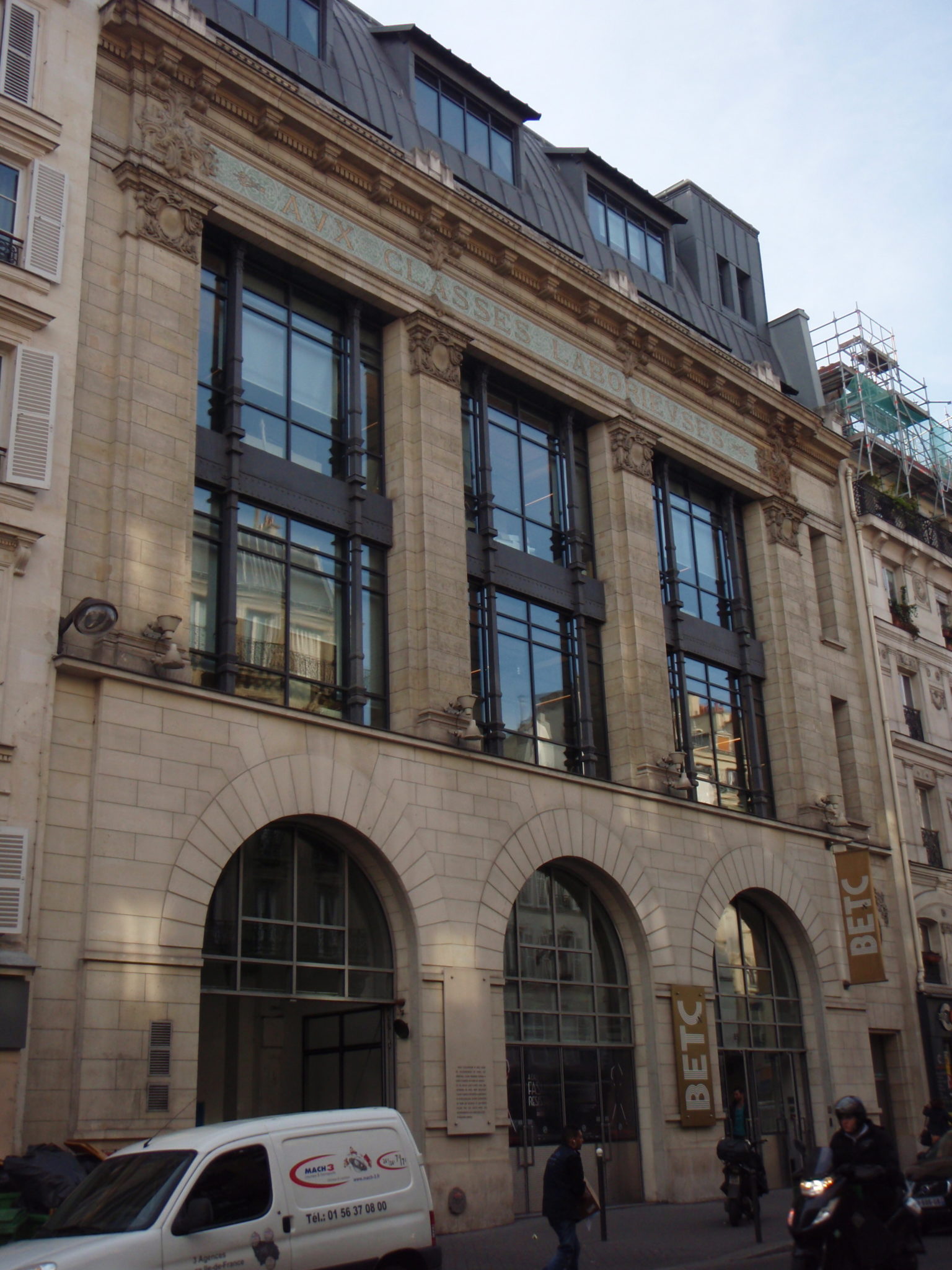
The former Lévitan furniture store
Overall this was an incredible learning experience for me. I finally saw the place that I have read so much about and the tour discussed the issues we are covering in our courses including the construction of memory. The museum certainly is a way to remember those who suffered and died during the Holocaust.
]]>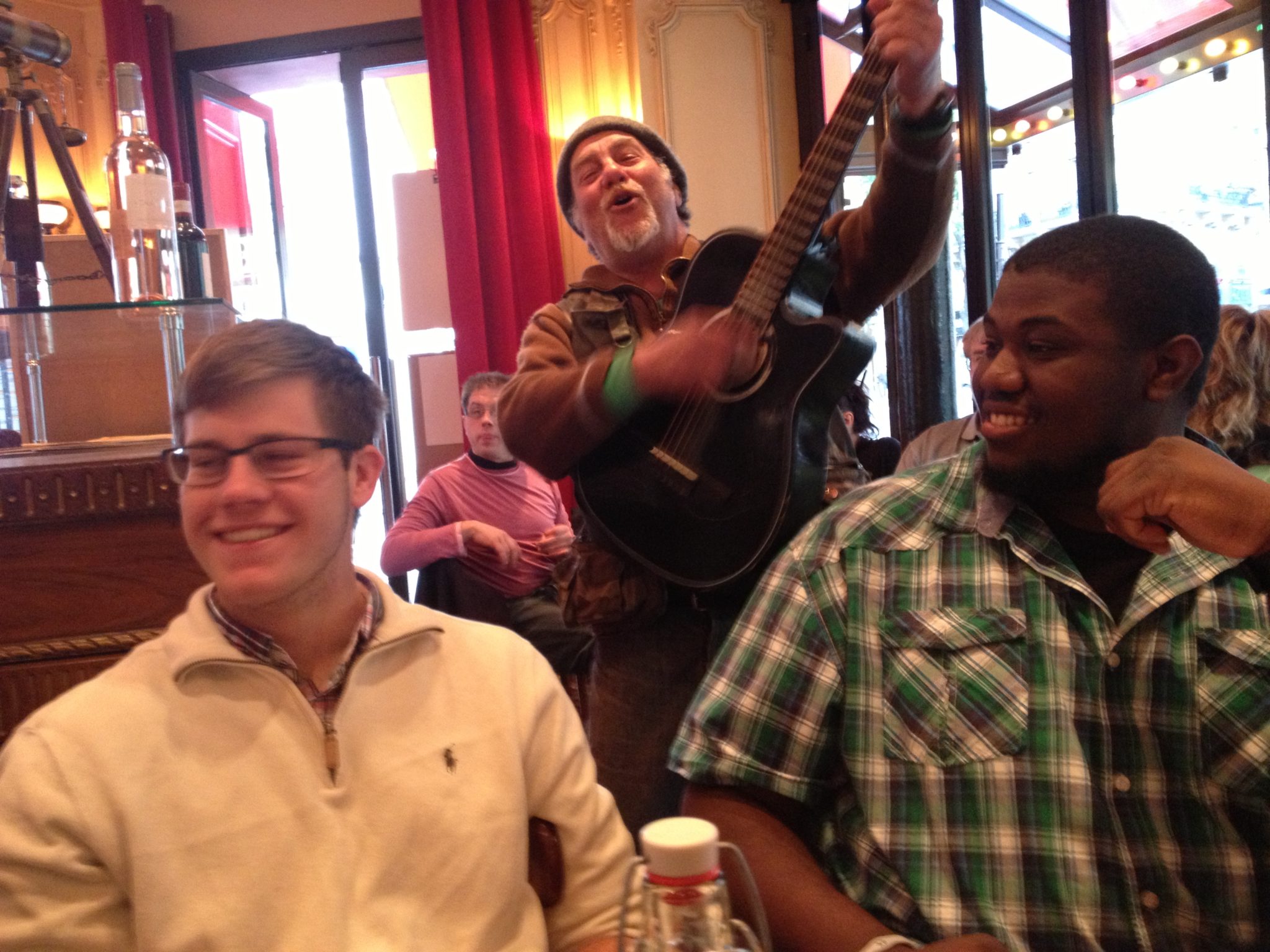
Will and Delancey are serenaded at the welcome dinner
We had a busy first week, and we have more in store for Week 2! During the first week, we focused a lot on the Great War and on getting settled in a new city. Paris is a huge cosmopolitan center and it’s an adjustment for many people: new place, different language, diverse culture, distinct foods.
The students have gotten used to taking the metro and navigating the city. They’ve also seen some of the iconic sights and some not-so-touristy places. They are discovering France’s history on a daily basis.
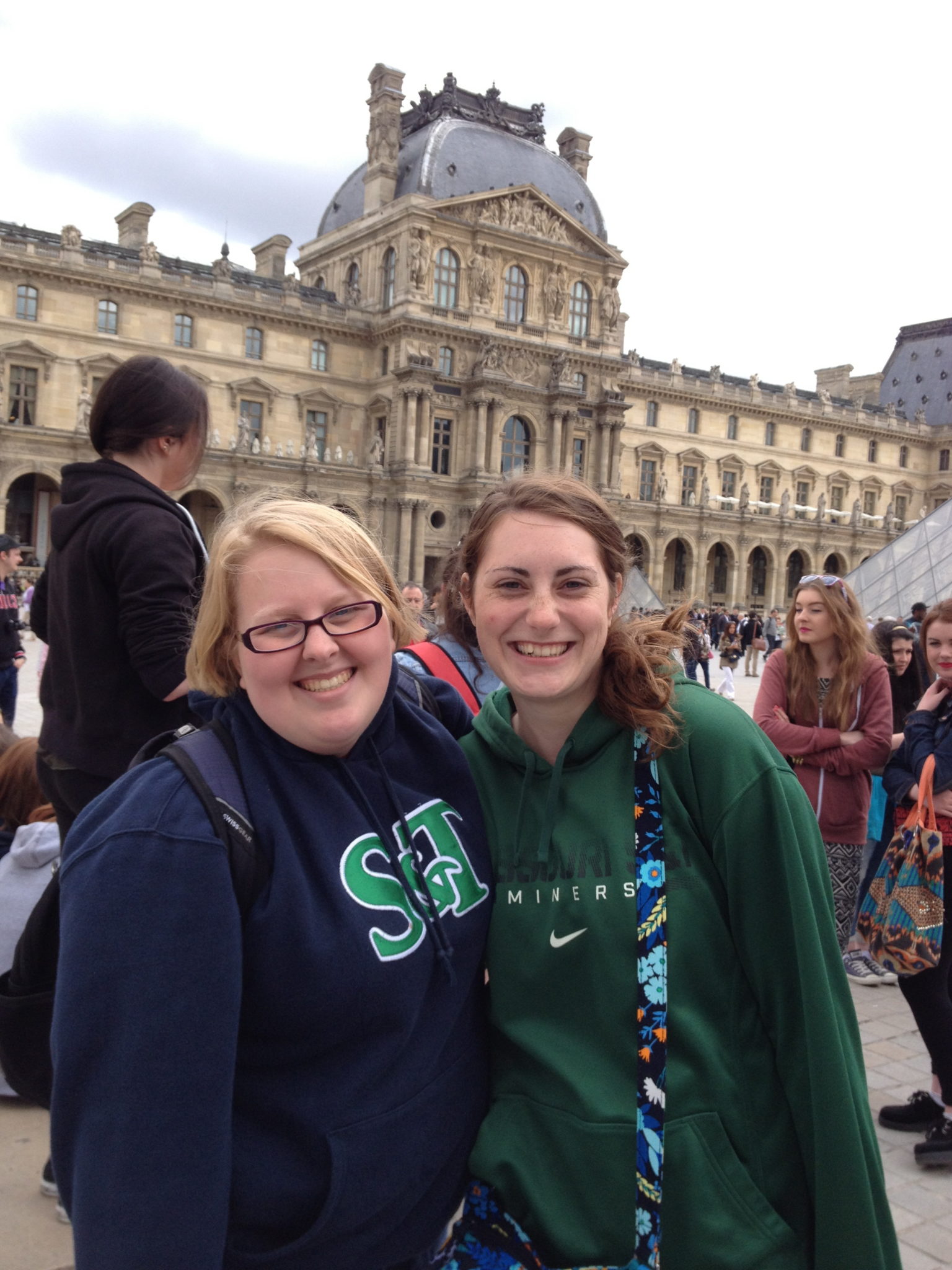
Claire & Courtney in S&T gear at the Louvre
This week promises to be just as exciting as we start to shift our focus to World War II:
Monday:
Walking tour of the Latin Quarter including stops at Notre Dame Cathedral, the Pantheon, the Sorbonne, and the Luxembourg Gardens. We will be discussing the role of the Catholic Church during the war, students in the Resistance, and Jean Moulin on our trek. We have also read excerpts from the Journal of Hélène Berr, a Jewish woman who attended the Sorbonne during the Occupation.
Tuesday:
Trip to Mont-Valérien. This fort on the outskirts of Paris served as the execution site for hostages taken by the Germans during the war. It is now a memorial site with competing historical narratives (Gaullist and Communist).
Wednesday:
Walking tour of the Marais and visit to the Shoah Museum. The Marais was one Parisian neighborhood with a large number of Jewish inhabitants during the war.
Visit to Vel d’Hiv memorials and the Eiffel Tower.
Thursday:
We will wrap up our time in Paris with a trip to the Montmartre neighborhood. An artistic hub, many wartime writers (such as Marcel Aymé) lived in this area and captured scenes of daily life under the Occupation in their works. The students will also be completing a photo scavenger hunt this week in search of memorials related to World War II.

Memorial plaque on the Seine

Group dinner restaurant
We’ve been planning for this day for 2 semesters. It’s the day that our students arrive to begin their study abroad experience! We have a welcome dinner planned for this evening at a French café and lots of activities planned for the week. Here’s a preview of our adventures. Be sure to check back for student posts about the excursions!
Monday:
Musée de l’Armée – Département des Deux Guerre Mondiales (Army Museum – Department of the Two World Wars.) Housed in Les Invalides, this museum will be our introduction to the two wars we will be studying during the trip.
Arc de Triomphe on the Champs-Elysées. We will be meeting under the famous Parisian landmark and “reading” the memorial.
Tuesday:
All day trip to the Somme region. We will be taking a guided tour of the World War I battlefields in this region as well as visiting the Historial de Péronne (museum) and various cemeteries and memorials dedicated to French, German, American, British, and Canadian soldiers. This promises to be an intense day!
Wednesday:
Walking tour of Père-Lachaise Cemetery. We will visit the war memorials in this famous cemetery. We are especially interested in the series of sculptures related to the Nazi concentration and death camps.
The Louvre. We will take a tour of the museum to see the famous masterpieces that the French evacuated for safekeeping during World War II. We have viewed the documentary The Rape of Europa, which explains the looting and protection of French art during the war.
Thursday:
We will finish up our study of World War I by visiting the site where the official treaty with Germany was signed: Versailles. The Treaty of Versailles (1919) was signed in the famous Hall of Mirrors and would have consequences for the future.
]]>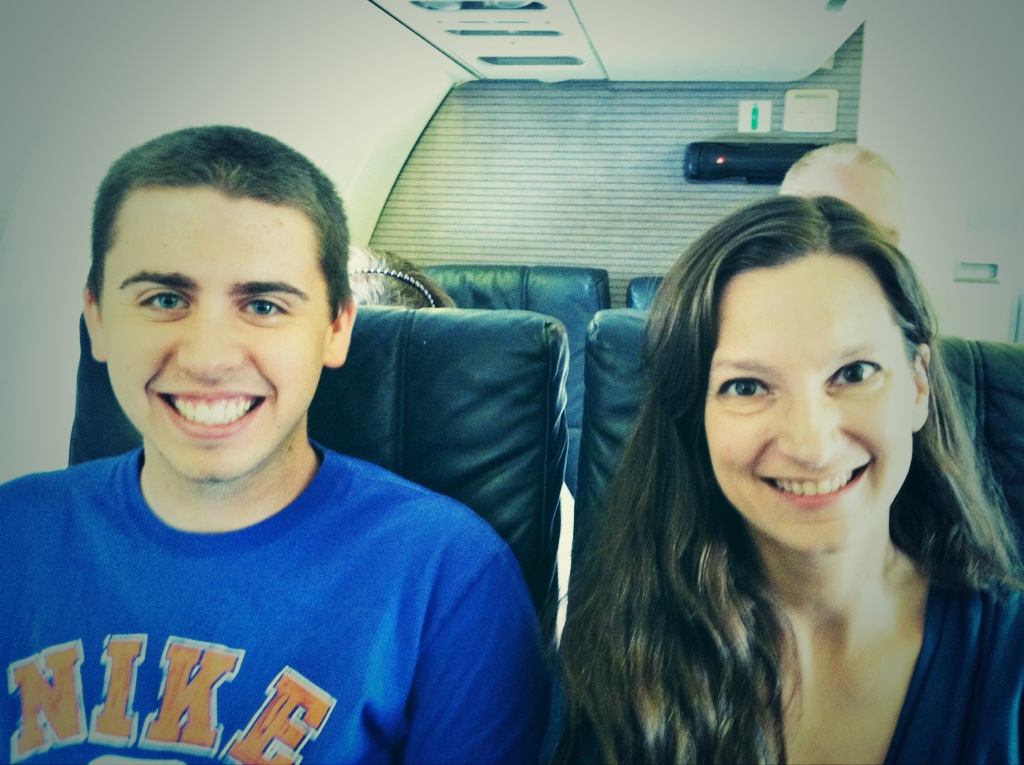
James with Dr. Langston on his first commercial flight ever!
All different kinds! If you take just a few minutes to read the biographies of the fifteen students participating in the War & Memory Study Abroad in France, you’ll discover a varied group of students. We have men and women and sophomores to seniors. Some are students who have never travelled abroad and some have travelled before and were looking for an opportunity to go again. Some come from small towns while others live in big cities. You will discover future scientists, business leaders, engineers, psychologists, historians, and those whose career paths aren’t clear yet in our group. A few have studied a foreign language; most have not. There are athletes, artists, musicians, outdoorsmen and women, history buffs, mechanics, military enthusiasts, foodies, introverts, extroverts, and Francophiles. (See their full bios at the “Meet the Bloggers – France 2013” link.)
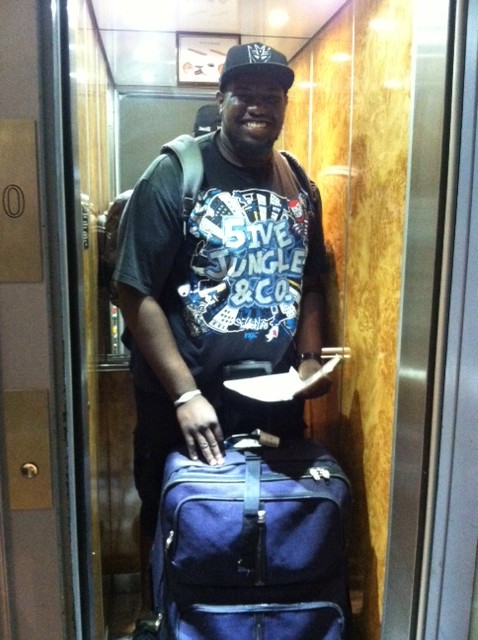
Delancey discovers small French elevators.
While the biographies demonstrate the diversity of students who can study abroad, there are a few traits they share: an excitement for learning; a strong desire to try something new; and curiosity about other places, people, and cultures. Study abroad can be for everyone! Taking the time to find the program that is right for you, whether it’s for a semester, a year, or even a few weeks in the summer, can lead to a life-changing experience. There are also opportunities for scholarships and financial aid that can make it easier for you to go. We hope you will enjoy the multiple, unique perspectives we will be sharing during our trip!
]]>
Cheese Shop on the Rue Montorgueil
Follow us on twitter to keep up with our trip in real time. See our daily itinerary, pictures of our destinations, and what we’re eating.
You can find us at @MinersInFrance
Enjoy!
]]> Check out the news story about our trip to France:
S&T students to experience war memories during trip to France
Keep watching for updates!
]]>