I was able to see the tourist attractions that children point out in books, like the Eiffel Tower and the Mona Lisa, and I was able to experience rare monuments dedicated to the tragedies and sacrifices of WWI and WWII.
It is hard to believe that I stood on the same beaches that thousands of soldiers marched on to liberate France while we enjoyed a tour of the area and ate at a local restaurant as if nothing happened. The eerie peacefulness of the area and the horrific photographs that you know were taken at the same spot where young children now swim and build sand castles is eye-opening.
At the same time, you realize how small you are during such an experience. It is amazing that in an 8-hour plane ride you can travel half a globe and experience a completely different culture.
My favorite place that I visited was the Louvre, and the second was the Pantheon, where I saw the final resting place of Rousseau and Voltaire. They wrote some of my favorite books, and I didn’t even realize I would see them! As for the Louvre, the amount of tourists was overwhelming. At the Mona Lisa, there was at least 100 people crowded in front of the work trying to get as close as possible. I was able to fight through the crowd, and I saw the masterpiece for the second time of my life. It was worth the crowd.
 You would never believe how much I had to fight to get this picture!!
Overall, the experience was amazing. I am extremely glad that I had the opportunity to learn about WWI, WWII, and French culture at the very heart of Paris and Caen! The most important thing I learned, besides that my knowledge on WWI and WWII was very rusty, would be that the City of Light is nothing like you read in the picture books. The city is even more beautiful than any picture you can buy, the people are not as arrogant as we think they are (but they are a little bit at times) and the monuments they create are timeless, peaceful, beautiful, and breathtaking.
My opinions of French culture never really changed, but I learned that they are very nice. I only had two people be rude to me, and I was lectured once on how could I visit Paris without learning French! I did get the occasional “sniff” when I asked if they spoke English, but after seeing how many tourists they get, I can understand their frustrations.
I miss Paris, but by the time I left I was sick of French food (shhhh, don’t let them know). I hope our blog gave you an idea of what it was like, and hopefully it will encourage others to visit!
]]>
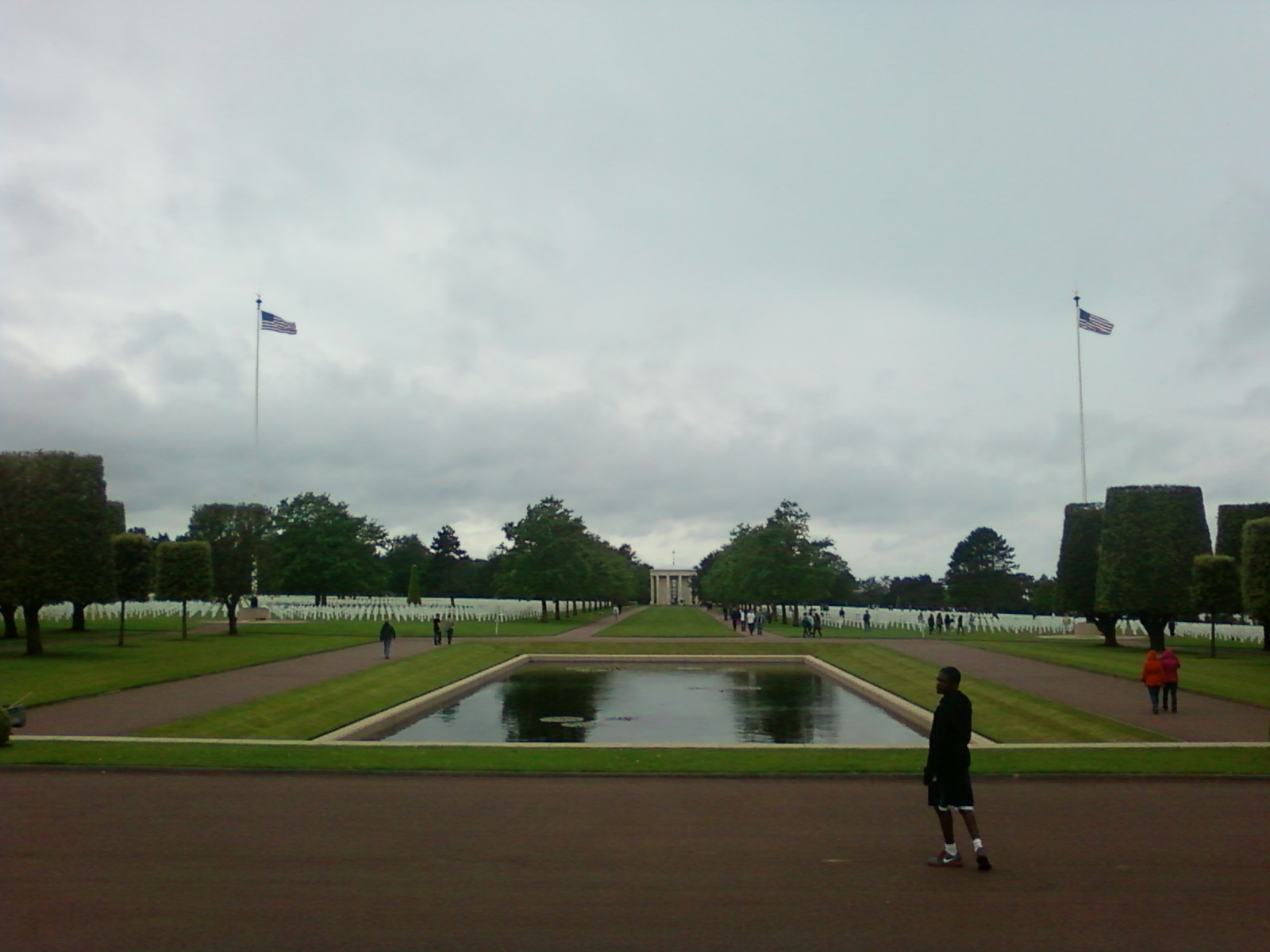
The American Cemetery
Taking a class at the university could never prepare someone for the things they might experience and feel when standing at the historical monuments in person. Yes, America has quite a few historical monuments that bring about similar feelings, but for France, World Wars I and II took place on their soil while we were an ocean away. Today’s American citizens could never compare such experiences of having their home country invaded and occupied, but for France the past still remains in the everyday of the citizens’ lives. Social order was heavily changed once France was occupied during World War II, with the weight of events still dictating how people act in social situations today by trying to have the utmost respect for another person despite differences so as not to repeat the mistakes made by others in the past.
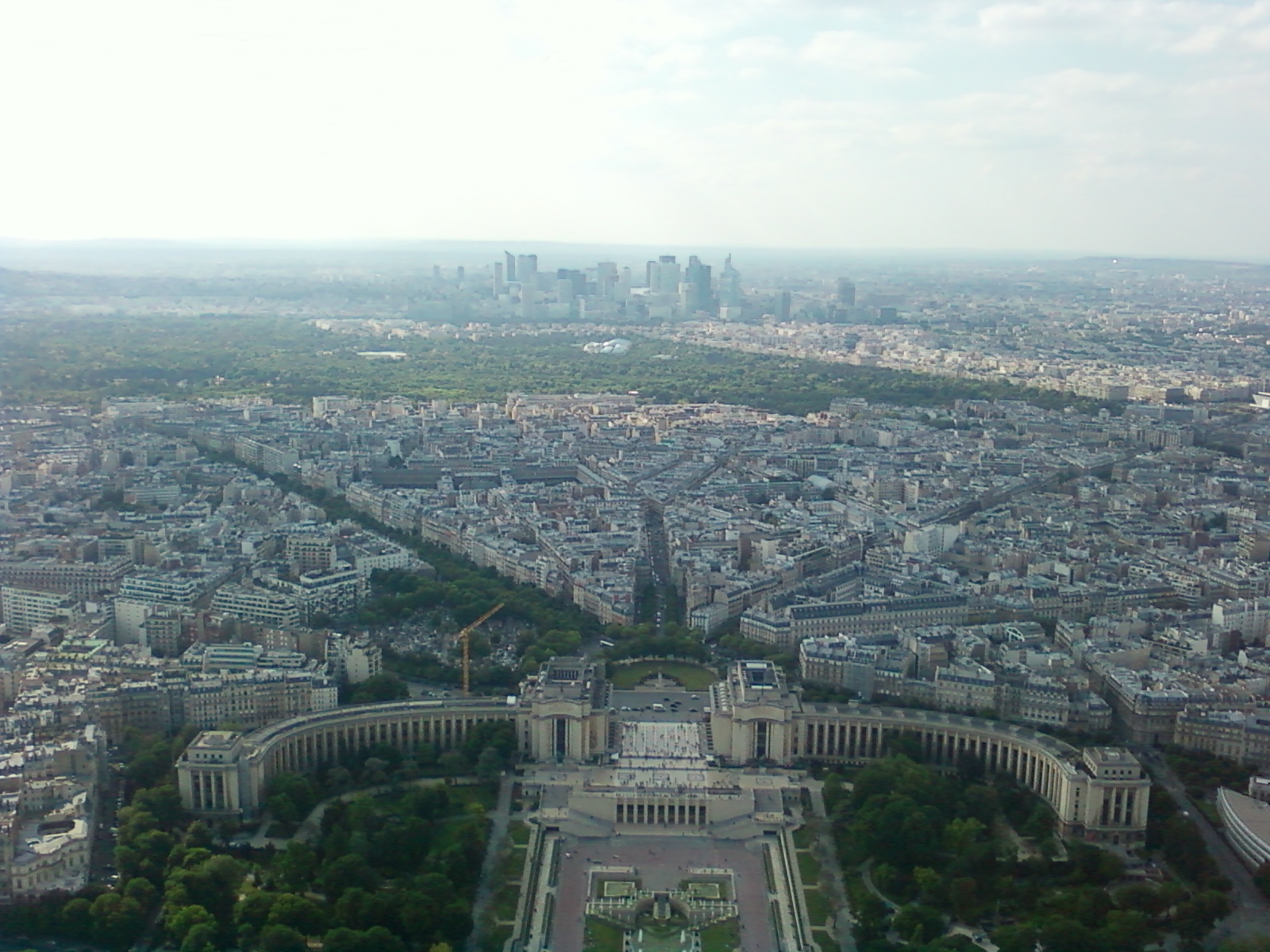
Sky view from the top of the Eiffel Tower
In total, the experience of studying abroad has really changed my thoughts on several issues here in the U.S., and though it is a bit hard to explain the feelings one might gain through studying abroad, I insist everyone take the leap of experiencing another culture at least once in their lives. The world, as it turns out, is much bigger and brighter than one could ever imagine, and the past memories that mold our world can turn every thought around the minute you learn how oddly similar yet different we are.
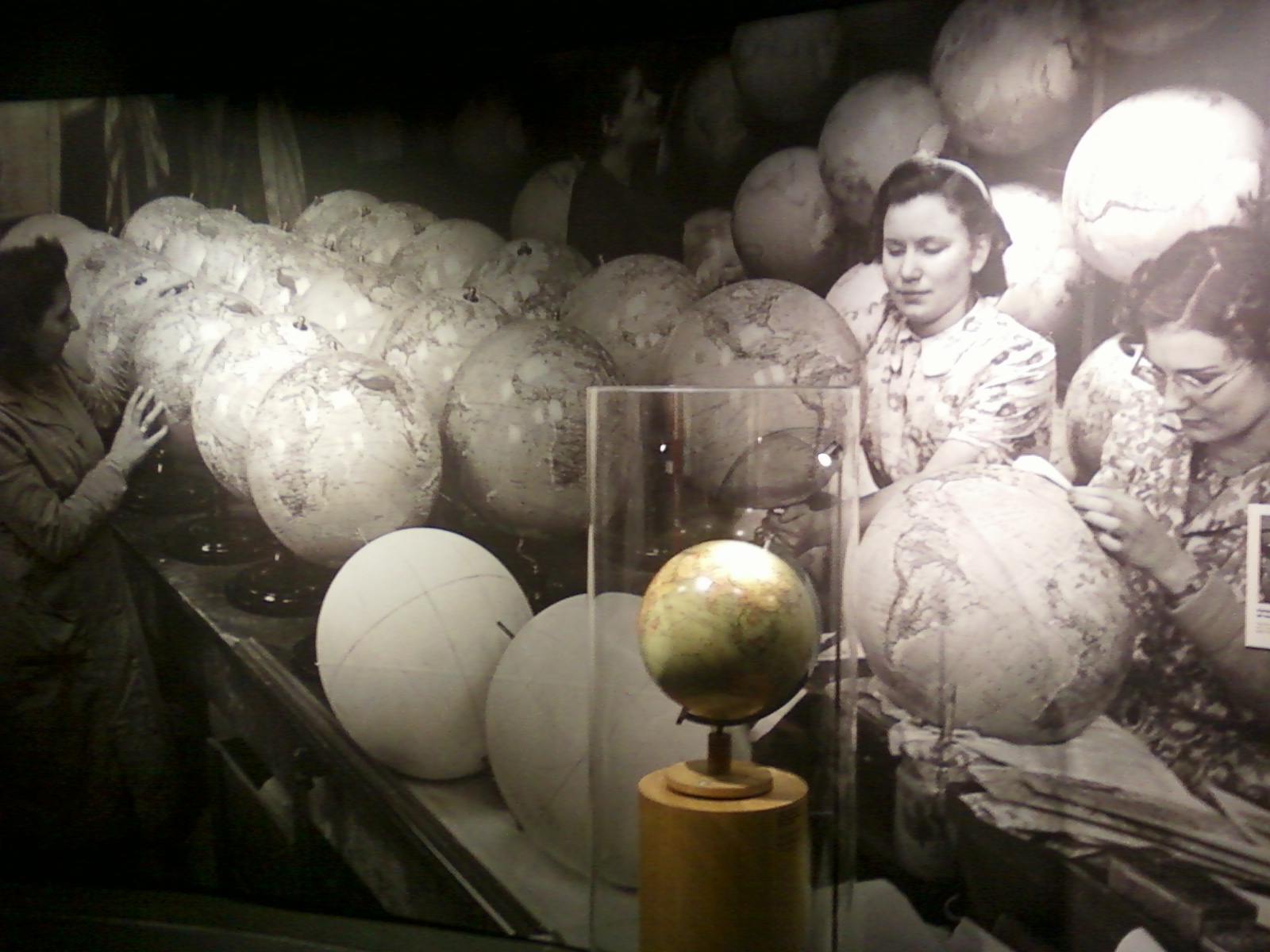
Making globes during World War II – Caen Memorial Museum
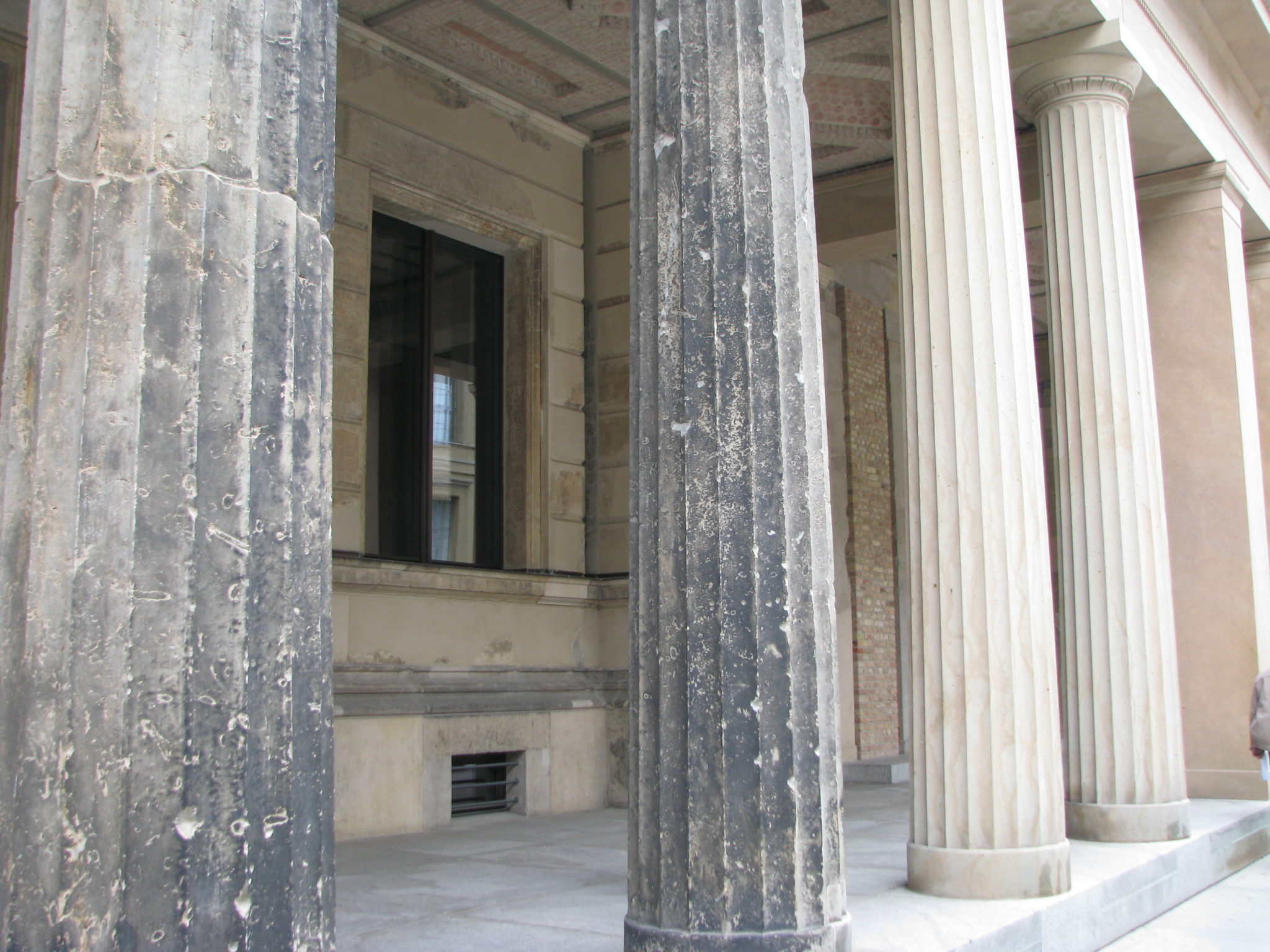
Artillery damage on the original columns outside the Pergamon Museum.
This past weekend, the students had a break from coursework to explore Paris or other European cities. I traveled to Berlin to see a friend of mine who now lives there. It was my first time in Germany, and like Claire, one of our students who also visited Berlin this weekend, I found the differences from Paris striking. You can read about Claire’s impressions here.
Traces of war and its aftermath are visible everywhere in Berlin. Buildings and monuments are scarred by bullets and artillery. Allied bombings damaged and destroyed much of the city, but importantly, many remains of the city’s landmarks have been preserved to serve as reminders of architectural and artistic accomplishments, but also of the country’s Nazi past.
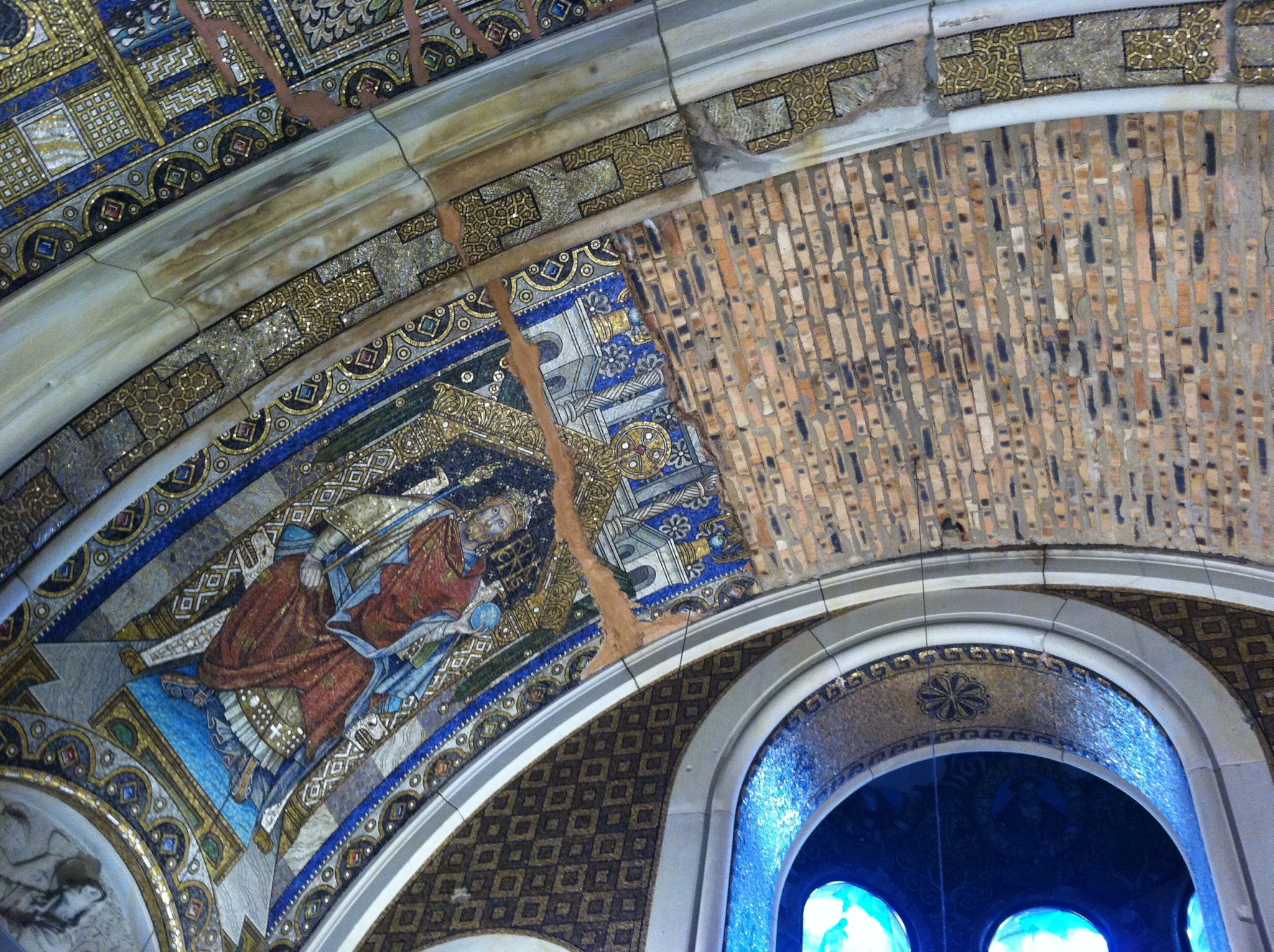
Inside the Kaiser Wilhelm Memorial Church.
Inside the Kaiser Wilhelm Memorial Church, built in the 1890s, you can see some of the beautiful mosaics that decorated the interior. But there are large sections missing on the ceiling and on the floor. In fact, most of the church itself is missing because of a 1943 bombing raid. A display inside explains the history of the church and its preservation. When the structure was scheduled for demolition in the 1950s, the people of Berlin protested, wishing instead to preserve it as a monument to peace and reconciliation. Another example of this type of memorialization is the former railway station Anhalter Bahnhof. During World War II, the station was used to deport tens of thousands of Jews. Today, though, all that is left standing is the central section of the front entrance.
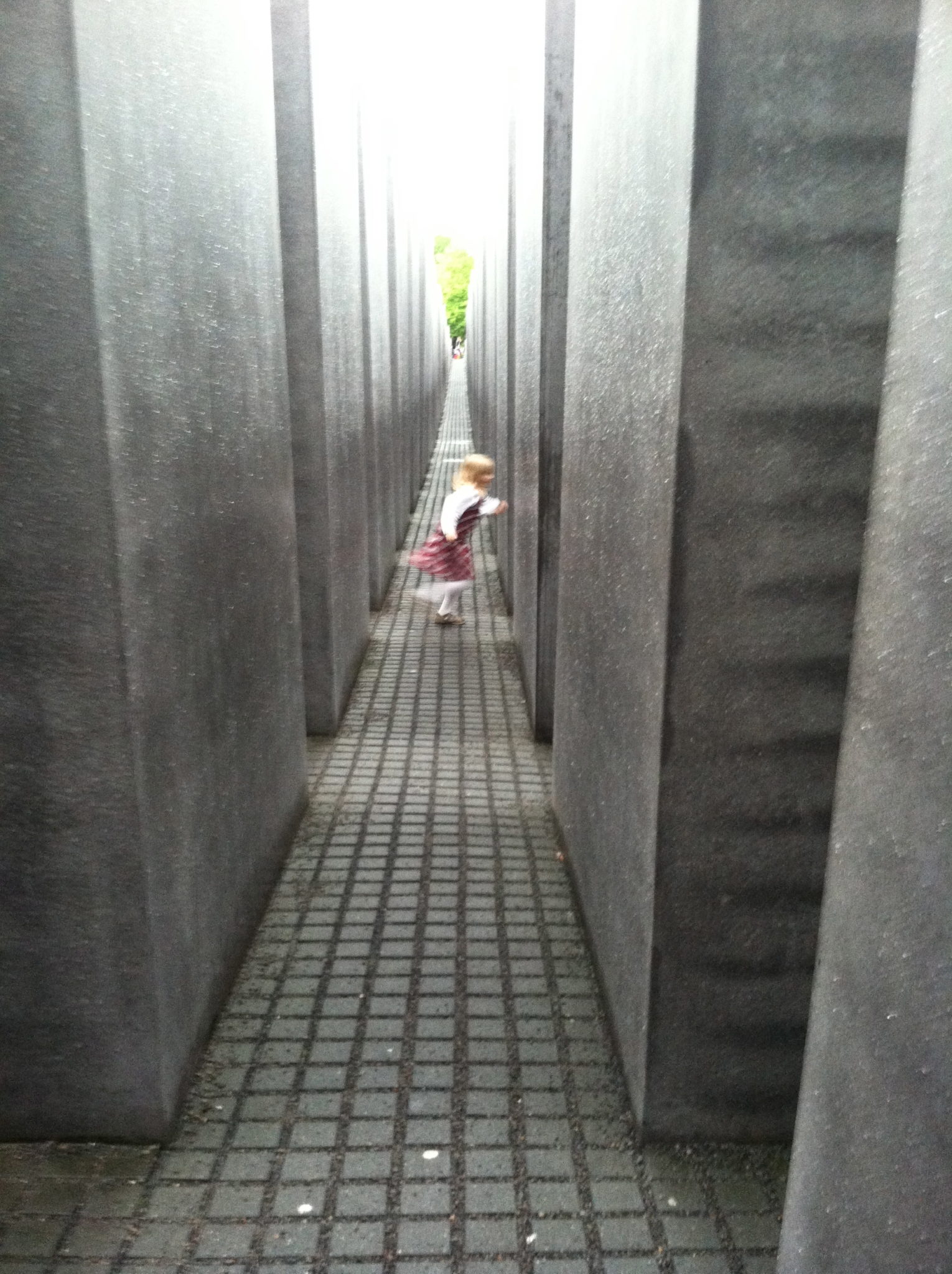
Memorial to the Murdered Jews of Europe
I also visited the Memorial to the Murdered Jews of Europe, which opened in 2005. Looking at this Holocaust memorial, I was struck by its grayness and its simplicity—it consists of 2,711 large cement blocks of various heights—some at ankle level and some that tower over visitors—spread out in a grid over five acres. The ground on which the blocks stand is hilly, and when you enter, it seems at first like a maze. Yet there is really nowhere to hide; you are exposed at all times. I was visiting the memorial with two seven-year-olds, both of whom really wanted to play hide-and-seek. I felt somewhat guilty participating in what seemed like a disrespectful activity and I mentioned this to some friends. One of them, Bethany Keenan, a professor at Coe College, is also leading a study abroad program in Europe this summer and had just been to the memorial. She told me that their tour guide had explained that such games “. . . might be disrespectful but they could also be life-affirming and celebratory, and as such can be considered a reappropriation of the space against the Nazis. If someone has a problem with hide-and-seek or other behaviors there, they should speak up. The way the site is produced puts the onus on the bystander to comment—and the lesson that bystanders must say something and stop things they disapprove of was the main message that most of the memorial sites in Berlin were aiming for.”
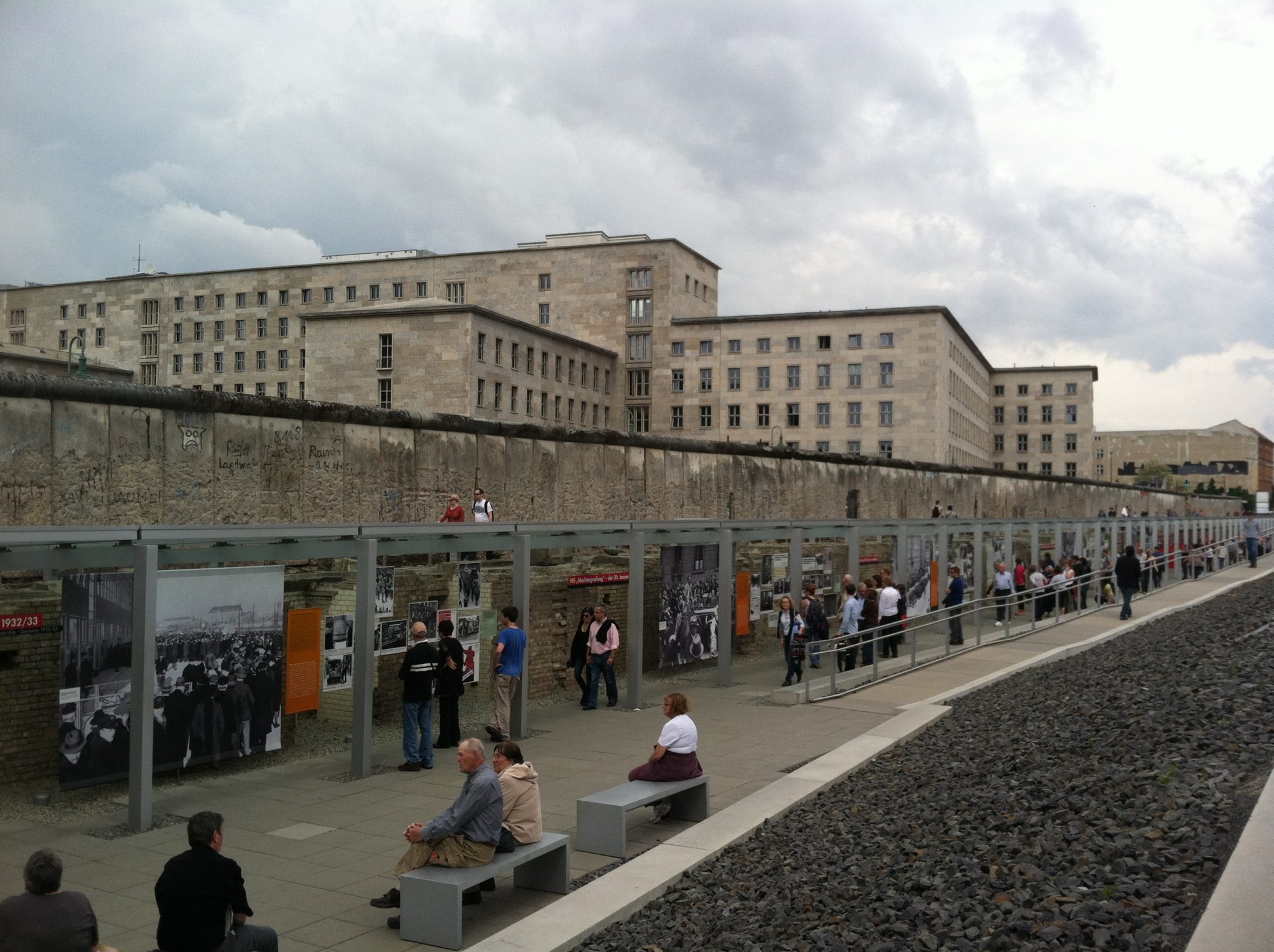
Topography of Terror site
The consequences of the aftermath of war are also striking, particularly since there are portions of the Berlin Wall scattered throughout the city. Construction of the Wall began in 1961 to cut off the stream of refugees fleeing west, and it stood for twenty-eight years as a symbol of the division of Germany and the Cold War. A large section of the Wall stands intact at the Topography of Terror site. A nearby sign explains that by 1989, 136 people had lost their lives at the Wall, shot down by GDR (German Democratic Republic) border guards. The accompanying outdoor exhibit provides information about the topics such as the rise of the Nazi Party, book burnings, and the persecution of Jews.

Commercialization of the Wall. You can pay to have your passport stamped here.

Postcards–then and now
One of the things that I was not expecting in Berlin was how much World War II has been commercialized. Tourist shops sell postcards depicting tanks, war planes, and soldiers; you can buy “authentic” pieces of the Berlin Wall and T-shirts advertising Checkpoint Charlie (a well-known crossing point between East and West Berlin during the Cold War). You can pay to have your passport stamped with the official Checkpoint Charlie stamps at a section of the Berlin Wall. Much of the memory of war has turned kitsch.
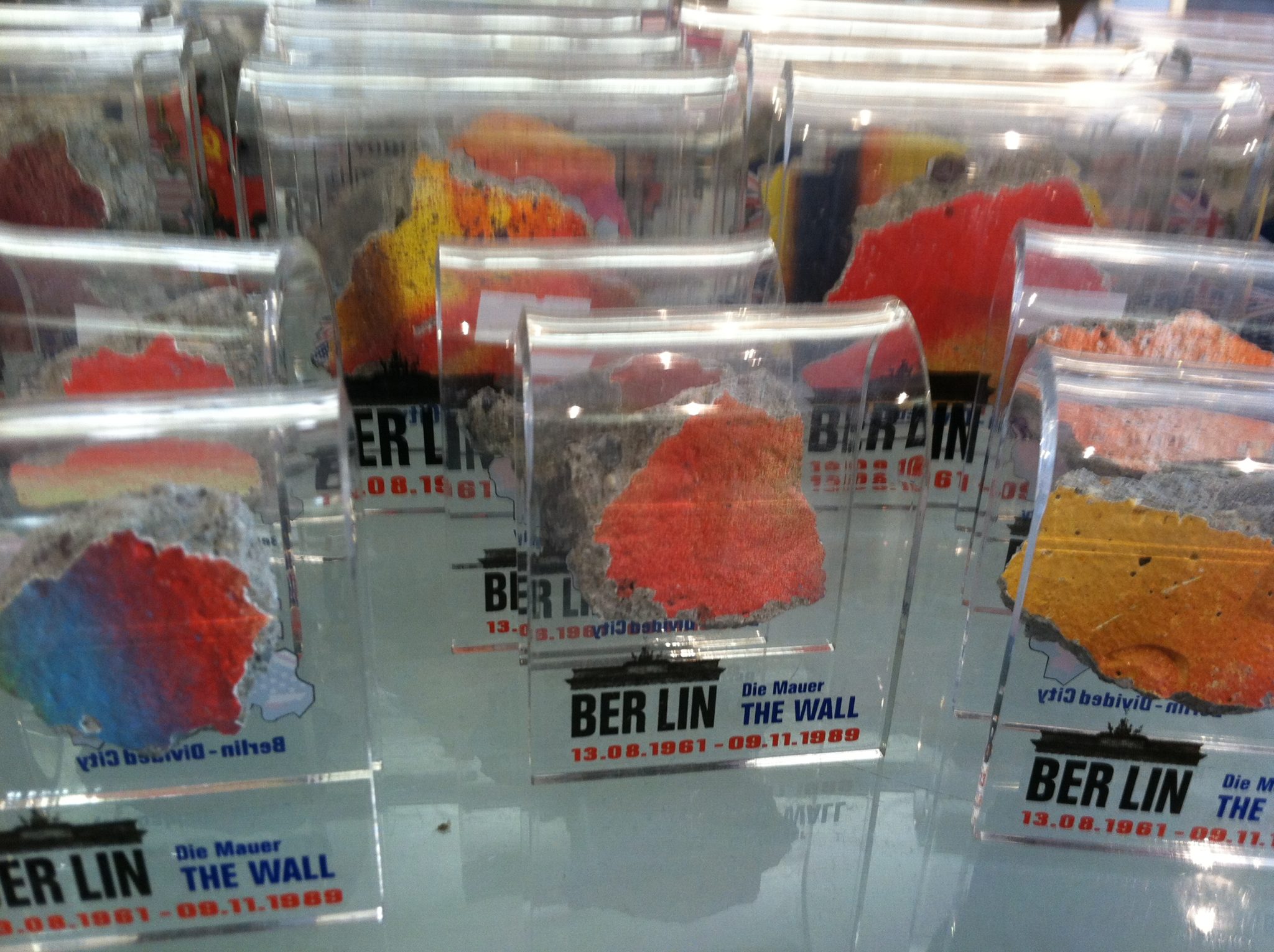
The Wall for sale in a tourist shop
Seeing the evidence of destruction everywhere I looked was disturbing. What struck me the most during my visit, however, was the continual threat of danger. I went with my friend to pick up his daughters from their elementary school. On the way back, we walked through a park that they go through every day. Posted signs warn visitors to keep off the grassy areas, not to maintain the lawns, but because there are still unexploded bombs there. World War II can still claim victims.

The grassy areas in this park still contain undetonated explosives.
Our tour guide for our visit to the World War I battlefields of the Somme remarked that it is clear when a war begins but that it is never clear when it is over, or who its last victims will be. In the Somme, much of the land is now unusable for farming—nearly one hundred years later—because of all of the lead in the ground. In these areas, they let the forests grow. For the same reason, it is unsafe to eat the fish from the river. Each year, people are uncovering shells, artifacts, and human remains. For example, when we stopped for lunch at a restaurant in Pozières, we learned that the man serving us (who is also a battlefield guide) had just two years before unearthed the body of an Australian soldier, along with a number of relics, at Mouquet Farm. You can read about the story here. For some families, such discoveries answer questions and bring peace. Other families will never know what became of their loved ones. For them, is the war ever really over?
My visit to Berlin was at once difficult and inspiring. Signs of destruction and violence are omnipresent, but as Claire mentioned in her post, construction and renovation projects are underway all over the city. The past remains visible and serves as a reminder to us of the horrors of war, but also of human strength and perseverance.
]]>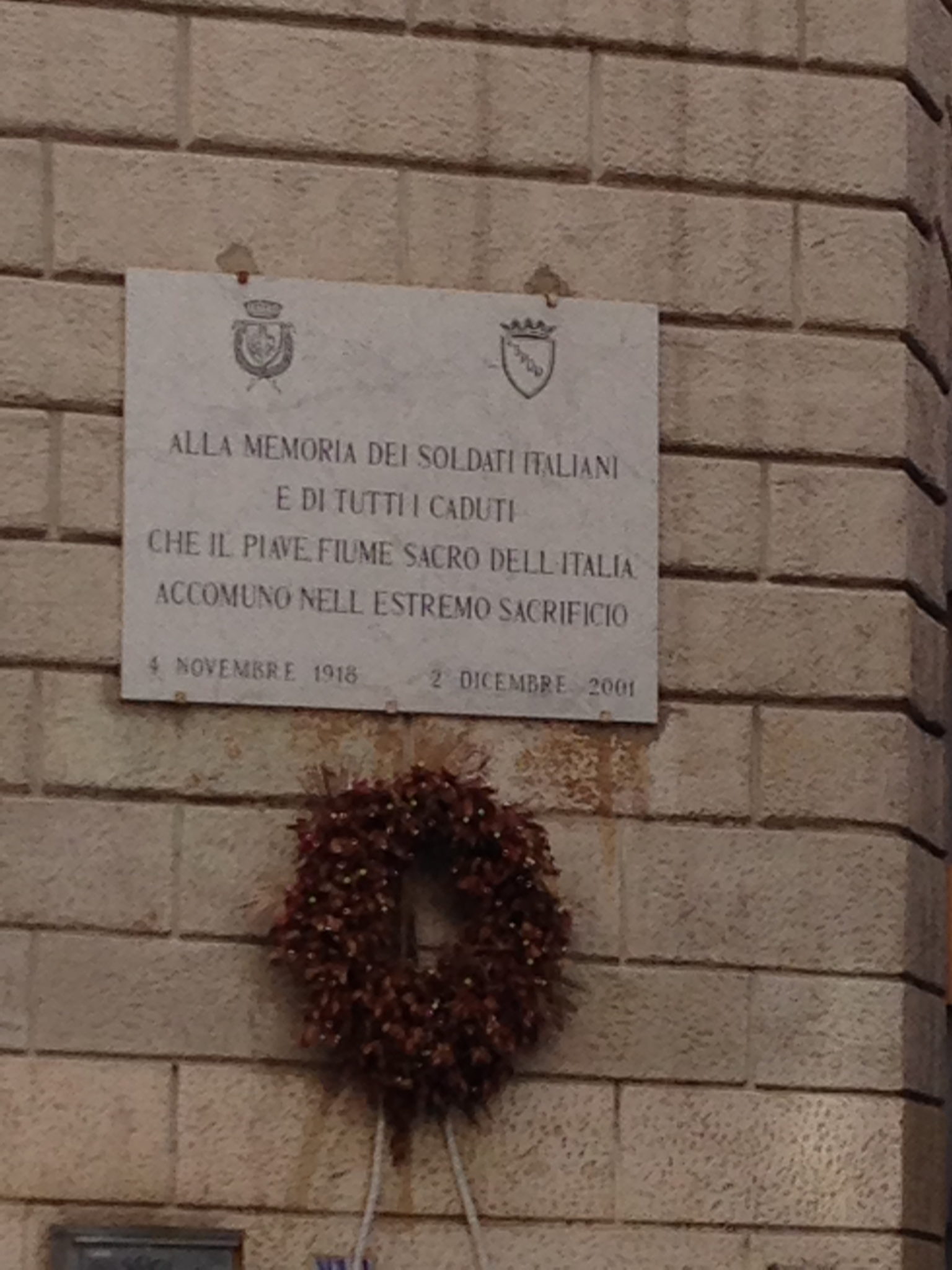
WWI Memorial in Rome
It is the end of week 1 in France. I came to Europe early and my first stop was Italy. The trip to Italy was not what I expected at all. In places where there seems to be a lot of tourism, people tend to speak English. This was not the case in Italy. The public transportation in Italy is also not as expansive as in other major cities. These were the challenges Courtney C. and I took head on.
We did prevail and manage to see some pretty amazing things! Even things that would pertain to our class in Paris. In Italy they have memorials set up around the city just as they do here in Paris.

We also found some more touristy places that everyone has seen in a movie or two.
Then I arrived in Paris. Flying into Orly airport I could see the Eiffel Tower from the air, it was AMAZING! I felt so incredibly happy, everything just seemed much easier to understand and navigate. I heard people speaking English! The fact that some many of the Parisians can speak English makes me so jealous. I wish I had command of another language as they do. It was also very comforting to know that I would soon be joining a larger group of people. That way we could all be lost and confused together!
 I’ve been to Paris before, but last time we did not go to the Somme, and I would have to say that field trip was my favorite. The trenches were amazing to see in real life. You can almost get a sense of what it would be like to be dug in and not necessarily knowing what was happening on the other side.
I traveled to Berlin this past weekend. There is history jumping out at you from every corner. It is like nothing I have ever seen before. While in Berlin I stayed in a hostel. That was a brand new experience! Staying in a small room with 9 other guys and girls and sharing 2 showers and a toilet. Being in Berlin I got to use some of my German! I was really excited to be able to communicate with people using my language skill. I was able to ask people for directions when I got turned around, which seemed to happen every time I got off of a metro.
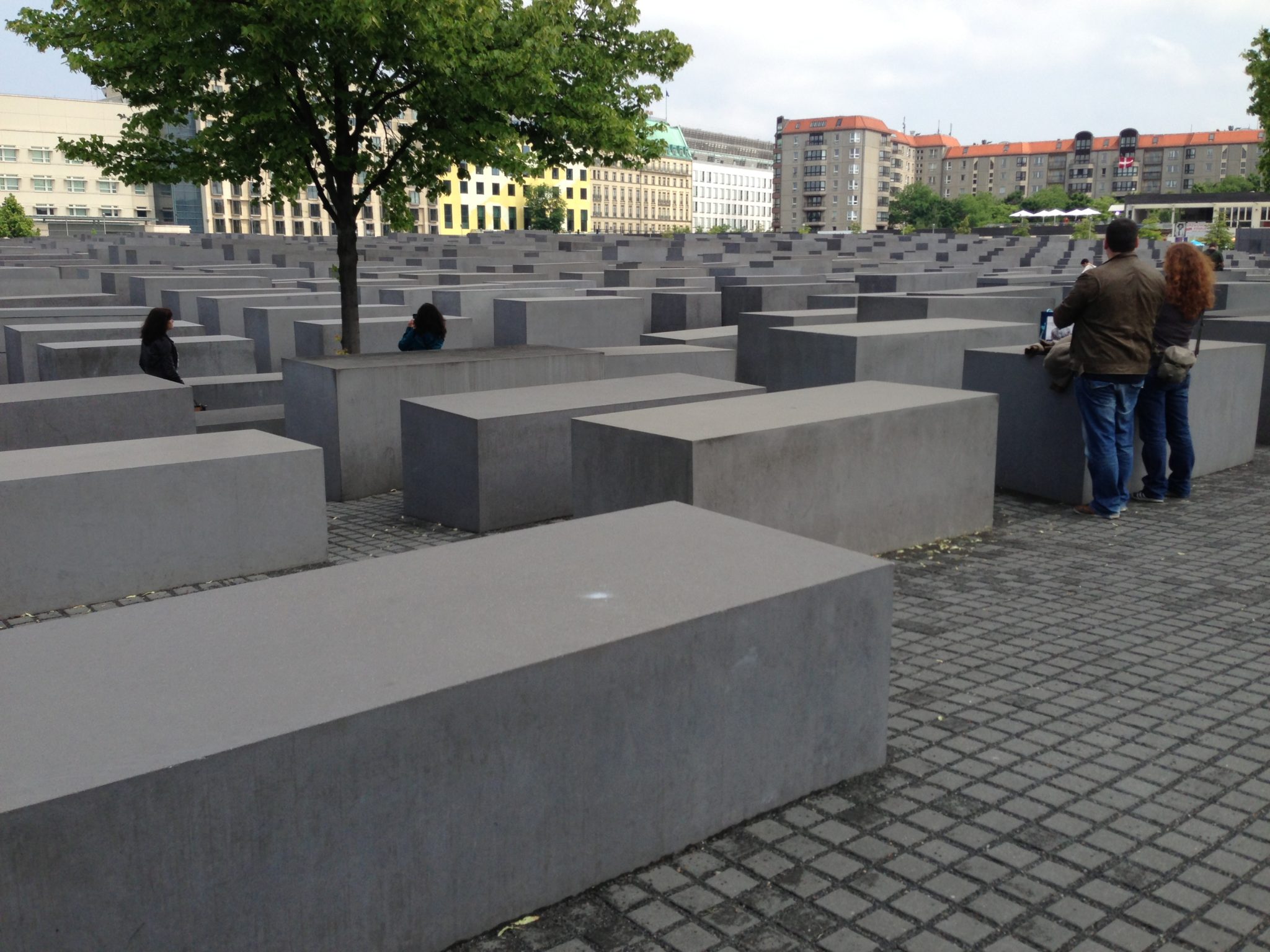
A few thousand blocks used to represent those who were lost.
I did manage to wander to some interesting places that do have to do with our class of memories of war.
This memorial is very different. The blocks don’t say anything, but the ground they are on is hilly, so you sink down into the maze and these massive blocks are all you can really see surrounding you. It was a very quiet place. The memorial is fairly new, but so is everything in Berlin. A tour guide even described it as a new city, and almost 1/3 was under construction or renovation while I was there. All of this because of the results of WWII, and Soviet occupation.

Part of the Wall is left standing as an outdoor exhibit.
The Berlin wall, and reminders of it, are all throughout the city, with many outdoor exhibits featuring the actual wall and new art made to look like it. The new art was protesting against a lot of Communists as well as saying ‘the next wall to fall is Wall Street’. They have to protect the wall, since so many people want to take pieces of it home, so it is behind fences.
I’m looking forward to the next part of our trip, and looking at it through the eyes of memory in war.

A trench at Beaumont-Hamel
On our tour of the area involved in the Battle of the Somme we learned a lot about the events leading to the Great War, the daily soldier’s experience, and the various armies that participated in the battles. The amount of blood shed, life lost, and fierce, violent combat was shocking to learn about outside of a classroom. Throughout school we learn about several key battles of the War, and we always read that they were bloody battles, but being at the actual battlefield, seeing trenches, and craters brings a whole new reality and appreciation for the nature of this War.
The position of the German lines and guns ensured that any allied troops coming across no man’s land were sure to become casualties, and that, coupled with artillery barrages made for hundreds of thousands of casualties. They bloody combat was not the only thing soldiers had to fear. Disease and illness was extremely common with all the filth in the trenches, and inadequate hygiene lead to many instances of infection such as trench foot. Beyond the terrible battle and living conditions, the thing that struck me most was that soldiers faced the danger of combat, the horror of trench life, and did their duty honorably.
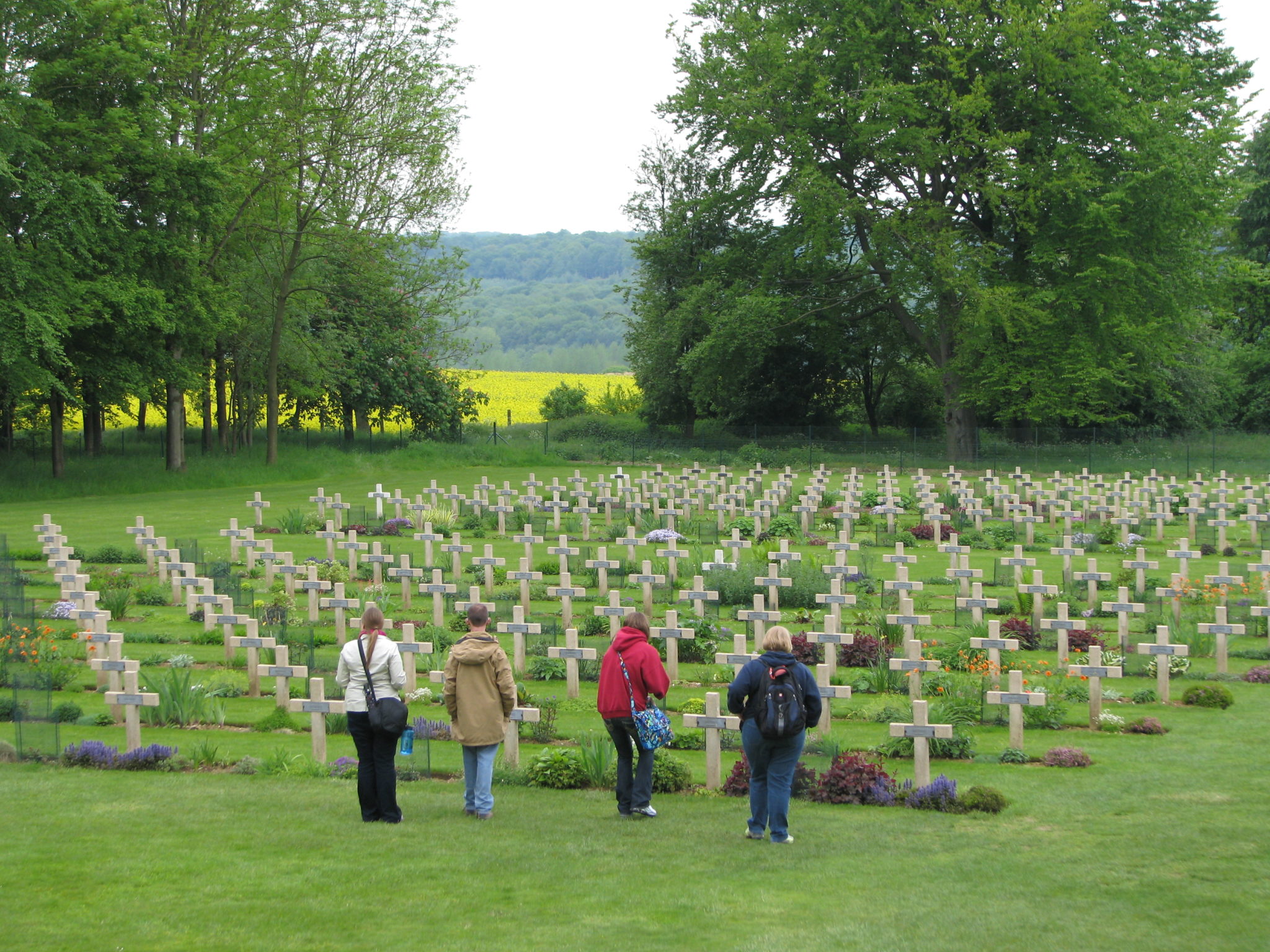
Rebecca, Bob, Courtney, and Claire at the French side of the cemetery at Thiepval
I can’t imagine how difficult digging those trenches was, especially the combat trenches that zigged and zagged. That is not to say that digging the communication trenches was any easier, and add to the physical labor the fact that the enemy was shooting at you the whole time, it seems insane. It seemed unbelievable that the allied troops only moved a few meters at a time, taking almost two months to move their line forward ten or twenty meters The violence displayed at the Battles of the Somme is unfortunately not uncommon for the war. To explain this I think the tour guide said it best, that there was a spirit of vengeance present for allies and enemies alike. It is obvious that if two armies fight for revenge, and especially to get back or keep land that has been contested for decades, the fighting is going to be extremely intense, and soldiers tended to attack with prejudice.

Stefani Lind listens to our guide talking about the Battle of the Somme
It was interesting to learn that the French had only a small percent of the allied troops present, leaving the British, Australian, Canadian, New Zealand, and colonial troops to fill the lines, troops that were fighting for an ally and not their own home land. Altogether it is unfortunate that the violence, the viciousness, the high loss of life, and gross amount of blood shed at the Somme was not uncommon during the war, and goes to show how countries like France and Germany lost an entire generation of youth.
]]>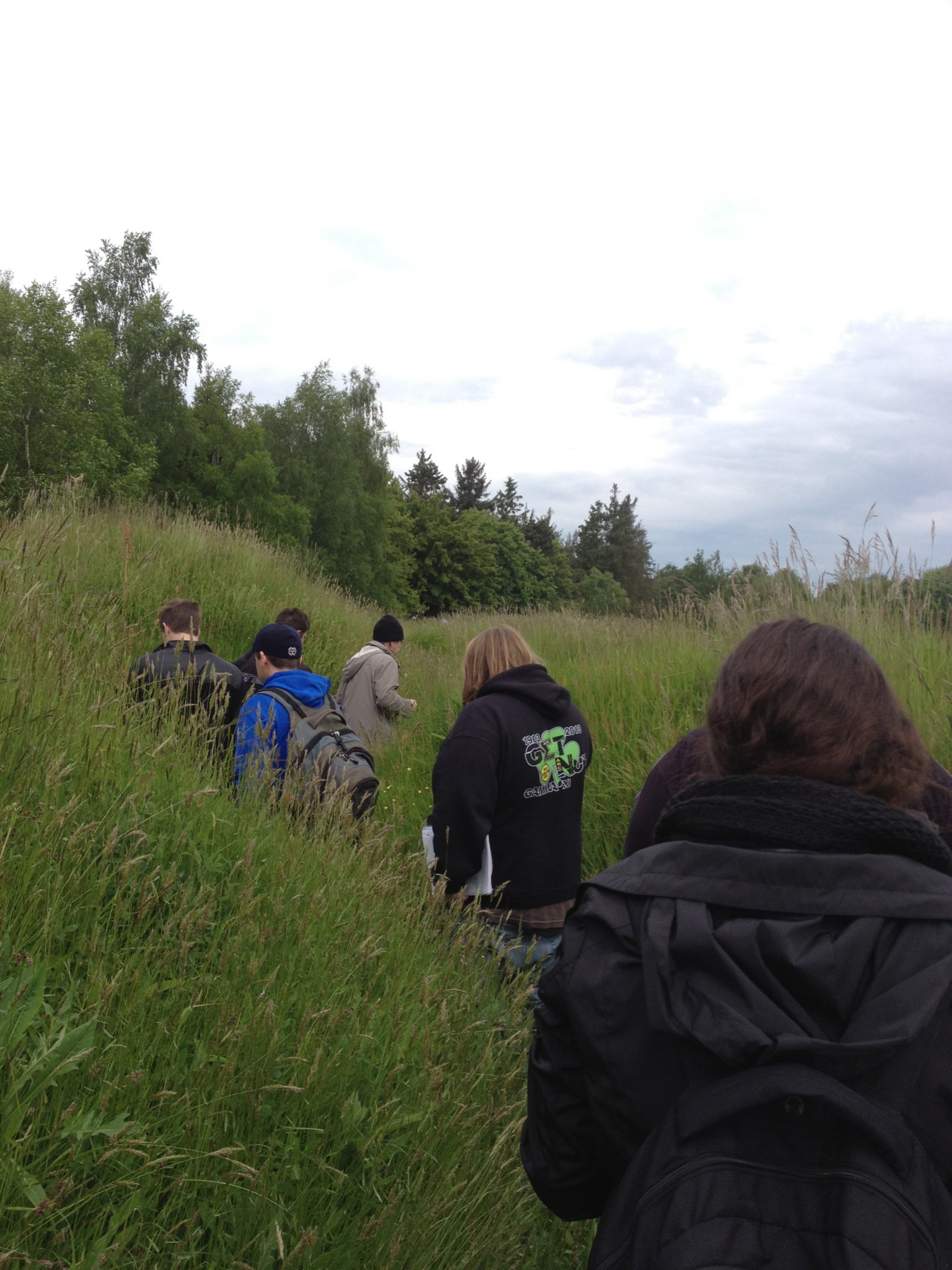
Students walk through the trenches at Beaumont-Hamel
Men could not leave the trenches and suffered horrible conditions. It was very difficult to get aid and much-needed supplies to the soldiers in the trenches. The soldiers suffered from thirst and starvation, trench foot, lack of ammo. They froze in the winter and endured the heat in the summer. The soldiers had nowhere to relieve themselves other than where they stood, the trenches were plagued by rats, and bacteria festered in every wound. Many soldiers suffered amputations due to infections due to these unsanitary conditions.
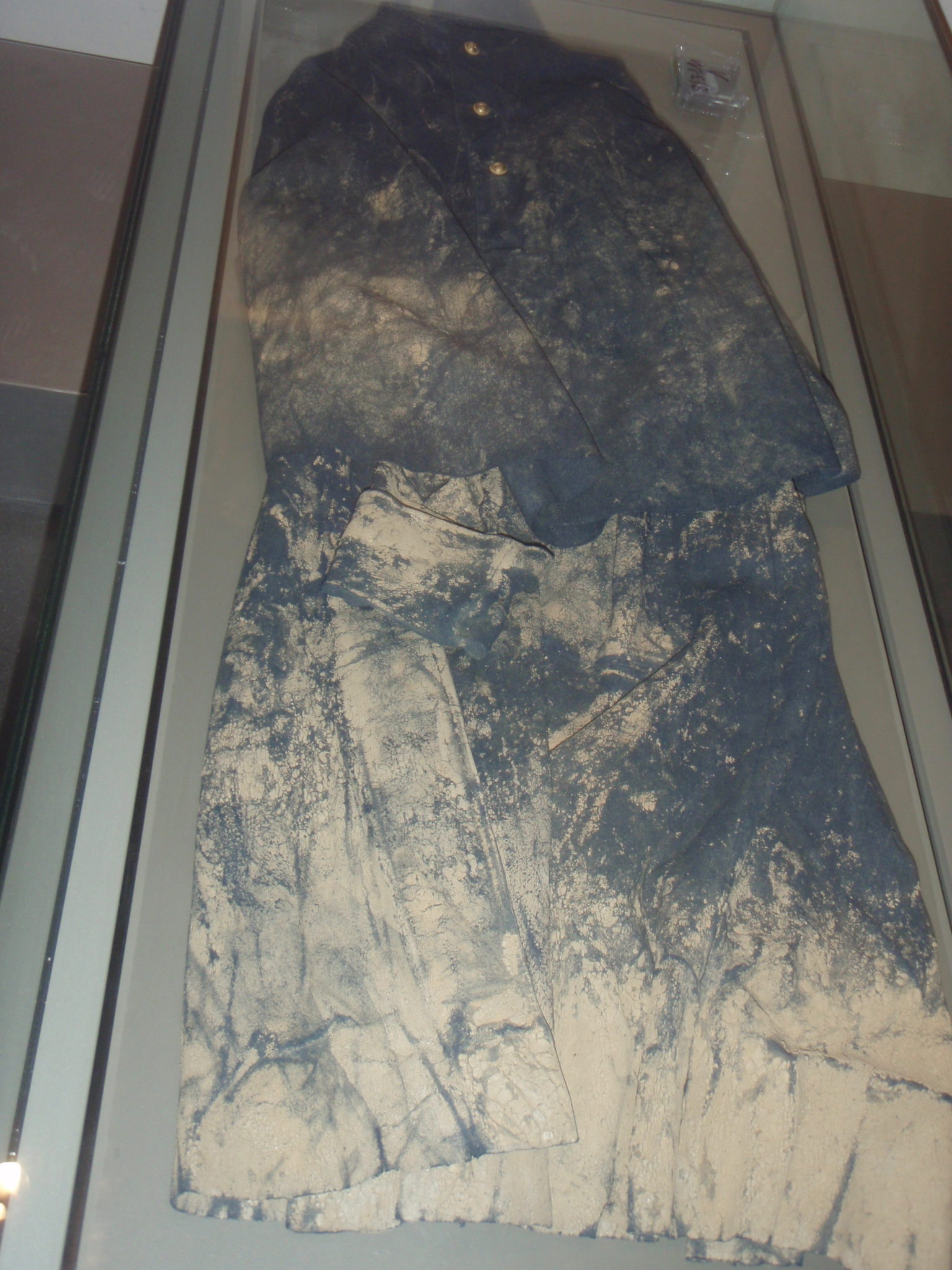
Muddy trench coat at the Musée de l’Armée at Les Invalides
New weapons were used with the introduction of the trenches. Barbed wire, poison gas, tanks, machine guns, aircraft, and mines were used for the first time. The use of these weapons resulted in mass casualties and the death toll count would reach into the tens of thousands on some days. Artillery was responsible for the majority of the casualties suffered on both sides, but machine guns and gas played their part too. Waves of oncoming troops would be mowed down by strategically placed machine guns and poison gas launched into the trenches flowed along, suffocating anyone unfortunate enough to be in the vicinity. Tanks were introduced towards the end of the war and were designed to plow through barbed wire blocking access to the enemy’s trenches. The Germans did not utilize the tank, which contributed to their defeat.
Fighting in the trenches of WWI was a nightmare. It mentally scarred soldiers who fought and opened the eyes of the world to the horrors of war. Many of the weapons and methods of trench warfare became the subjects of treaties and agreements of countries worldwide. Many measures have been taken to try to prevent a repeat of events that occurred in the trenches.
]]>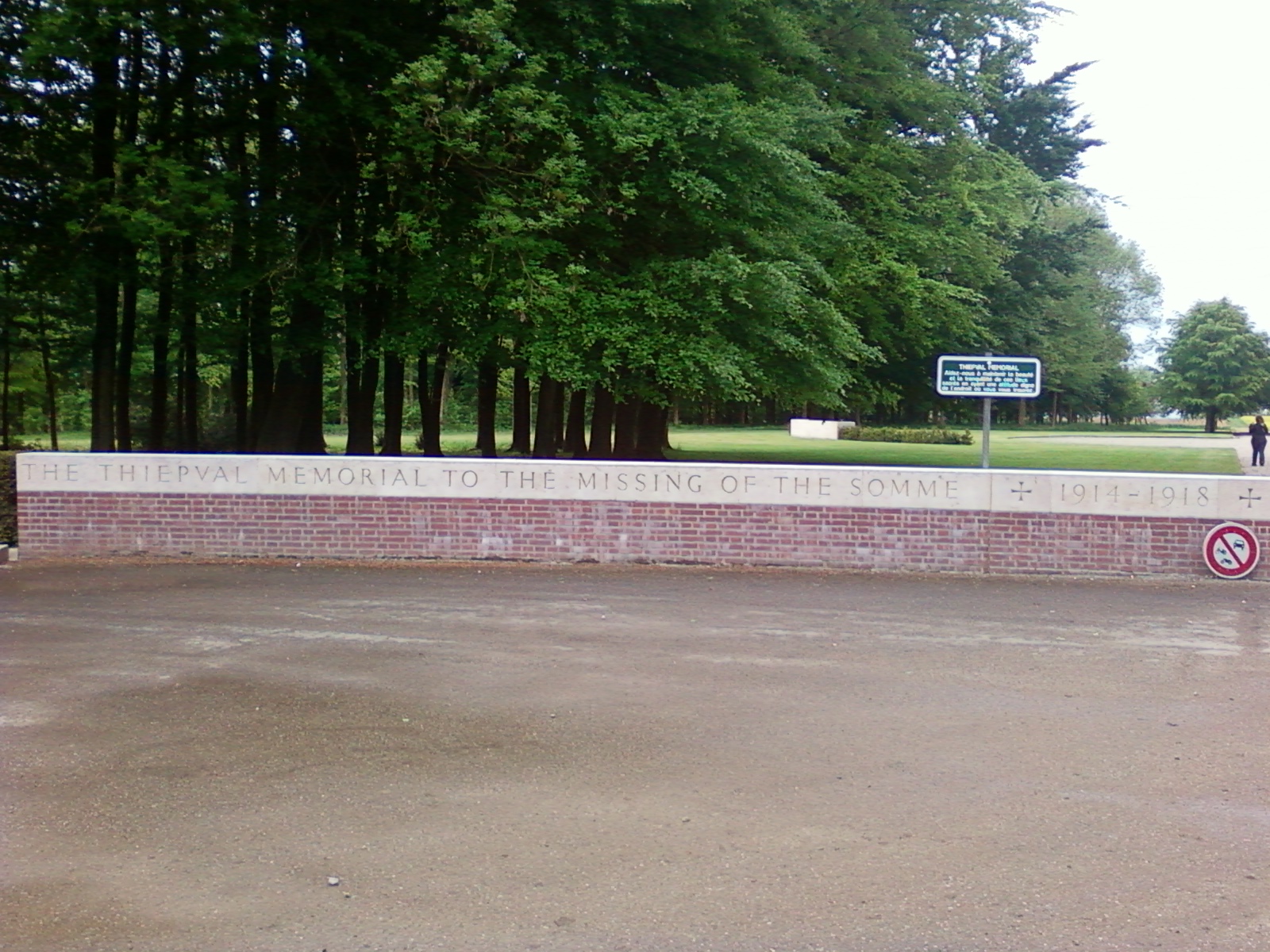 On Tuesday, May 28th, the Missouri S&T students and faculty visited various places that went over the entire Battle of the Somme, many of which included graveyards and memorials. One such memorial that was visited mid-morning was Thiepval, precisely, The Thiepval Memorial to the Missing of the Somme. Though we were only given a half-hour at the memorial, the impact of the site was still very heavy on us, as standing under the arches of the brick memorial and seeing every name of the nearly 72,000 missing men brought about feelings of intense loss. At the memorial, we visited the visitors’ center first and had an introduction to the Somme battles by our tour guide. We saw pictures of the men and in the eyes of the soldiers one could see the horrors they experienced in war. Looking around the small visitors’ center could never prepare a person for the monument itself, even with the small model on display in the lobby.
 After a few minutes, everyone took the small hike up hill to the monument, which took a trail from behind the visitors’ center, past a couple of cottages, and through waist-high stone walls giving a small inscription of what is present on site. The huge gravel circle in front of the monument led up to a wide grass field one had to walk across to reach the structure, as no paths were built. The Thiepval Memorial itself was imposing on the scenery and can be seen from far-off distances in the countryside, but standing before the structure’s steps themselves brings the gravity of the situation down on a visitor, especially once one comes close enough to read the names scrawled across every part of the one-hundred-and-fifty-foot-tall monument. The laurel wreaths on the building also add to the monument by giving the names of the battles occurring in the Somme, as well as the many dedications to the soldiers on the upper walls of the structure.
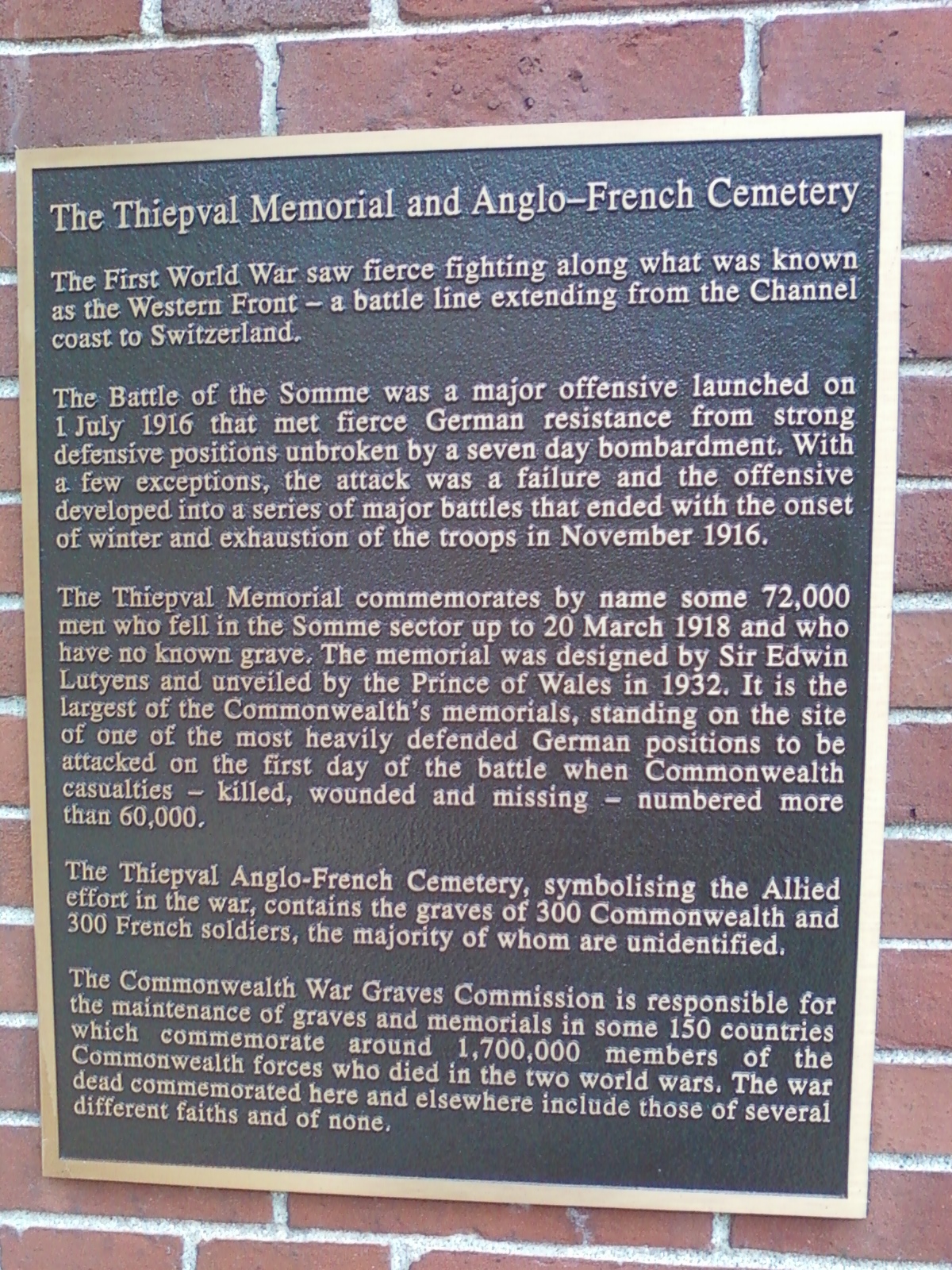 As a representation of The Battles of the Somme, the Thiepval Memorial truly does give an accurate impression, as by representing every man that went missing in the battles it gives some people the sense of the war not being over yet. It does honor the memory of the missing, but the war can never really be over and give everyone closure until all of the names on the walls of Thiepval are accounted for – even in modern times, the war is still ongoing in the hearts and minds of the people who knew the deceased. To have such an overwhelming structure that stands over the rest of the land, the Thiepval Memorial could also act as a representation of the men who stood to protect the country and still remain on this land as guardians, with their duty ending once the body is found and given a proper burial. As the stone in the middle of the memorial says, “Their name liveth for evermore.” These soldiers will continue to exist in memory until the day when they are found and put to rest, and their battles, finally, put to an end.
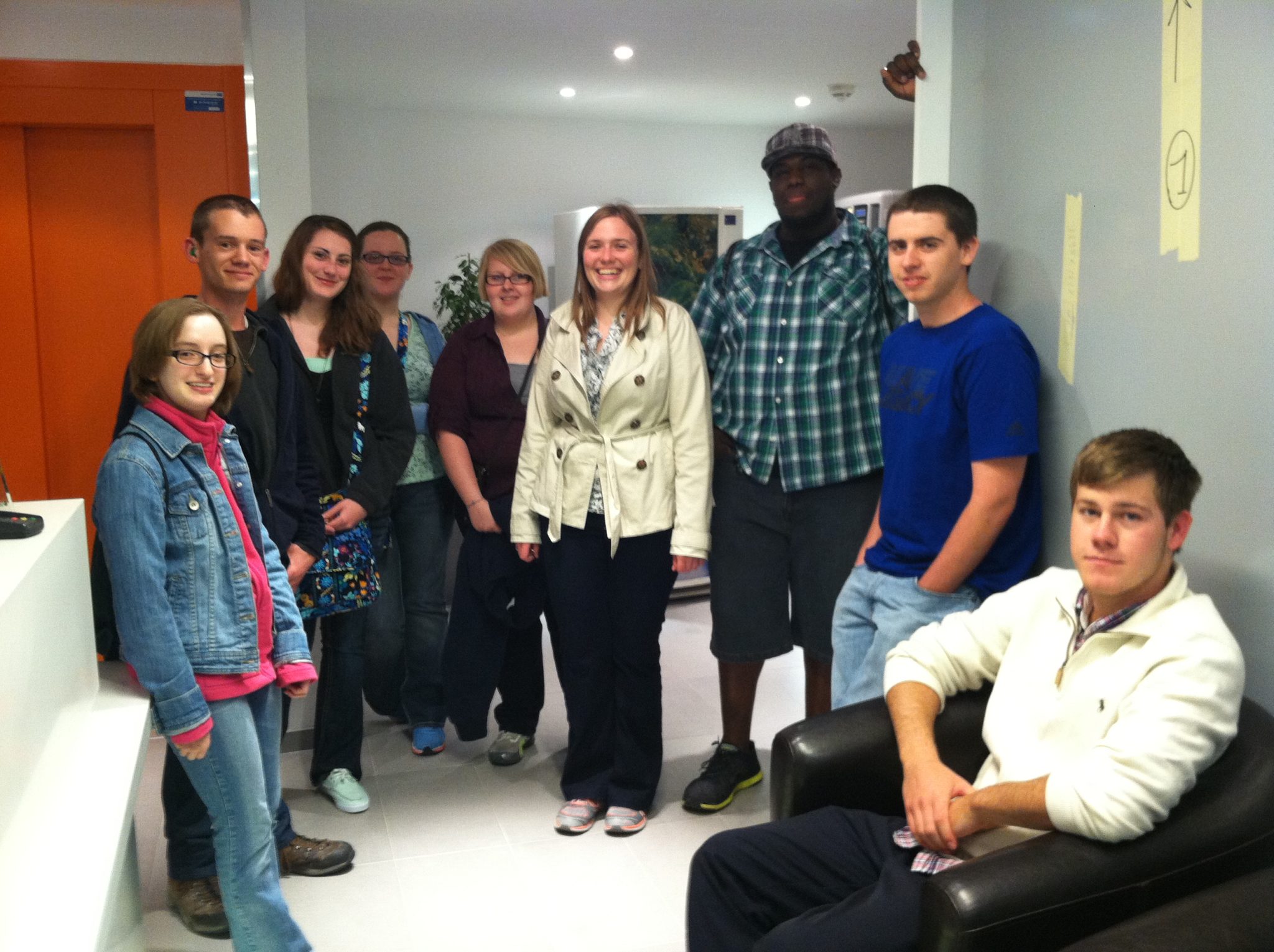
All of our students have arrived safely. Just getting to Paris was a learning experience for all of them. The past few days they have begun exploring the city.
Our hotel is located in the 10th arrondissement in Paris, only a five-minute walk from the Canal St-Martin. It is a nice neighborhood, close to the Gare de l’Est (a train station) and many restaurants. But it is not surrounded by the iconic monuments we associate with Paris.
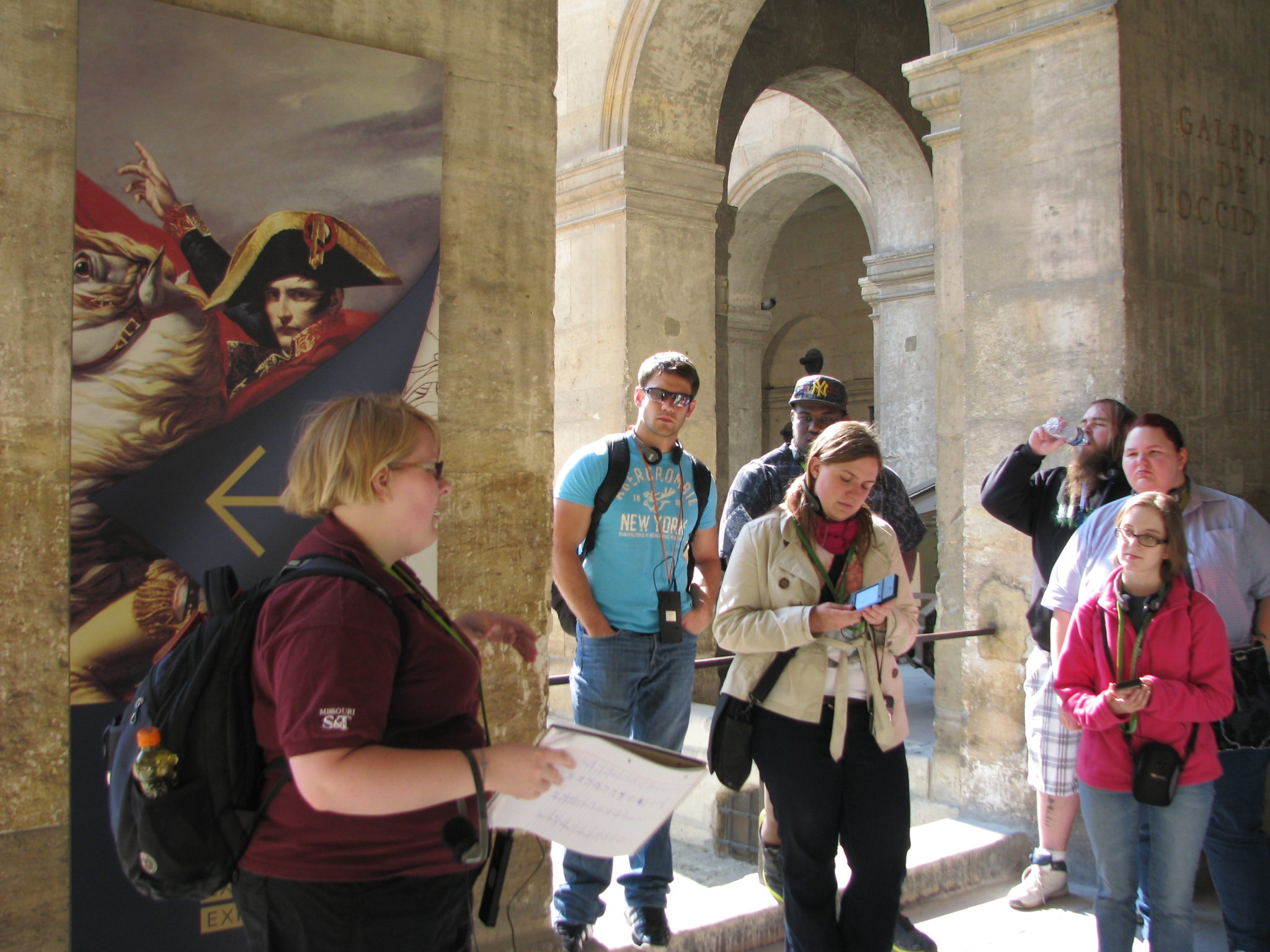
Claire gives a talk on war propaganda
So when we took our first excursion on Monday, it was exciting to watch the students’ expressions as we came up out of the metro station and they got their first glimpse of Les Invalides, with its golden dome. We visited the World War I and II exhibits there, and Claire presented a talk on war propaganda.
Later that afternoon, we met the students at the Arc de Triomphe. While Shannon and I were walking along the Champs-Elysées, we ran into Dr. Dan Oerther and his family! They are in France for a conference.
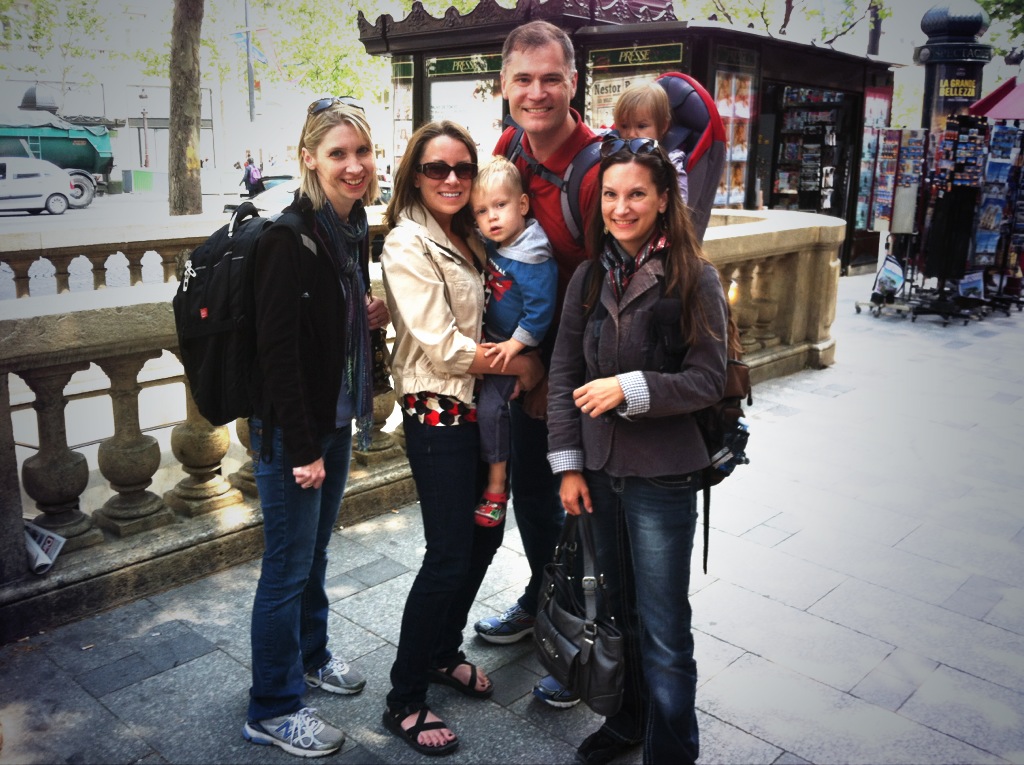
It’s a small world! Here we are with Dr. Oerther and his family on the Champs-Elysées.
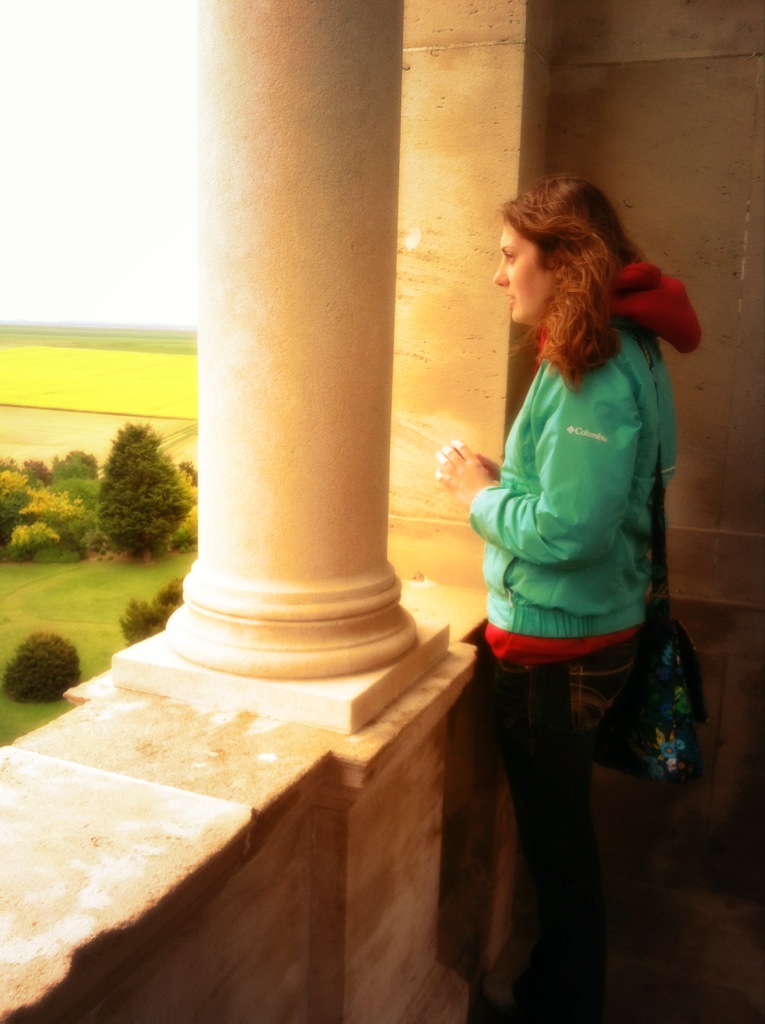
Courtney looks out over a battlefield in the Somme
Today (Tuesday) we went for an all-day tour of the Somme. The students will be posting more information about these visits in the following days.
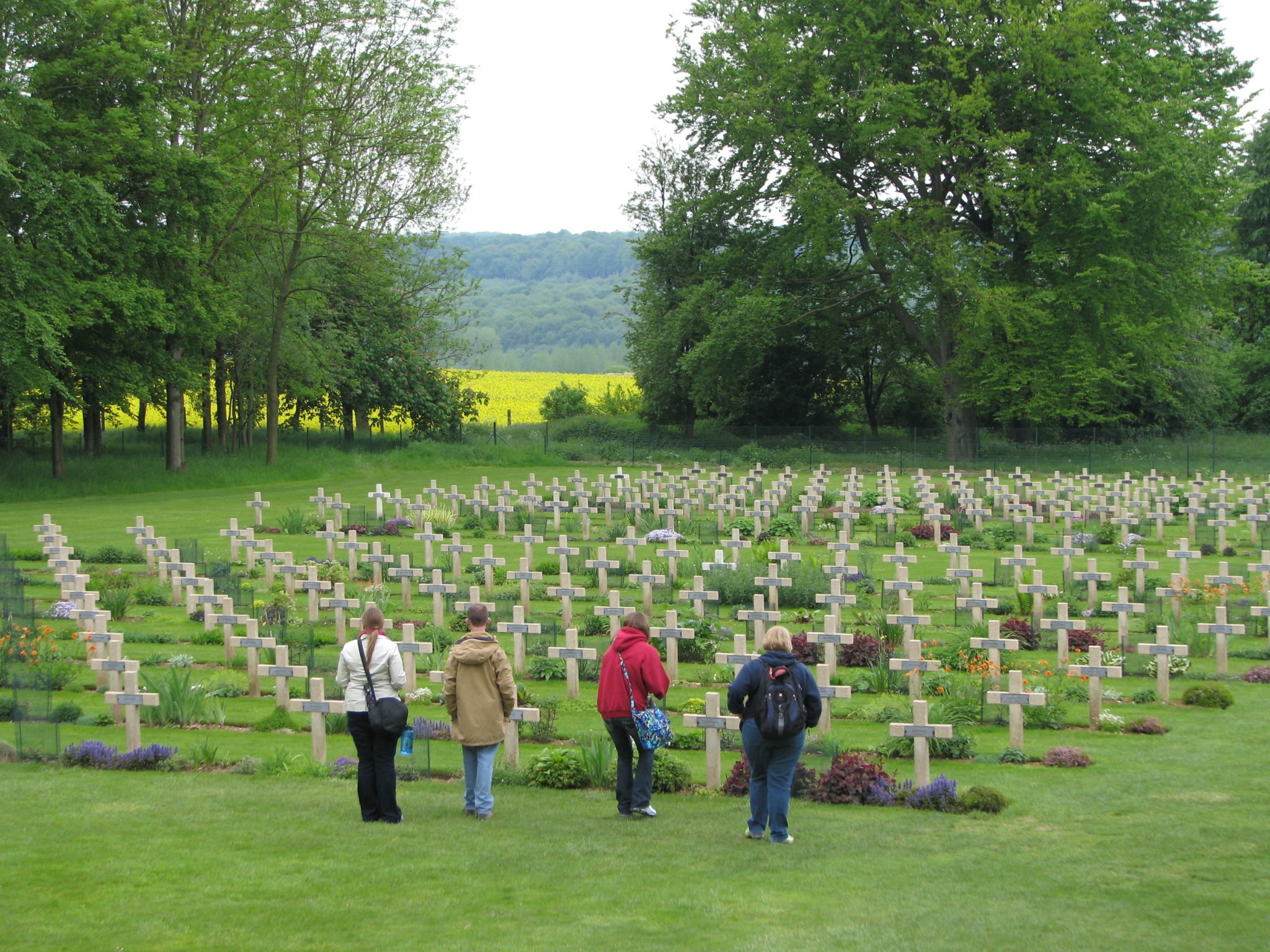
Students contemplating the French side of the cemetery at Thiepval
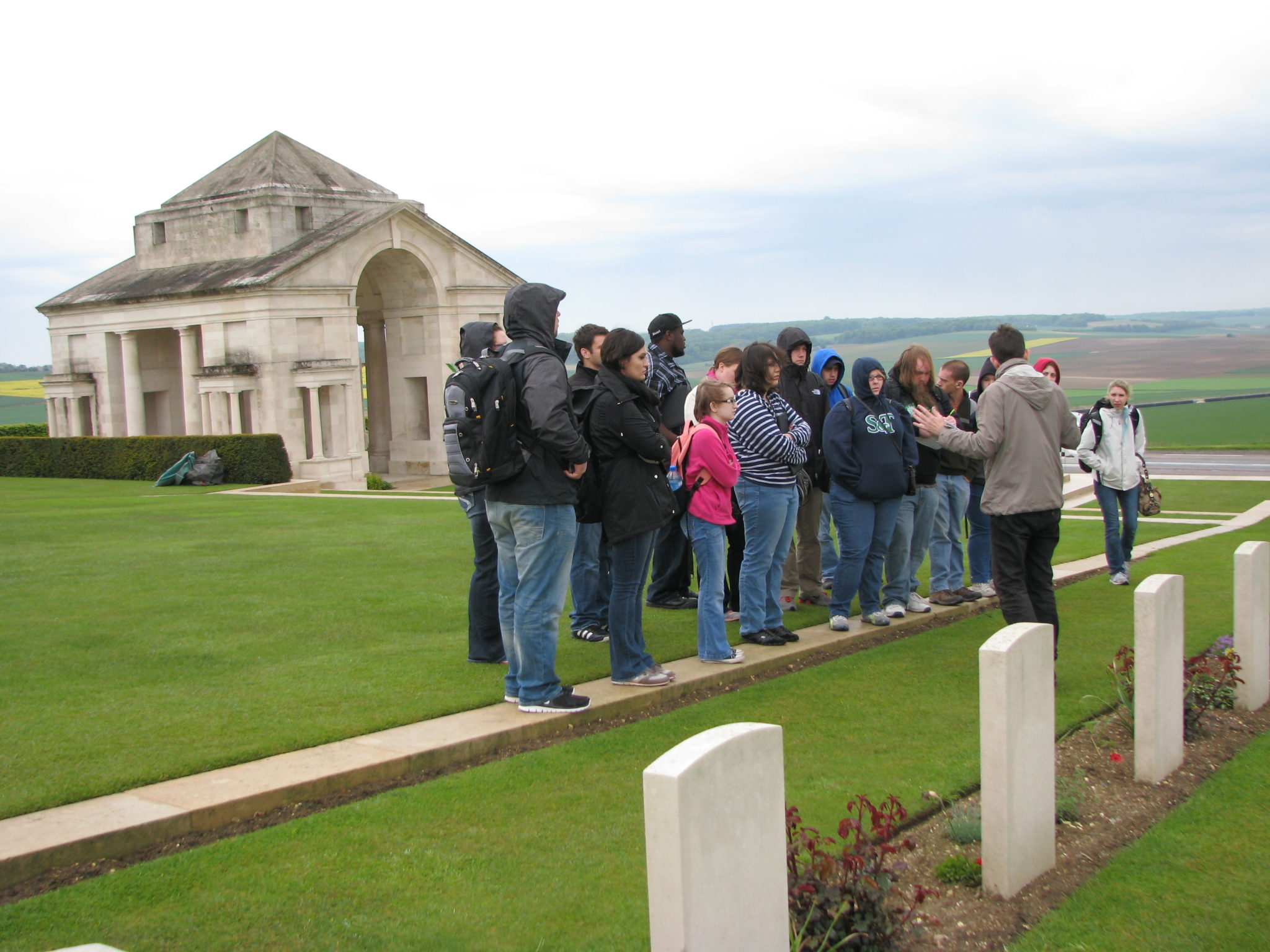
Our guide teaches us about the Battle of the Somme
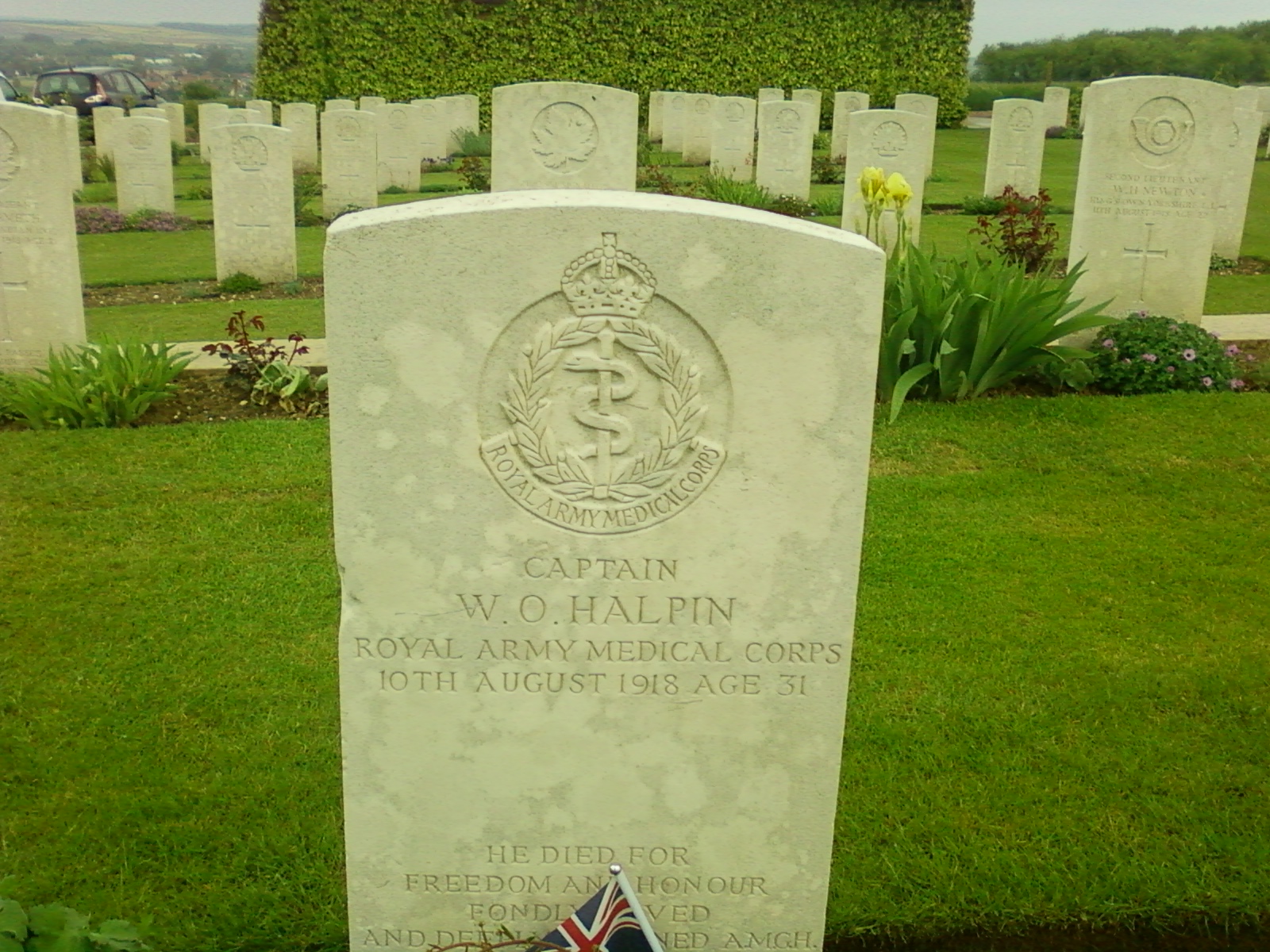
British soldier’s grave stone at Villers – Bretonnuex
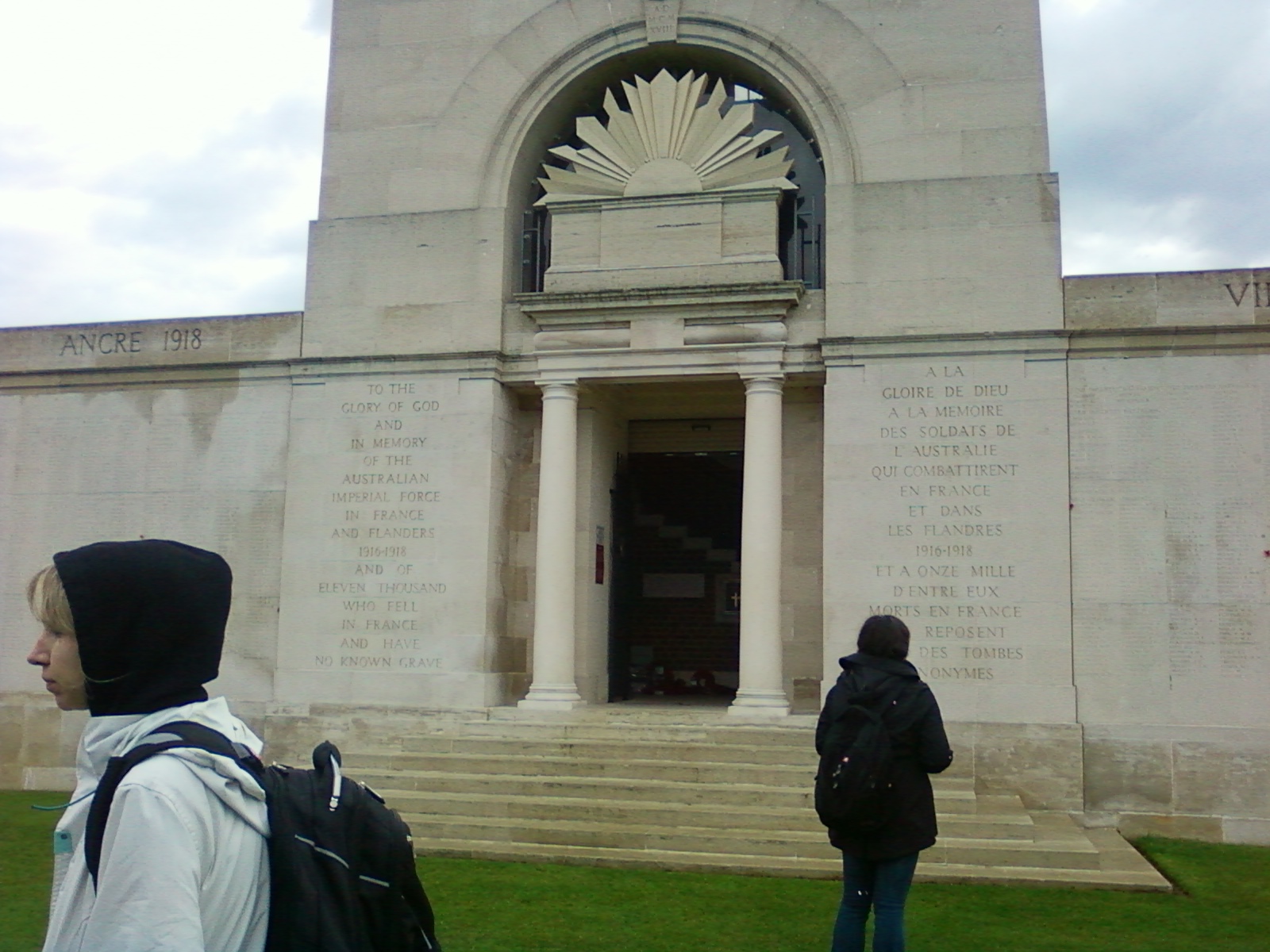
The main memorial building of Villers – Bretonnuex
Our biggest stop of the day, after visiting various graveyards, had to be the trenches – we actually got to walk through the trenches along the soldiers path! It was very heart-wrenching thinking about how many men lost their lives in the very places we stood, but all the while an honorable memory.
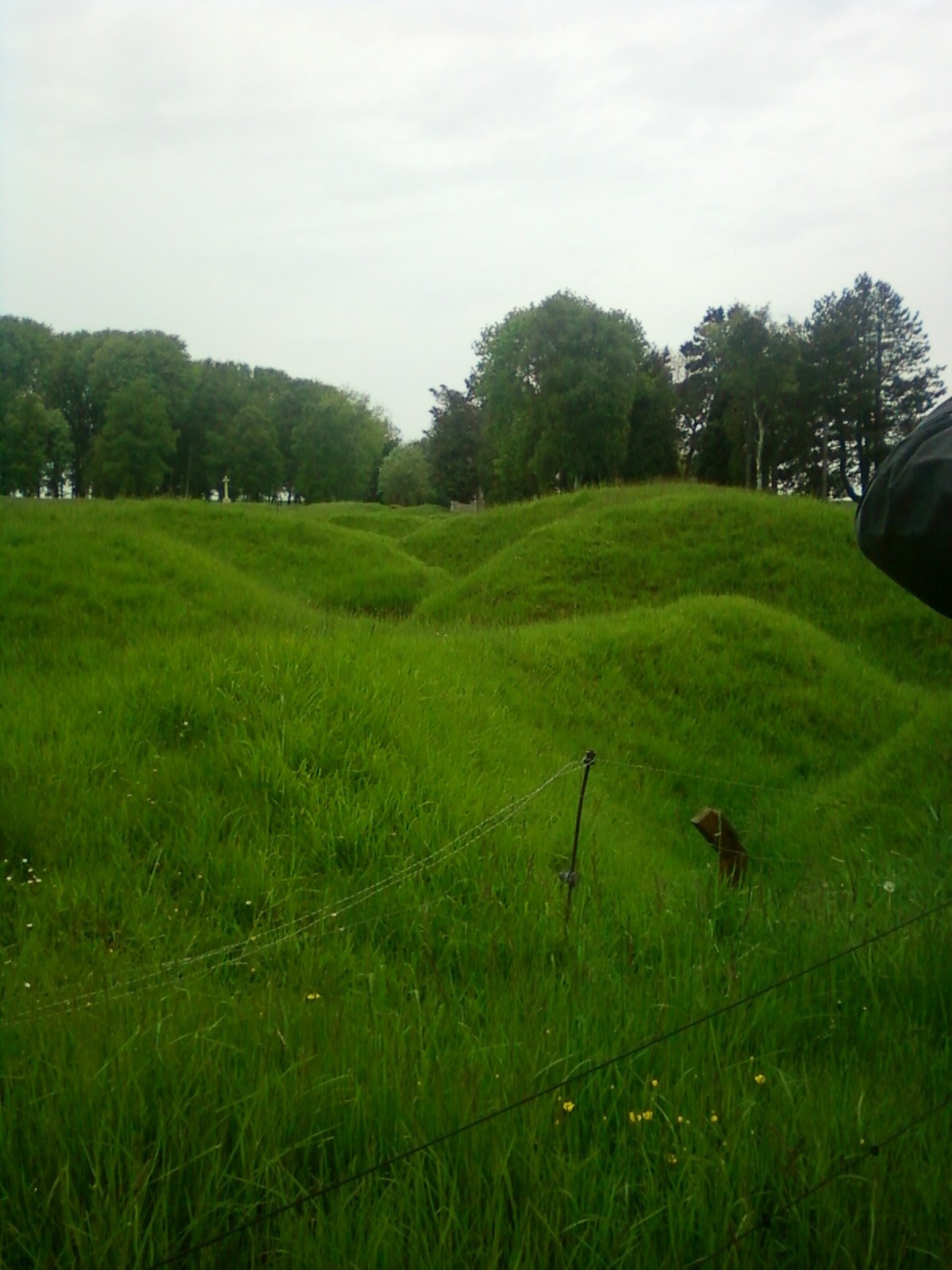
The zig-zagging path of trenches at the Newfoundland memorial
Our last stop was the Historial de la Grande Guerre, where we got to see the uniforms of soldiers laid out in pits of the floor with all of their gear, propaganda posters covering the walls, and artifacts from The Great War. Seeing items that the men once used really strikes a chord in a person, it makes it hard to believe that the war occurred only ninety-nine years ago.
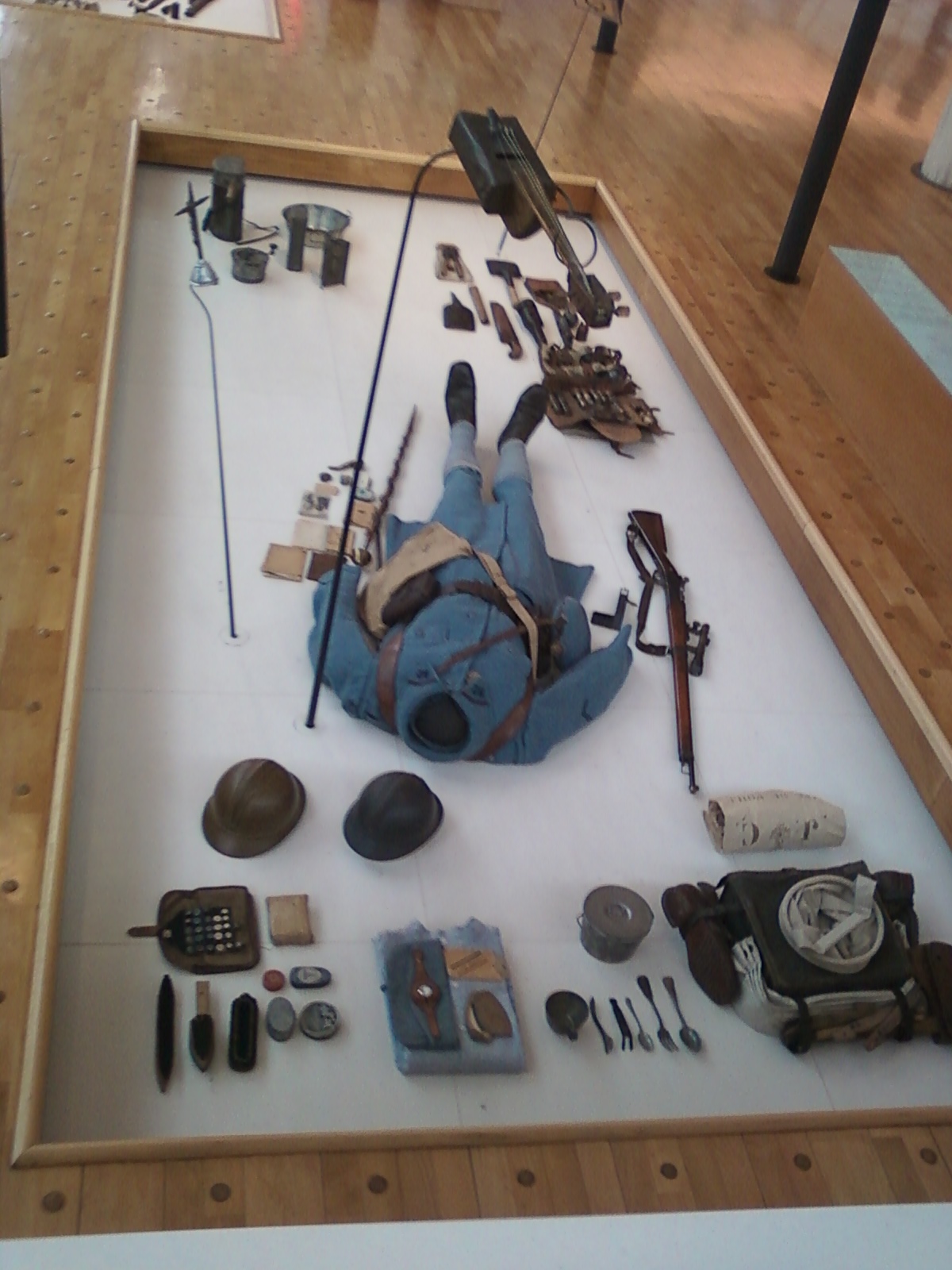
Uniform of a French Soldier – Historial de la Grande Guerre
It makes you really think and feel the pasts setting, the feelings the people had to be experiencing in their time, and how those feelings echo into the present when we look back on our shared history. Everything we saw today brought to light the true meanings of memory and how those memories intertwine with history.
~Stephenie Lynch
]]>
Group dinner restaurant
We’ve been planning for this day for 2 semesters. It’s the day that our students arrive to begin their study abroad experience! We have a welcome dinner planned for this evening at a French café and lots of activities planned for the week. Here’s a preview of our adventures. Be sure to check back for student posts about the excursions!
Monday:
Musée de l’Armée – Département des Deux Guerre Mondiales (Army Museum – Department of the Two World Wars.) Housed in Les Invalides, this museum will be our introduction to the two wars we will be studying during the trip.
Arc de Triomphe on the Champs-Elysées. We will be meeting under the famous Parisian landmark and “reading” the memorial.
Tuesday:
All day trip to the Somme region. We will be taking a guided tour of the World War I battlefields in this region as well as visiting the Historial de Péronne (museum) and various cemeteries and memorials dedicated to French, German, American, British, and Canadian soldiers. This promises to be an intense day!
Wednesday:
Walking tour of Père-Lachaise Cemetery. We will visit the war memorials in this famous cemetery. We are especially interested in the series of sculptures related to the Nazi concentration and death camps.
The Louvre. We will take a tour of the museum to see the famous masterpieces that the French evacuated for safekeeping during World War II. We have viewed the documentary The Rape of Europa, which explains the looting and protection of French art during the war.
Thursday:
We will finish up our study of World War I by visiting the site where the official treaty with Germany was signed: Versailles. The Treaty of Versailles (1919) was signed in the famous Hall of Mirrors and would have consequences for the future.
]]>